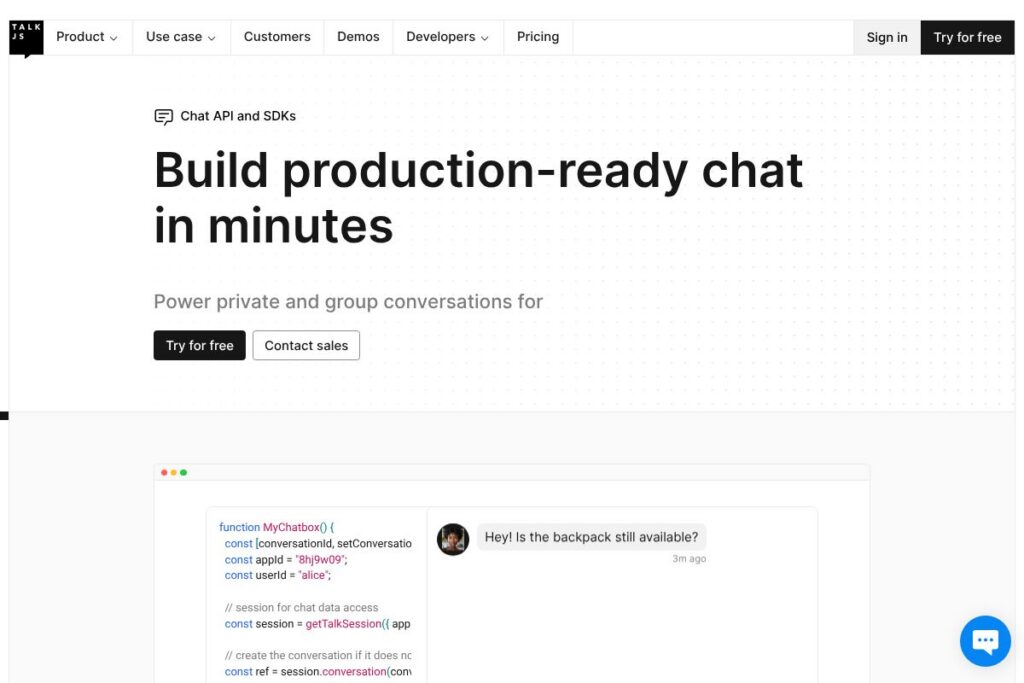
What is TalkJS
TalkJS is a developer-focused messaging platform that provides an API, client SDKs, and ready-to-ship UI components to add in-app chat to web and mobile products. It handles the real-time plumbing, message storage, presence, and moderation primitives so teams can focus on user experience and business logic rather than rebuilding chat infrastructure.
Compared with SendBird and PubNub, TalkJS emphasizes fast integration and customizable front-end components while still offering the core infrastructure features expected from a production chat provider. Compared with GetStream, which focuses heavily on feed and activity stream use cases, TalkJS concentrates on conversational UX, persistent searchable history, and built-in moderation tools that fit marketplaces, marketplaces, and community apps.
TalkJS does particularly well at reducing front-end implementation time with pre-built, themeable chat UIs and developer-friendly SDKs. It is a good fit for product teams and startups that need reliable real-time messaging without building backend services from scratch, as well as enterprises that prefer an embeddable chat layer with enterprise security and compliance controls.
How TalkJS Works
Integration starts by creating user identities in your backend and issuing secure session tokens that the client SDK consumes to create authenticated chat sessions. The client SDKs manage WebSocket connections for real-time updates, deliver presence and typing indicators, and sync message state across devices.
You can use the JavaScript widget for quick embedding or the native iOS and Android SDKs for deeper customization. For custom UI or advanced flows, the REST API and webhooks let server-side code send messages, manage conversations, and react to moderation events in real time.
A typical workflow is: provision users on your server, create or fetch conversations via the API, initialize the client SDK with a session token, and then render the pre-built components or a custom UI tied to SDK event handlers for message, presence, and moderation events.
TalkJS features
TalkJS bundles the features needed for high-performance in-app chat into a single platform, with prebuilt UIs and SDKs plus server-side APIs for control and compliance. Recent improvements emphasize AI readiness, moderation tooling, and scalability for billions of messages monthly, with a reported 130M+ monthly messages sent through their infrastructure.
Let’s talk TalkJS’s Features
AI integration
Built-in hooks and a flexible messaging model allow you to embed virtual assistants or AI bots into conversations. This supports automated replies, contextual assistants, and bot-driven workflows that act like a participant in the chat.
Private, group, and public chat
Support for 1-on-1 conversations, team group chats, and large public channels is available through the same API model, letting apps reuse the same security, moderation, and storage controls across different conversation types.
Real-time presence and typing indicators
Presence functionality shows which users are online, who is typing, and message read states, giving a live feel comparable to Slack, WhatsApp, or Messenger and improving conversational flow and responsiveness.
Mentions, reactions, and link previews
Conversations support @mentions, emoji reactions, and automatic link previews to make threads easier to follow and more expressive. These features help increase engagement and make conversational history more useful.
Moderation and spam control
Automated moderation tools can flag harmful content, filter profanity, detect spam, and allow actions such as banning users or removing messages. These controls are exposed via the API so moderation workflows can be automated or integrated with human review.
Searchable and persistent message history
Messages are stored securely and are instantly searchable, enabling history access across devices and time. Data export and retention controls give teams the ability to meet compliance and audit requirements.
Voice and video integration
TalkJS supports integration points for voice and video calls so you can add real-time media sessions to conversations, commonly by combining TalkJS messaging with a third-party RTC provider for live calls.
Ready-to-ship UI and themeability
Pre-built chat components provide a fully functional UI you can customize at the pixel level, including layouts, themes, and behavior. These components significantly reduce front-end development time while allowing full brand alignment.
Flexible SDKs and developer tooling
Cross-platform SDKs for the web and native mobile platforms are framework-agnostic and designed for developer productivity, with examples, guides, and quickstart templates to accelerate implementation.
Secure infrastructure and reliability
The platform includes encryption in transit and at rest, TLS v1.3 support, GDPR alignment, and enterprise-grade SLAs. The architecture is designed to scale globally and to handle high message volumes with predictable performance.
With these capabilities combined, TalkJS aims to let teams ship polished, reliable chat experiences quickly while retaining the flexibility to customize behavior and integrate AI, moderation, and media as needed.
TalkJS pricing
TalkJS uses a subscription-based SaaS model with tiered plans that scale from developer usage to enterprise deployments, and custom enterprise options for high-volume or regulated deployments. Since pricing details and plan structures can change, the best way to get current tiers and any usage limits is to review the provider’s official information on the TalkJS site.
For exact plan names, monthly versus annual billing differences, and enterprise add-ons such as higher SLAs or custom data residency, see the TalkJS homepage or contact their sales team for tailored options.
What is TalkJS used for
TalkJS is commonly used to add in-product messaging to marketplaces, SaaS apps, customer support products, and community platforms. Typical use cases include buyer-seller conversations, peer messaging in social apps, in-app customer support threads, and team collaboration channels.
Product teams use TalkJS when they want a fully managed messaging backbone plus UI components, rather than building real-time networking, storage, presence, and moderation from scratch. The platform is also used by companies that need searchable, persistent chat history and clear moderation controls for community safety.
Pros and cons of TalkJS
Pros
- Fast front-end delivery: Pre-built, themeable UI components let teams ship chat interfaces quickly without building all components from scratch. This reduces development time and helps maintain design consistency.
- Comprehensive moderation tooling: Automated filters, flagging, and ban mechanics make it easier to operate safe public communities with minimal custom code required for enforcement workflows.
- Developer-friendly SDKs and APIs: Framework-agnostic SDKs, REST APIs, and webhooks simplify integration into existing stacks and support custom UX and server-side logic.
- Scalable infrastructure: Built to handle high message volumes with encryption, compliance controls, and enterprise SLA options for production reliability.
Cons
- Custom pricing for large deployments: Enterprise-level features and SLAs often require custom contracts, which can add procurement complexity for smaller teams that prefer transparent public pricing.
- Dependency on managed service: Using a hosted chat provider means less control over the underlying infrastructure compared with fully self-hosted open-source alternatives, which may matter for teams with strict data residency or customization needs.
- Integration effort for advanced RTC features: Voice and video typically require combining TalkJS messaging with a separate RTC provider, which adds integration work for in-call features.
Does TalkJS Offer a Free Trial?
TalkJS offers a free developer plan for testing and short-term evaluation, and paid plans typically include trial or demo options. The developer tier is designed for integration and prototyping with limited production usage, while paid plans target production deployments and enterprise needs. For exact trial durations, developer plan limits, and how trials convert to paid subscriptions, consult the TalkJS homepage or reach out to their team.
TalkJS API and Integrations
TalkJS provides a REST API plus client SDKs for JavaScript, iOS, and Android, and it exposes webhooks for event-driven integrations. The TalkJS documentation details endpoints for creating conversations, sending messages, managing users, and handling moderation events.
Integrations are typically implemented via webhooks, server-side API calls, or middleware connectors like Zapier to link messaging events to analytics, CRMs, or notification systems. For security and compliance details, review the TalkJS security documentation.
10 TalkJS alternatives
Paid alternatives to TalkJS
- SendBird — A full-featured chat and messaging platform focused on enterprise use cases, with rich moderation and analytics features.
- GetStream — Real-time feeds and chat APIs with SDKs and UI components, suited for activity feeds and chat combined experiences.
- PubNub — A realtime data stream network offering low-latency messaging and presence features for applications at scale.
- CometChat — Chat APIs and pre-built UI kits with support for voice, video, and moderation tools targeting web and mobile apps.
- Pusher (Channels) — Realtime messaging infrastructure for pub/sub and presence, often used for lightweight chat and live updates.
- Firebase (Realtime Database / Firestore + FCM) — Managed backend with real-time sync and push notification capabilities used by teams building custom chat solutions.
Open source alternatives to TalkJS
- Matrix (Element / Synapse) — A decentralized open protocol for real-time communication with open-source servers and clients suited for full control and federation.
- Rocket.Chat — Self-hosted team chat platform with extensive customization, integrations, and admin controls for privacy-conscious deployments.
- Mattermost — Open-source collaboration platform focused on team messaging with enterprise-focused deployment options.
- Zulip — Threaded open-source chat designed for organized, topic-based conversations in engineering and community teams.
- Chatwoot — Open-source customer engagement platform that includes live chat and inbox features for support teams.
Frequently asked questions about TalkJS
What is TalkJS used for?
TalkJS is used to add production-ready in-app messaging to web and mobile products. It provides APIs, SDKs, and UI components for private chats, group conversations, and public channels.
Does TalkJS have an API for sending messages programmatically?
Yes, TalkJS exposes a REST API and client SDKs for sending and managing messages. The API also supports conversation management, moderation actions, and user provisioning as described in the TalkJS documentation.
Can TalkJS handle moderation and spam filtering?
Yes, TalkJS includes automated moderation features and tools for filtering, flagging, and banning users. These controls can be combined with server-side workflows and human review for stronger community safety.
Is TalkJS secure for enterprise applications?
TalkJS supports encryption in transit and at rest, TLS v1.3, and offers enterprise-grade SLAs and compliance features. Security documentation on the provider site outlines GDPR alignment and other controls.
Does TalkJS support voice and video calls?
TalkJS supports integration points for voice and video sessions alongside messaging. Most teams pair TalkJS messaging with an RTC provider to enable full in-call media functionality.
Final verdict: TalkJS
TalkJS provides a pragmatic balance between speed of delivery and production readiness by combining a robust messaging backend with themeable, pre-built UI components and developer-friendly SDKs. It is strong for teams that want a quick path to in-app messaging with built-in moderation, presence, searchable history, and AI integration hooks.
Compared with SendBird, which targets large enterprises with extensive analytics and deep customization, TalkJS often yields faster front-end implementation and simpler developer workflows while still meeting security and scalability needs. For organizations evaluating pricing and features, TalkJS is worth considering when you prioritize fast integration, UI customization, and built-in moderation over running a fully self-hosted or heavily customized chat stack.