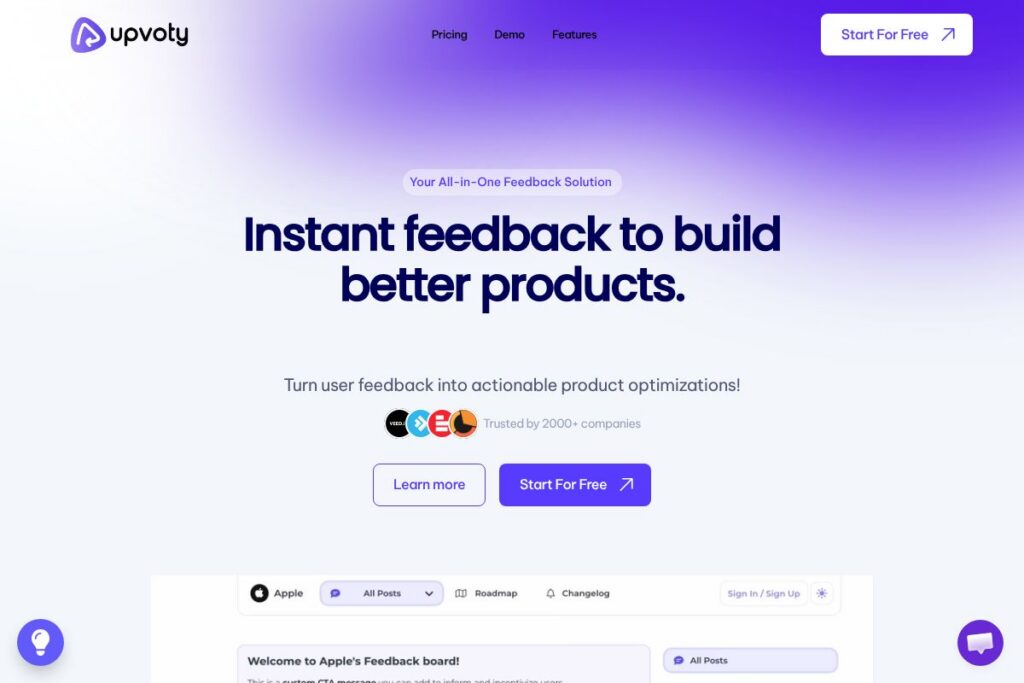
Upvoty Explained
Upvoty is a user feedback platform that helps product teams collect feature requests, vote on suggestions, and communicate progress through roadmaps and changelogs. It organizes input on public or private boards, adds structure with tags and leaderboards, and provides widgets and a hosted portal to capture feedback from websites and apps. For signup and platform details visit Upvoty’s homepage at Upvoty’s homepage.
Compared with similar tools, Upvoty sits between simple voting boards and full product management suites. Compared to Canny, Upvoty emphasizes lightweight setup and straightforward boards that are easy to embed; Canny focuses more on deeper product analytics and integrations. Versus Productboard, Upvoty provides an easier, more opinionated feedback flow for small to mid-sized teams, while Productboard offers heavier roadmap planning and customer insights for enterprise product organizations.
All of this makes Upvoty a practical choice for product teams that need a single place to capture requests, prioritize by votes, and keep users informed without adding complex workflow overhead. It works well for SaaS companies, digital agencies, and any product team that wants direct user input with minimal setup.
How Upvoty Works
Upvoty presents feedback through boards users can access directly from a public portal or via an embedded widget on your site. Visitors submit ideas or vote on existing posts, and each item can be tagged, merged, and tracked through a development lifecycle.
Product teams triage incoming suggestions using moderation controls, tags, and leaderboards to see which requests have the most traction. Teams then add chosen items to a visual roadmap and publish changelogs when features ship to close the feedback loop.
Typical workflows include embedding an Upvoty widget to collect requests, routing high-priority items to internal tracking, and updating a public roadmap to reduce support volume and align stakeholders with development priorities.
What does Upvoty do?
Upvoty bundles feedback collection, prioritization, and user communication into a single interface. Core features include public and private boards, voting and leaderboards, a visual roadmap, changelogs for release announcements, and embeddable widgets for capturing requests on product pages.
Let’s talk Upvoty’s Features
Feedback Boards
Boards collect feature requests and ideas with voting, comment threads, and leaderboards so teams can see what customers care about most. Public boards help gather broad input, while private boards keep feedback internal for controlling visibility.
Roadmap
Roadmaps provide a single overview of planned, in-progress, and shipped work tied to feedback items. That makes it simple to prioritize based on votes and to show users where requests sit in the development lifecycle.
Changelogs
Changelogs let teams publish releases and keep users informed about shipped features, bug fixes, and improvements in one place instead of through dispersed emails or support replies.
Widgets and Embeds
Lightweight widgets capture feedback directly within your product or website without sending users to a separate site. Widgets can be customized to match your branding and positioned to invite feature requests at key moments.
Tags and Structure
Tags let teams group feedback into themes, products, or priority buckets to simplify triage. Structured tags improve filtering and reporting when sorting large volumes of suggestions.
Moderation Controls
Moderation tools allow approval of new posts and comments before they appear, preventing spam and keeping boards focused. Moderation workflows let product managers maintain quality and relevance on public boards.
User SSO and Authentication
Single sign-on and authentication options let companies restrict access to private boards or integrate feedback capture with existing user accounts. This is helpful for B2B products that require identity control.
Custom Domain and Branding
Custom domain support and design customization make it possible to host feedback portals under your brand and to match the look and feel of your product, improving trust and adoption.
Duplicate Merging and AI Assistance
Duplicate detection and merge tools reduce noise by consolidating similar suggestions, while AI-assisted merging speeds up cleanup of large feedback volumes.
Multilingual Support
Language settings and localized emails let teams run feedback portals in the native language of their customers, improving clarity and response rates across regions.
Upvoty’s biggest strength is keeping feedback collection, prioritization, and user updates tightly connected, which reduces manual follow up and ensures product decisions are informed by real user votes.
Upvoty pricing
Upvoty uses a subscription SaaS model and provides a trial period to evaluate the platform; public, detailed plan prices were not listed in the available content. For the most accurate and current plan tiers and billing options, view Upvoty’s current pricing options on Upvoty’s homepage at Upvoty’s homepage.
Enterprise
Enterprise – Custom pricing (Advanced security, SSO, priority support, and onboarding). For enterprise needs, contact sales via the enterprise information available on Upvoty’s site.
Notes on billing
Monthly and annual billing options are commonly offered by feedback SaaS platforms with discounts for annual commitments. To compare available features and billing cycles, check Upvoty’s signup and plan details at Upvoty’s homepage.
What is Upvoty Used For?
Upvoty is used to centralize feature requests, collect votes, and track product conversations in a visible, accountable way. Teams use it to prioritize development based on user demand and to reduce one-off support requests by publishing roadmaps and changelogs.
It is ideal for product managers who need a straightforward feedback loop, marketing and customer success teams who want a single place to point users to for feature status, and founders who want to validate ideas with real user votes.
Pros and Cons of Upvoty
Pros
- Simple feedback capture: The interface focuses on making it easy for users to submit and vote on requests, which increases engagement and signal quality.
- Integrated communication tools: Roadmaps and changelogs are built in, enabling teams to share progress and close the loop with requesters without maintaining separate pages.
- Flexible visibility: Public and private boards, plus SSO and custom domains, let businesses choose the right privacy level for different audiences.
- Moderation and structure: Tags, approval workflows, and duplicate merging keep boards organized and actionable as volume grows.
Cons
- Limited advanced product analytics: For teams that need deep product usage analytics tied to feedback, a separate analytics tool may still be required.
- Scaling integrations may require setup: Complex enterprise workflows typically need configuration or third-party connectors to route feedback into existing ticketing or development systems.
Does Upvoty Offer a Free Trial?
Upvoty offers a 14-day free trial. The trial typically includes access to feedback boards, widgets, roadmap, and changelogs so teams can test collection and communication workflows; visit Upvoty’s homepage to start a trial and see whether a credit card is required at signup.
Upvoty API and Integrations
Upvoty provides integration options for common tools and automation platforms, and supports webhooks to push events into third-party systems. Key integrations typically include Slack, Zapier, and popular support tools to surface feedback where teams already collaborate.
For developer access, see the Upvoty API documentation which outlines endpoints for creating and retrieving feedback items, managing users, and subscribing to webhook events.
10 Upvoty alternatives
Paid alternatives to Upvoty
- Canny — A widely used feedback board with advanced moderation, integrations, and analytics for product teams.
- Productboard — Focuses on connecting customer feedback to product planning with strong research and prioritization features.
- UserVoice — A long-standing feedback and support platform that combines request voting with customer support workflows.
- Nolt — A simple, affordable feedback board with upvoting and embeddable widgets aimed at small teams.
- Feature Upvote — Lightweight voting boards that emphasize simplicity and ease of embedding.
- Pendo — Combines in-app guidance, analytics, and feedback capture for product-led growth teams.
Open source alternatives to Upvoty
- Fider — An open source feedback platform designed for voting and idea management, easy to self-host and customize.
- Discourse — An open source discussion platform commonly used as a feedback forum with plugins and voting options.
- GitHub Issues — Free to use for public projects and commonly repurposed as a feedback board for developer-focused products.
- OpenProject — An open source project management suite that can be adapted for feedback tracking and roadmap planning.
Frequently asked questions about Upvoty
What is Upvoty used for?
Upvoty is used to collect and prioritize user feedback and to communicate product progress. It centralizes feature requests, supports voting, and publishes roadmaps and changelogs to keep users informed.
Does Upvoty integrate with Slack and Zapier?
Yes, Upvoty supports integrations with Slack and Zapier. Those integrations let teams forward feedback notifications and automate workflows between Upvoty and other tools.
Can I import existing feedback into Upvoty?
Yes, Upvoty supports importing feedback from spreadsheets and other feedback tools. Import utilities and API endpoints help move existing requests into Upvoty boards while preserving votes and metadata.
Is Upvoty suitable for private internal feedback collection?
Yes, Upvoty supports private boards and SSO authentication for internal use. That makes it suitable for collecting feedback from employees, beta testers, or select customers.
Does Upvoty offer a developer API?
Upvoty provides an API and webhook support for automation. Developers can use the API to create, update, and fetch feedback items and to integrate boards into custom workflows, see the Upvoty API documentation for endpoints.
Final Verdict: Upvoty
Upvoty excels at giving teams a focused, easy-to-deploy feedback system that ties requests directly to a public roadmap and changelogs. Its simplicity and built-in communication features reduce the overhead of managing feedback across spreadsheets and support tickets, making it particularly suitable for small to mid-sized product teams.
Compared with Canny, Upvoty often costs less to get started and offers quicker setup for basic feedback workflows, while Canny may be preferable for teams that need deeper analytics and enterprise-grade integrations. For detailed plan and billing options, check Upvoty’s homepage and trial signup at Upvoty’s homepage.