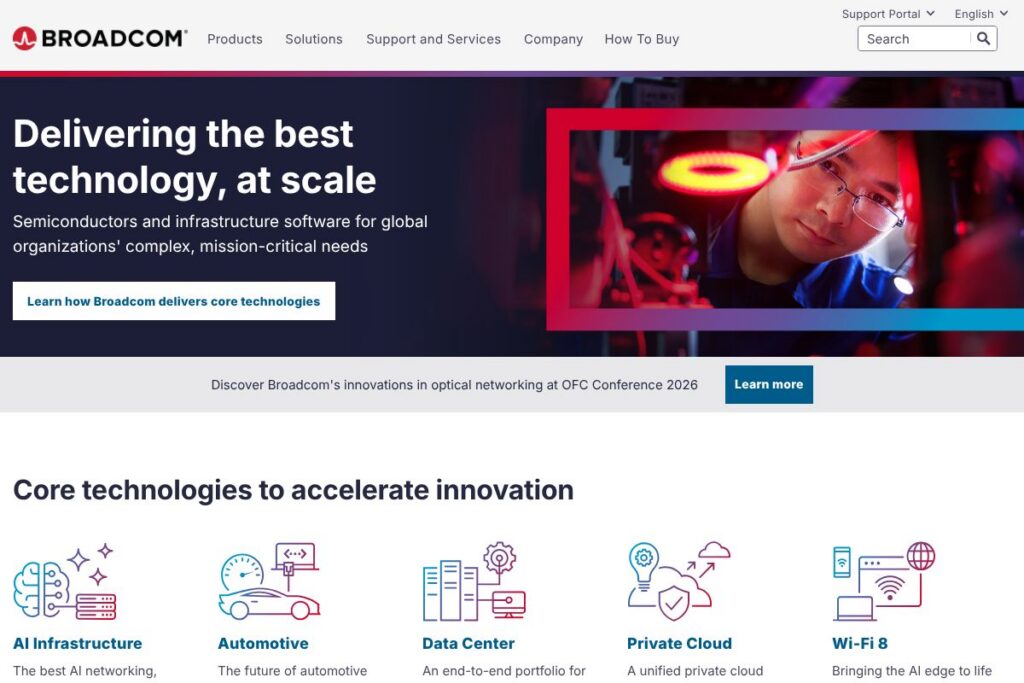
What is Broadcom
Broadcom supplies semiconductors and infrastructure software used by equipment makers, cloud providers, data centers, and large enterprises that run mission-critical systems. Its semiconductor portfolio includes networking, wireless, and storage chips; its software portfolio covers private cloud, mainframe tools, cybersecurity, and storage area network management. Broadcom combines multi-year R&D investment and high-volume manufacturing partnerships to support customers at scale.
Compared with competitors, Broadcom focuses on an integrated hardware-plus-software approach rather than only CPUs or general-purpose processors. Intel competes heavily on server CPUs and platform silicon, while AMD competes in computing and graphics processors. Cisco targets networking systems and software, with a stronger emphasis on finished network appliances rather than the broad silicon and enterprise software mix Broadcom offers.
All of this makes Broadcom a strong fit for OEMs, telecom carriers, cloud operators, and large enterprises that need high-throughput networking, Fibre Channel storage, or enterprise infrastructure software with vendor-grade support. Broadcom performs particularly well where hardware and software must be certified together and supported over long lifecycles, such as carrier networks, hyperscale data centers, and mainframe operations.
How Broadcom Works
Broadcom operates as a combined semiconductor design and enterprise software company. On the silicon side it follows a fabless model, designing chips and working with foundries and manufacturing partners to produce silicon at scale. For software, Broadcom licenses enterprise products and provides long-term maintenance, security updates, and paid support for large customers.
Customer engagements typically start with product selection and technical validation, move to volume supply chain and integration with OEM platforms, and continue with lifecycle support and firmware or software updates. For an overview of product categories and technical resources, see Broadcom’s product portfolio and the support center.
Broadcom features
Broadcom’s product set spans two broad domains: semiconductor components for connectivity and storage, and enterprise infrastructure software for cloud, mainframe, and security. Key capabilities include high-performance network silicon, Fibre Channel storage controllers and management, wireless connectivity chips, and enterprise software suites for private cloud and mainframe environments. The company also provides lifecycle support, firmware and driver updates, and commercial licensing for large customers.
Key functionality includes:
High-performance networking silicon
Broadcom produces network switch ASICs and PHYs designed for high throughput and low latency in data center and carrier networks. These chips are optimized for large-scale switching, programmability, and power efficiency, helping equipment vendors meet bandwidth and density requirements.
Wireless and connectivity chips
The company offers radio and connectivity silicon used in mobile devices, access points, and consumer gateways. These components focus on throughput, coexistence in crowded spectrum, and interoperability with industry Wi-Fi and Bluetooth standards.
Storage controllers and Fibre Channel management
Broadcom supplies controllers for NVMe and SAS storage arrays plus Fibre Channel host bus adapters and management software. This combination supports high-availability storage systems, hardware acceleration for I/O, and centralized storage area network operations.
Enterprise infrastructure software
Broadcom’s software portfolio covers private cloud management, mainframe tooling, cybersecurity solutions, and enterprise automation. These products are aimed at large IT environments that require scale, compliance, and long-term support contracts.
Lifecycle support and professional services
Broadcom provides maintenance contracts, firmware and driver distribution, and paid professional services for integration, testing, and migration projects. Long-term support and security patching are standard for enterprise customers.
With this mix of silicon, software, and support, Broadcom’s biggest benefit is delivering components and systems that can be deployed and maintained at hyperscale and across long platform lifecycles. That makes it especially useful where coordination between hardware and enterprise software matters.
Broadcom pricing
Broadcom uses enterprise and contract-based pricing rather than standard public plans. Pricing varies by product type: semiconductor components are sold through distributors and OEM agreements with volume discounts, and infrastructure software is typically licensed under multi-year enterprise contracts with per-instance or capacity-based terms. For authoritative guidance on procurement and licensing, contact Broadcom’s sales channels.
Enterprise
Enterprise – Custom pricing (Software licensing, support SLAs, and hardware supply agreements are negotiated per customer and depend on volume, support level, and deployment model). For procurement options and commercial terms, reach out via Broadcom’s contact and sales channels or consult the support portal for product-specific licensing information.
What is Broadcom Used For?
Broadcom components and software are used to build and operate high-capacity network switches and routers, carrier-grade wireless infrastructure, enterprise storage systems, and data center servers. Equipment manufacturers integrate Broadcom ASICs and PHYs into switches and routers, while storage vendors use Broadcom storage controllers and Fibre Channel products in SAN equipment.
On the software side, Broadcom products are used for private cloud orchestration, mainframe lifecycle management, cybersecurity tooling, and storage area network administration. The typical users are OEMs, cloud providers, telecommunications companies, large enterprises, and government agencies that require robust support and long-term product stability.
Pros and cons of Broadcom
Pros
- Broad product breadth: Broadcom covers both semiconductor silicon and enterprise infrastructure software, allowing integrated solutions and coordinated support across hardware and software.
- Scale and performance: Broadcom’s networking and storage silicon targets high throughput and low latency, which benefits data center and carrier deployments that need predictable performance.
- Long-term support: Enterprise software licensing and maintenance options provide multi-year support, security updates, and professional services for complex deployments.
Cons
- Enterprise contracting model: Pricing and licensing are typically negotiated per customer, which can mean longer procurement cycles and less price transparency for smaller buyers.
- Vendor consolidation effects: Broadcom’s wide product and acquisition activity can create heavier dependence on a single vendor for both hardware and software components.
- Complex product lines: Evaluating and integrating Broadcom products can require specialized engineering resources, particularly for low-level silicon features and storage networking configurations.
Does Broadcom Offer a Free Trial?
Broadcom does not offer a public free plan or self-service trial for most enterprise products; software evaluations and hardware samples are provided through sales and partner channels. Prospective customers should contact Broadcom’s sales team for evaluation licenses, trial software, or engineering sample requests via the contact page.
Broadcom API and Integrations
Broadcom provides APIs, SDKs, and management interfaces for many of its products, including storage management APIs, firmware interfaces for silicon, and integrations for enterprise software products. Developers and integrators can find technical documentation and product APIs through Broadcom’s support and documentation site.
Key integrations include ecosystem support for major cloud platforms and OEM systems, interoperability with hypervisors and storage stacks, and partner integrations used by telecom and networking equipment vendors. For specific API endpoints and developer guides, consult Broadcom’s product documentation and developer resources.
10 Broadcom alternatives
Paid alternatives to Broadcom
- Intel: Offers server processors, platform silicon, and networking products that compete in data center compute and platform markets. Intel emphasizes CPU performance and platform-level ecosystem support.
- AMD: Provides CPUs and GPUs for servers and workstations, competing on compute density and platform efficiency for cloud and enterprise workloads.
- NVIDIA: Competes mainly in accelerator and networking spaces with GPU compute for AI and Mellanox networking products for high-performance data center networking.
- Cisco: Sells finished network systems and software for enterprise and carrier networks, with a focus on integrated appliances and networking services.
- Marvell: Produces networking, storage, and connectivity silicon for data center and enterprise markets, often competing on power efficiency and specific connectivity features.
- Qualcomm: Competes in wireless connectivity and mobile chipset domains, particularly for devices and gateways requiring integrated cellular and Wi-Fi solutions.
- Micron: Provides memory and storage solutions that pair with Broadcom controllers and offer alternatives for storage subsystem vendors.
Open source alternatives to Broadcom
- OpenCompute Project: A hardware design community that publishes open designs for servers, storage, and networking; useful for organizations adopting open hardware approaches.
- OpenBMC: An open-source firmware stack for baseboard management controllers used in server management and hardware control tasks.
- Open vSwitch: A software-based virtual switch used in cloud and virtualized environments as an alternative to some proprietary networking features.
- Ceph: An open-source distributed storage system that can replace proprietary SAN management for many large-scale storage use cases.
Frequently asked questions about Broadcom
What does Broadcom do?
Broadcom supplies semiconductor components and enterprise infrastructure software. Its offerings include network ASICs, wireless connectivity chips, storage controllers, and enterprise-class software for cloud, mainframe, and storage management.
How is Broadcom priced for enterprise software?
Broadcom uses custom, contract-based pricing for enterprise software and hardware. Licensing terms and support levels are negotiated based on deployment scale, duration, and required service levels.
Does Broadcom provide APIs for integration?
Yes, Broadcom provides APIs and SDKs for many products. Technical documentation and product-specific API references are available through Broadcom’s support portal.
Can Broadcom components be purchased through distributors?
Yes, many Broadcom semiconductor products are available via distribution and OEM channels. Volume buyers and equipment manufacturers typically establish supply agreements, while smaller purchasers use authorized distributors.
Is Broadcom suitable for cloud and hyperscale deployments?
Yes, Broadcom’s networking and storage silicon and infrastructure software are widely used in cloud and hyperscale environments. The company designs components to meet high-throughput, low-latency, and long-lifecycle requirements common in those settings.
Final verdict: Broadcom
Broadcom excels at delivering high-performance silicon and enterprise-grade infrastructure software that must operate reliably at scale. Its combined hardware and software portfolio is particularly valuable where customers require certified interoperability, multi-year support, and vendor-managed lifecycle updates for networking and storage systems.
Compared to Intel, which focuses heavily on CPUs and public product pricing for commodity server components, Broadcom emphasizes integrated networking and storage solutions plus enterprise software licensed through custom contracts. That means Broadcom is often a better match for large OEMs, carriers, and cloud providers that need coordinated hardware-software roadmaps and long-term support rather than off-the-shelf component purchasing.
For procurement, licensing, or product documentation, consult Broadcom’s official product portfolio and reach out through the company contact page to discuss deployment options, evaluation licenses, or volume purchasing agreements.