What is Cisco
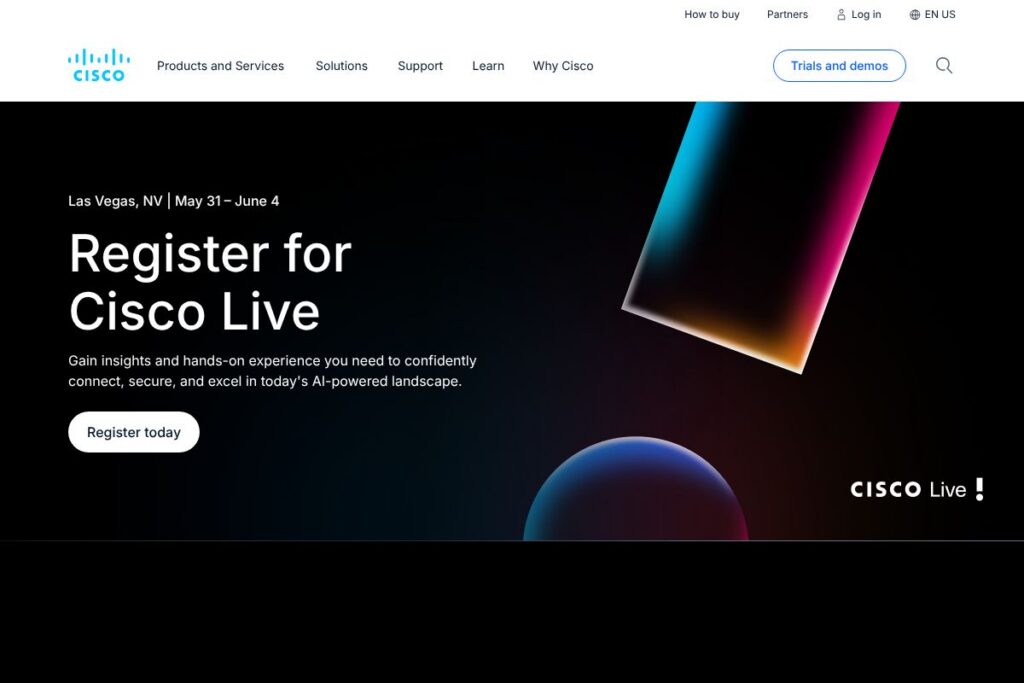
Cisco is a global provider of networking hardware, software, and services that help organizations design, operate, and secure large-scale IT environments. Its portfolio spans routers, switches, programmable silicon, security appliances, software-defined networking, and full-stack solutions for data center, cloud, and edge deployments. Cisco positions those capabilities around AI-ready infrastructure and unified management to support modern workloads and complex, distributed operations.
Compared with competitors in core networking and security, Cisco offers a broader integrated portfolio. Arista Networks focuses heavily on high-performance data center switching and telemetry for cloud operators, while Juniper Networks emphasizes programmable routing and SDN controllers; Palo Alto Networks concentrates more narrowly on next-generation firewalls and security platforming. Cisco differentiates by combining silicon, network fabric, and security with professional services and a large global support organization.
All of this makes Cisco particularly suitable for large enterprises, hyperscalers, and service providers that need unified networking, embedded security, and lifecycle support across campus, branch, cloud, and edge sites. Organizations that require tight vendor integration across hardware, software, and managed services will find Cisco’s integrated approach advantageous.
How Cisco Works
Cisco delivers its capabilities as a combination of hardware platforms, software services, and cloud-managed operations. Programmable switches and routers run network services while management and policy are applied through centralized controllers and cloud consoles, enabling consistent configuration and enforcement across on-premises and cloud environments.
Operational workflows use Cisco automation, assurance, and AI-driven insights to reduce manual troubleshooting. Teams typically deploy Cisco’s observability tools to collect telemetry, use Cisco IQ and automation to analyze and remediate issues, and apply policy templates to maintain compliance and zero-trust segmentation across sites and devices.
Cisco features
Cisco’s platform centers on networking performance, security distributed across the fabric, and AI-enabled operations. Core capabilities include AI-optimized networking, purpose-built silicon, distributed zero-trust enforcement, edge-to-cloud platforms, and a unified AI experience called Cisco IQ for insights, automation, and support. The company continues to extend AI-driven troubleshooting, observability, and agent-driven automation for large-scale enterprise deployments.
AI Infrastructure
Cisco provides systems and reference architectures for running AI workloads, combining high-throughput networking, storage connectivity, and validated hardware stacks that support GPU clusters and AI pipelines. These solutions are designed to reduce bottlenecks between compute and storage, improving data throughput for model training and inference.
AI-optimized Networking
Networking products are tuned to prioritize low latency, high throughput, and deterministic paths for AI data flows, which helps large models move training data between clusters faster. Features such as segmentation, traffic engineering, and telemetry support help operators maintain predictable performance for AI workloads.
Purpose-built Programmable Silicon
Cisco designs programmable silicon for switches and routers that targets performance and energy efficiency at scale. Programmability allows network teams to offload specific processing tasks, apply fine-grained policies, and evolve capabilities through software updates without hardware replacements.
Distributed Enforcement and Zero Trust
Cisco’s security fabric delivers distributed policy enforcement across data center, cloud, campus, and IoT environments to enable zero-trust segmentation. Unified policy management helps reduce lateral movement risks and applies consistent application protection across hybrid environments.
Security Embedded in the Network
Security capabilities are integrated at multiple layers of the network stack, including micro-segmentation, threat detection, and inline protection. This reduces dependency on isolated appliances and simplifies protection for complex campus and hybrid-cloud architectures.
Edge Platform
The edge platform combines modular compute, data services, and centralized management to run latency-sensitive and location-bound applications with data center-class features. Built-in security and policy enforcement make it easier to operate distributed edge nodes at scale.
Cisco IQ
Cisco IQ provides a unified AI-powered experience for real-time insights, automated troubleshooting, guided remediation, and learning for both support and professional services. It consolidates telemetry and applies AI to produce recommendations and scriptable actions for operators.
Observability and Assurance
Assurance tools collect telemetry across networks and applications, apply analytics to surface anomalies, and generate actionable diagnostics to speed incident resolution. These capabilities help IT teams turn raw telemetry into prioritized remediation steps.
Data Center and Cloud Solutions
Cisco offers validated reference architectures and software-defined data center components that integrate networking, compute, and storage orchestration for private and hybrid cloud models. The aim is to provide consistent operations and secure connectivity for both traditional enterprise and AI workloads.
With these features, Cisco’s biggest benefit is providing an end-to-end, integrated platform that combines networking performance, embedded security, and AI-driven operations to support enterprise-scale deployments. That integration reduces the operational friction of managing multiple point products and helps organizations run complex, distributed systems with consistent policies.
Cisco pricing
Cisco uses an enterprise, custom-pricing model for the majority of its hardware and software solutions, with costs determined by product family, deployment scale, licensing model, subscription options, and support level. Pricing for specific solutions and services is provided through sales channels and is tailored to each customer’s architecture, service-level requirements, and procurement model.
Enterprise Licensing and Subscriptions
Enterprise Licensing – Custom pricing based on product bundles, feature sets, and number of devices or seats.
Support and Maintenance – Custom service tiers for technical support, software updates, and hardware replacement based on SLA requirements.
Contact and Quotes
For deployment-specific pricing and licensing options, check Cisco’s product and solutions pages or request a tailored quote via Cisco’s contact sales resources. See the Cisco product and solutions overview for links to solution pages and the Cisco contact sales page to initiate a procurement conversation.
What is Cisco Used For?
Cisco is used to build and operate the underlying network, security, and management plane for enterprises, service providers, and data centers. Common tasks include core routing and switching, WAN connectivity, secure remote access, firewalling, application segmentation, and converged campus and branch networking.
Organizations also use Cisco to deploy AI-ready infrastructure and edge platforms that support distributed AI inference, training pipelines, and data collection at scale. Operational teams lean on Cisco’s assurance and automation tools to reduce mean time to repair and maintain consistent policy enforcement across hybrid environments.
Pros and Cons of Cisco
Pros
- Comprehensive product portfolio: Cisco offers hardware, software, and services that cover networking, security, data center, and edge, which simplifies vendor management and integration.
- Enterprise-grade support and services: Cisco provides global professional services, training, and a broad partner ecosystem to support large deployments and custom integrations.
- Strong security posture: With distributed enforcement, zero-trust segmentation, and embedded security features, Cisco delivers defense-in-depth across hybrid environments.
- AI and observability investments: Cisco IQ and AI-optimized networking add operational visibility and automation that help teams manage complex, large-scale systems.
Cons
- Complex licensing and procurement: Enterprise-grade flexibility often brings complex licensing models that require careful planning and vendor negotiations.
- Higher total cost for full-stack deployments: Integrated, end-to-end solutions can carry a higher upfront investment compared with assembling best-of-breed point products.
- Operational learning curve: Large feature sets and programmable silicon require skilled staff and established processes to exploit advanced capabilities fully.
Does Cisco Offer a Free Trial?
Cisco offers product trials and developer resources for evaluation, and selected software products have trial licenses or limited free tiers. Cisco also maintains the Cisco DevNet developer portal with free sandboxes, APIs, and learning material to test integrations and prototypes before committing to production licensing.
Cisco API and Integrations
Cisco provides extensive APIs and developer resources through the Cisco DevNet portal; the API documentation and developer sandboxes include REST, streaming telemetry, automation frameworks, and SDKs for common workflows. These APIs enable automation of provisioning, telemetry ingestion, policy management, and integration with orchestration tools.
Key integrations include public cloud platforms and enterprise systems such as VMware, AWS, Microsoft Azure, ServiceNow, and major observability platforms. Cisco offers connectors and reference guides to help integrate networking and security telemetry into existing ITSM and monitoring pipelines.
10 Cisco alternatives
Paid alternatives to Cisco
- Arista Networks: Focused on high-performance data center switching, telemetry, and programmability for cloud-scale environments.
- Juniper Networks: Offers routing, switching, and SDN controllers with a strong emphasis on automation and programmable network OS.
- Palo Alto Networks: Enterprise-grade security platform centered on firewalls, cloud security, and threat prevention services.
- Fortinet: Security-first vendor with integrated firewall, SD-WAN, and secure access solutions at enterprise scale.
- Hewlett Packard Enterprise: Broad portfolio covering networking, servers, storage, and hybrid cloud integration with enterprise support.
- VMware: Provides virtualized networking and security via NSX and multi-cloud infrastructure solutions for software-defined data centers.
- Microsoft Azure Networking: Cloud-native networking and security services for organizations standardizing on Microsoft cloud infrastructure.
Open source alternatives to Cisco
- Open vSwitch: A production-quality, multilayer virtual switch used in virtualized environments and SDN deployments.
- FRRouting: An open routing stack for Linux that supports common routing protocols for custom or cost-sensitive network builds.
- pfSense: A widely used open-source firewall and router platform suitable for branches, SMBs, and lab environments.
- OPNsense: A fork of pfSense with an emphasis on modularity and a modern web interface for firewalling and routing.
- Cilium: A networking, security, and observability layer for cloud-native workloads, built on eBPF for high-performance packet processing.
Frequently asked questions about Cisco
What is Cisco used for in enterprise networks?
Cisco is used for building and operating enterprise networks, data centers, and secure access systems. Its products cover routing, switching, wireless, security, and management for hybrid infrastructure.
Does Cisco provide APIs for automation?
Yes, Cisco provides APIs and developer resources through Cisco DevNet. The platform includes REST APIs, streaming telemetry, SDKs, and sandboxes to automate provisioning and collect telemetry.
How does Cisco handle security for AI workloads?
Cisco embeds security across the network fabric and provides distributed enforcement for zero trust segmentation. That approach helps protect data flows between AI training and inference clusters across hybrid deployments.
Can Cisco solutions be deployed at the edge?
Yes, Cisco offers edge platforms with centralized management and built-in security. These platforms deliver data center-like capabilities at distributed locations for low-latency and location-bound applications.
Is Cisco pricing fixed per product?
Cisco typically uses custom enterprise pricing that varies by product mix, scale, and support level. Organizations should contact Cisco sales or partners for tailored quotes and licensing details.
Final verdict: Cisco
Cisco stands out for its breadth of products that integrate networking, security, and infrastructure software with professional services and a large global support network. It is well suited to organizations that need validated, enterprise-grade solutions that cover campus, data center, cloud, and edge environments while offering advanced telemetry and automation for operations.
Compared with Palo Alto Networks, which focuses more narrowly on security appliances and cloud-delivered prevention, Cisco offers a broader portfolio that includes programmable silicon, high-performance networking, and full-stack infrastructure, while both vendors commonly use custom enterprise pricing. For buyers prioritizing an integrated networking and operations strategy across many sites, Cisco’s end-to-end approach is a practical option; for those prioritizing a single-vendor security-first posture, a specialized security provider may be a closer fit.