Dacast in a Nutshell
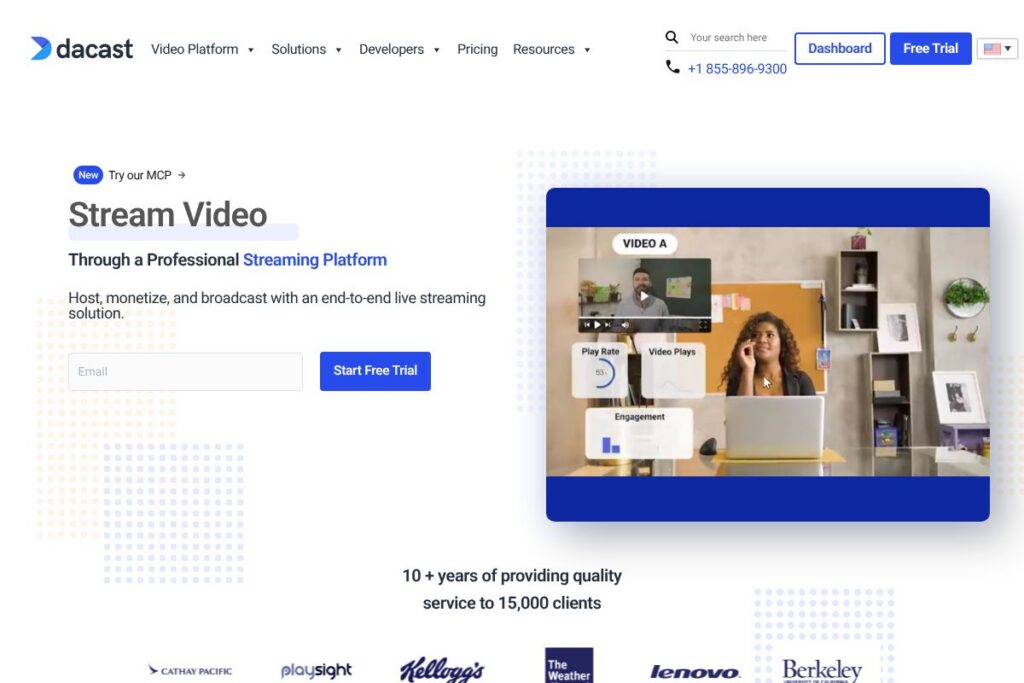
Dacast is a cloud-based online video platform that provides secure live streaming and video-on-demand hosting with tools for monetization, access control, analytics, and developer integration. It targets broadcasters, enterprises, media publishers, religious organizations, sports teams, and event producers who need reliable delivery and governance of video content across devices.
Compared with Vimeo Livestream and Brightcove, Dacast emphasizes a self-service platform with developer-friendly APIs and an add-on model for monetization and paywall features. Vimeo tends to bundle creator-facing production and community features, while Brightcove focuses on large enterprise deployments with extensive enterprise services; Dacast sits between those options by offering scalable delivery and built-in monetization without requiring enterprise procurement.
Dacast is particularly strong at combining CDN-backed live delivery with flexible monetization options, API access for custom workflows, and integrated analytics, making it a practical choice for organizations that want production-grade streaming without a lengthy onboarding process. The platform is well suited to teams that need secure, white-label playback, control over distribution, and the ability to attach pay-per-view or subscription revenue models to their video content.
How Dacast Works
Dacast delivers live and VOD content through a web-based control panel and a set of APIs for managing streams, assets, and playback. Publishers create channels for live events or upload files for on-demand playback, configure security and monetization settings, then publish via an embedded player or direct links.
For live streaming, encoders such as OBS, Wirecast, or hardware encoders push an RTMP feed to Dacast which then transcodes, packages, and delivers the stream through multiple CDNs to reduce buffering and latency. For VOD, uploaded files are processed and served with adaptive bitrate playback to improve viewer experience across network conditions.
Workflows commonly include creating a paywall for an event, embedding the Dacast player on a website, tracking engagement with analytics, and using the API to automate publishing to other platforms. Administrators can also control access with tokenized URLs, geo-restrictions, and domain-level embedding rules to prevent unauthorized viewing.
Dacast features
Dacast’s platform is organized around secure delivery, monetization, developer controls, and enterprise features. Core capabilities include live streaming, VOD hosting, paywall monetization, analytics, DRM and tokenized access, and API access for automation. Recent focus areas include improved encoder compatibility, expanded CDN peering, and more flexible monetization workflows.
Secure Video Hosting
Secure hosting includes tokenized playback, domain and referrer restrictions, and optional DRM to protect content from unauthorized reuse. These controls help organizations maintain control over distribution and comply with licensing or privacy requirements.
Video Monetization
Dacast supports multiple monetization models such as pay-per-view, subscriptions, and ad insertion through built-in paywall tools and API hooks. Publishers can collect payments, limit access windows, and integrate billing flows to generate revenue from events and evergreen content.
Stream Live Events
Live event streaming uses redundant CDN delivery and adaptive bitrate to minimize buffering and reach large audiences with low interruption. The platform supports scheduled events, live transcoding, and live recording to VOD for immediate post-event replay.
VOD Management
VOD management covers upload, transcoding, metadata, and organization of on-demand libraries with category and playlist support. The API allows automated ingestion, metadata updates, and programmatic control over playback and access rules.
OTT Platform
Dacast offers tools to build OTT channels and deliver content to apps, smart TVs, and mobile devices using standard streaming protocols and SDKs. This makes it possible to launch branded channels across devices while retaining centralized control.
24/7 Customer Support
Support options include documentation, live chat, and higher-tier support packages with faster SLAs; the platform advertises support starting at $39/month. For broadcasters running mission-critical events, premium support and dedicated account management are available as add-ons.
API Access and Developer Tools
A REST API and playback APIs enable automation of uploads, stream creation, analytics retrieval, and white-label player configuration. Developer tools make it possible to embed custom workflows into existing CMS and billing systems for end-to-end automation.
Analytics and Reporting
Built-in analytics track plays, viewer geography, engagement metrics, and bandwidth usage to help publishers understand performance and monetize more effectively. Reports can be exported or queried via API for integration into business dashboards.
With these features, Dacast provides a full stack for secure streaming and monetization, bringing hosting, delivery, and developer control into a single platform that supports both live broadcast and on-demand distribution.
Dacast pricing
Dacast uses a subscription-style SaaS model with tiered plans that scale by bandwidth, storage, and support level, plus an available 14-day free trial with 10 GB of bandwidth. Support packages and add-ons such as dedicated customer support begin at $39/month; larger broadcasters typically move to custom plans or enterprise agreements.
Monthly Billing:
Monthly subscriptions are available and billed month-to-month, useful for event-based streaming or temporary needs. Costs vary based on included bandwidth and storage, with additional usage billed according to plan terms; check Dacast’s homepage for current plan structures and offerings.
Annual Billing:
Annual contracts are offered for organizations that require steady bandwidth and predictable costs and usually reduce the effective monthly cost compared with month-to-month plans. Annual commitments are commonly paired with priority support and higher usage allowances; contact sales for tailored annual pricing information via Dacast’s homepage.
Enterprise
Enterprise pricing is custom and depends on expected traffic, CDN footprint, DRM requirements, and service-level needs. For enterprise deployments, Dacast provides custom SLAs, white-labeling, dedicated account support, and volume bandwidth pricing; reach out to sales from Dacast’s homepage to discuss specific requirements.
What is Dacast Used For?
Dacast is used to stream live events, conferences, religious services, sports matches, and corporate communications to web and mobile audiences while retaining control over monetization and access. Organizations rely on the platform to broadcast one-off events or to run recurring channels with subscription access.
It is also used for publishing on-demand libraries, internal training libraries, and OTT channel delivery that requires DRM, custom player branding, and analytics. Typical users include media companies, event producers, non-profits, churches, sports leagues, and enterprises that need secure, scalable streaming.
Pros and Cons of Dacast
Pros
- Secure playback controls: Tokenized URLs, domain restrictions, and optional DRM provide strong protection for paid or licensed content, reducing unauthorized distribution.
- Built-in monetization: Integrated paywalls and support for pay-per-view or subscription models let publishers collect revenue without a separate billing stack.
- Developer-friendly API: A full REST API enables automation of uploads, stream provisioning, and analytics for custom workflows and integrations.
- Flexible delivery with CDN redundancy: Multi-CDN delivery and adaptive bitrate streaming help maintain quality for large live events and distributed audiences.
Cons
- Bandwidth can add cost: Heavy live viewership or long-duration events can increase monthly costs where additional bandwidth is charged beyond plan allowances, making budgeting important.
- Enterprise features may require add-ons: Advanced SLAs, dedicated support, and large-scale enterprise services typically shift deployments into higher-cost tiers or custom contracts.
- Learning curve for advanced workflows: Teams that want to use the API, DRM, and OTT SDKs effectively will need developer resources to integrate and automate full workflows.
Does Dacast Offer a Free Trial?
Dacast offers a 14-day free trial with no credit card required and an initial allocation of 10 GB of bandwidth. The trial lets users test live streaming, VOD uploads, and basic monetization workflows; after the trial, continued use requires a paid subscription or enterprise agreement.
Dacast API and Integrations
Dacast provides a developer API for automating uploads, creating streams, managing assets, and retrieving analytics; see the Dacast API documentation for available endpoints and examples. The platform is compatible with common encoders such as OBS, Wirecast, and hardware RTMP encoders, and integrates with ad servers, CMS platforms, and payment gateways through API hooks.
Common integrations include embedding the white-label player in websites, connecting billing processors for pay-per-view flows, and using analytics exports to feed business intelligence tools. For specialized integrations and SDKs for mobile or OTT apps, refer to the developer resources in the Dacast documentation.
10 Dacast alternatives
Paid alternatives to Dacast
- Vimeo Livestream — A creator- and publisher-friendly platform with integrated production tools and OTT features, suited for creators and organizations that value ease of use.
- Brightcove — An enterprise-focused video cloud with extensive business features and professional services for large-scale broadcasters and media companies.
- Kaltura — A modular video platform that provides on-premise and cloud options with a strong focus on education and enterprise video management.
- IBM Video Streaming — Enterprise-grade streaming and analytics with global delivery and enterprise support for large organizations.
- JW Player — Video hosting and player solutions with strong customization for publishers who need fast playback and ad integration.
- Wowza — Known for low-latency streaming and customizable server deployments, used by broadcasters with specific protocol needs.
- Mux — Developer-focused video APIs for streaming and VOD with usage-based pricing and robust analytics for tech-first teams.
Open source alternatives to Dacast
- Ant Media Server — An open source media server that supports low-latency WebRTC and adaptive streaming for live and on-demand workflows.
- Nginx RTMP Module — A lightweight open-source approach to self-hosted streaming using Nginx with RTMP support for ingest and HLS delivery.
- Red5 — Open-source media server software suitable for streaming and real-time applications with community and commercial editions.
- PeerTube — A decentralized, federated video hosting platform that provides community-driven hosting as an alternative to centralized OVPs.
Frequently asked questions about Dacast
What does Dacast cost per month?
Dacast uses tiered subscription pricing with custom enterprise options, and support packages start at $39/month; actual plan costs vary by bandwidth, storage, and features. For current plan options and to compare monthly versus annual billing, visit Dacast’s homepage.
Does Dacast offer an API for automation?
Yes, Dacast provides a REST API for stream management, uploads, and analytics; refer to the Dacast API documentation for endpoints and integration examples. The API supports programmatic control of assets, playback tokens, and reporting data.
Can Dacast help me monetize live events?
Yes, Dacast includes built-in monetization tools such as pay-per-view and subscription paywalls, plus hooks to integrate external payment processors. Publishers can set access windows, price points, and reuse recordings as VOD for additional revenue.
Is Dacast suitable for corporate internal streaming?
Yes, Dacast is well suited for internal communications and training, offering secure playback controls, private streaming options, and analytics to track employee engagement. Domain restrictions and tokenized access help keep internal content private.
Does Dacast support OTT and streaming to apps?
Yes, Dacast supports OTT delivery and SDK integration for distributing channels across mobile apps, connected TVs, and web players using standard streaming protocols and player customization. Consult the developer resources for SDKs and best practices.
Final verdict: Dacast
Dacast is a practical, developer-friendly online video platform that combines secure hosting, paywall monetization, and API access within a single service. It performs particularly well for organizations that need programmatic control over streaming workflows, integrated monetization, and CDN-backed delivery without committing to large enterprise contracts.
Compared with Brightcove, which is oriented toward enterprise accounts with custom pricing and broad professional services, Dacast provides a clearer entry point for small to mid-size broadcasters and event producers, with support options starting at $39/month and a 14-day trial to evaluate delivery and monetization features. For teams seeking a balance between control, monetization, and cost, Dacast is a strong option to consider.