What is Aha!
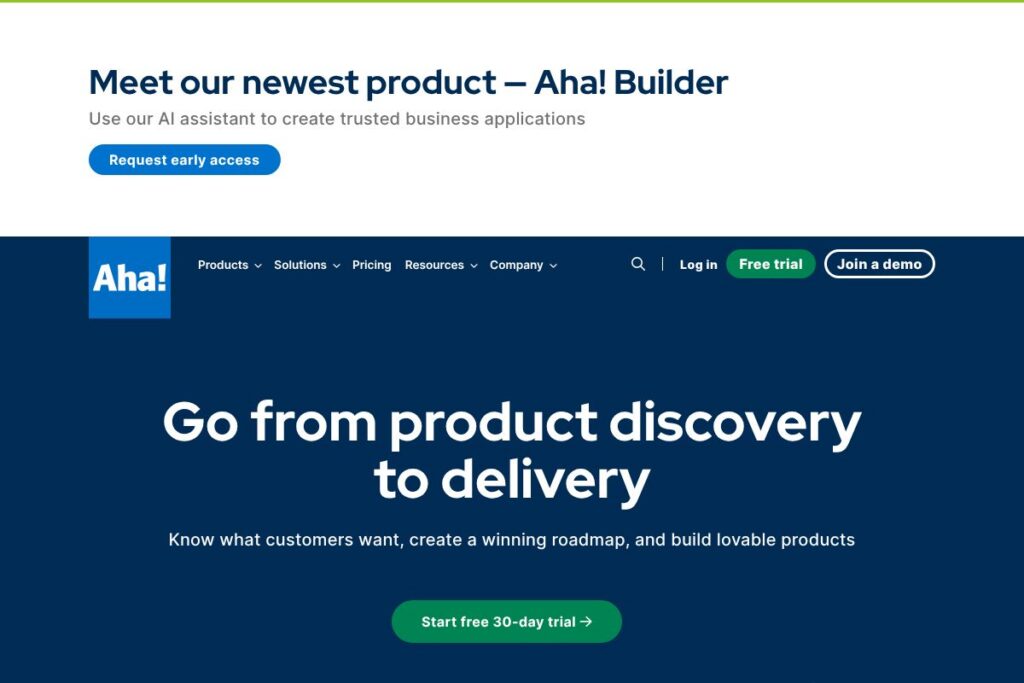
Aha! is a product development platform that helps product teams capture customer insights, define strategy, plan roadmaps, and coordinate delivery across engineering and design. It combines workspaces for idea management, visual roadmaps, release planning, requirements, and analytics so teams can move from discovery to delivery within one environment.
Aha! often sits alongside or replaces standalone tools such as Jira for engineering work tracking and Productboard for research-driven prioritization. Compared with Productboard, Aha! provides stronger built-in roadmapping and release planning; compared with Jira, Aha! focuses more on strategy and portfolio planning rather than issue-level sprint tracking.
All of this makes Aha! well suited for product managers and product-led organizations that need an integrated product process. The platform is especially useful for teams that want traceability from customer feedback and strategy through to releases and metrics, and for organizations that prefer a single product-centric workspace rather than stitching multiple point tools together.
How Aha! Works
Aha! organizes work around product strategy, ideas, roadmaps, and releases. Teams start by defining goals and initiatives, then capture ideas and customer feedback in idea portals that can be triaged, scored, and converted into features or requirements.
Roadmaps are visual and configurable, letting teams plan at multiple levels: strategy, product, and release. Once work is planned, Aha! can send requirements and work items to development trackers such as Jira or GitHub, while keeping progress synced so product managers retain visibility.
Collaboration is supported through comments, shared views, and stakeholder portals, and the built-in analytics help teams measure progress against goals. Practical workflows include linking customer requests to features, mapping features to releases, and automating status updates to engineering systems.
Aha! features
Aha! bundles product strategy, idea management, visual roadmapping, requirements management, and analytics into a single suite. Recent product updates emphasize better collaboration, more flexible roadmap visuals, and an AI assistant that helps with drafting requirements and summarizing customer feedback.
Let’s talk Aha!’s Features
Strategy and goals
Aha! provides tools to capture vision, set product goals, and break goals into initiatives and releases. This creates clear alignment between high-level strategy and the tactical work that teams plan and deliver.
Idea management
Idea portals centralize incoming user feedback and suggestions from customers and internal teams. The system supports scoring, tagging, and workflows to convert validated ideas into features, which improves prioritization based on evidence.
Visual roadmaps
Roadmaps are highly configurable timelines and release views that can be filtered by product, line of business, or goal. They support cross-product planning and can be exported or embedded for stakeholder updates.
Requirements and feature specs
Aha! includes structured requirement pages with acceptance criteria, designs, and attachments to specify what engineering teams need to build. These specs can be linked to tickets in tools like Jira while maintaining a single source of product truth.
Release and dependency planning
The platform supports release planning with dependency tracking and capacity views, which helps teams schedule work across multiple releases and identify blockers early.
Analytics and reporting
Built-in reports, custom charts, and dashboards let teams measure progress against goals and visualize feature performance. These insights help inform roadmap adjustments and stakeholder reporting.
AI assistant
Aha!’s AI features assist with drafting requirements, summarizing feedback, and generating roadmap narrative to speed routine writing tasks and help teams iterate faster on product documents.
With these capabilities Aha! reduces tool switching and preserves traceability from idea through delivery, which is the biggest practical benefit for product-centered organizations.
Aha! pricing
Aha! uses a SaaS subscription model with plans tailored to product managers, product teams, and enterprise organizations. Pricing is tiered by product edition and features, and enterprise options include advanced security and administrative controls.
Because Aha! publishes plan details and periodic promotions on its site, view the Aha! product development platform for current pricing and edition comparisons. For enterprise inquiries you can check the Aha! contact and enterprise options for quotes tailored to team size and required features.
What is Aha! Used For?
Aha! is used to run product discovery, prioritize features, and align teams around a visual roadmap. Product managers use it to centralize customer feedback, score ideas, and translate validated opportunities into detailed requirements.
Engineering and design teams use Aha! primarily for context and planning because it links strategic goals and roadmaps to the work that lands in development trackers. Product leaders use the platform for portfolio planning and cross-product visibility when coordinating releases across multiple teams.
Pros and Cons of Aha!
Pros
- Comprehensive roadmap tooling: The platform provides flexible, multi-level roadmaps that support strategy-to-release planning and stakeholder communication.
- Integrated idea and requirements flow: Teams benefit from a single source of truth that connects customer feedback, prioritized ideas, and feature specifications.
- Strong enterprise controls: Enterprise editions include administrative controls, single sign-on, and audit capabilities that help with compliance and large-team governance.
- Developer integrations: Aha! offers deep integrations with engineering tools so requirements stay synced while development proceeds in systems like Jira and GitHub.
Cons
- Learning curve for new users: The breadth of features can require a deliberate onboarding process and configuration to match an organization’s workflows.
- Cost for smaller teams: Comprehensive suites may be more expensive than lightweight roadmap or issue-tracking tools for very small teams or startups.
- Customization complexity: Highly customized configurations can require administrative time to maintain and may complicate upgrades.
Does Aha! Offer a Free Trial?
Aha! offers a 30-day free trial for new users so teams can test roadmapping, idea management, and requirements workflows. The trial typically includes access to core features and the AI assistant; sign up from the Aha! free trial page to begin a trial and evaluate the platform with your team.
Aha! API and Integrations
Aha! provides a developer API for reading and writing product data programmatically; the Aha! API documentation describes endpoints for ideas, releases, features, and more. The API supports automation, custom reporting, and connecting Aha! to internal systems.
Key native integrations include connectors to Jira, GitHub, GitLab, Slack, and popular analytics and support tools; see the Aha! integrations directory for details and setup guides. Integration workflows are designed to keep product planning in sync with engineering execution.
10 Aha! alternatives
Paid alternatives to Aha!
- Productboard — Focuses on customer-driven product prioritization with research repositories and feature scoring.
- Jira — Strong issue and sprint tracking for engineering teams, often paired with separate roadmap tooling.
- Monday.com — Flexible work OS that can be configured for roadmaps and product planning with visual boards.
- Asana — Task and project management with roadmap views for coordinating cross-functional work.
- ClickUp — All-in-one work platform that combines tasks, docs, and roadmaps with customizable workflows.
- Pendo — Product analytics and in-app guidance that complements roadmap planning with user behavior data.
- Roadmunk — Focused roadmap tool with visualization options and stakeholder reporting features.
Open source alternatives to Aha!
- OpenProject — Open source project and product management with roadmapping and release planning modules.
- Taiga — Agile project management platform that supports backlog, sprint planning, and a lightweight roadmap view.
- Wekan — Kanban-style board system suitable for simple idea and backlog tracking with self-hosting options.
- Redmine — Flexible, self-hosted project tracker with plugins that can be adapted for basic product planning.
Frequently asked questions about Aha!
What is Aha! best used for?
Aha! is best used for end-to-end product planning and roadmapping. It helps teams collect feedback, prioritize ideas, and map work to releases while keeping strategy visible.
Does Aha! integrate with Jira and GitHub?
Yes, Aha! integrates with both Jira and GitHub. Integrations keep requirements and status updates synchronized between product plans and engineering trackers.
Can Aha! help with customer feedback management?
Yes, Aha! includes idea portals and feedback workflows. Teams can capture, score, and link customer requests to features and releases.
Is Aha! suitable for enterprise organizations?
Yes, Aha! offers enterprise-grade controls and customizations. Enterprise plans include SSO, advanced permissions, and administrative features for large product organizations.
How long is the Aha! free trial?
Aha! provides a 30-day free trial. The trial allows teams to test core features including roadmaps, idea management, and the AI assistant.
Final Verdict: Aha!
Aha! excels at giving product teams a single, structured place to define strategy, collect input, and plan releases. Its strengths are visual roadmapping, traceability from ideas to delivery, and integrations that preserve context between product and engineering tools.
Compared with Productboard, which emphasizes customer research and prioritization, Aha! offers broader capabilities for release planning and portfolio management. For teams that already use Jira for execution, Aha! provides complementary product planning layers while keeping work synced, making it a strong choice for organizations that need strategy-to-delivery alignment rather than just task tracking.