What is EasyVista?
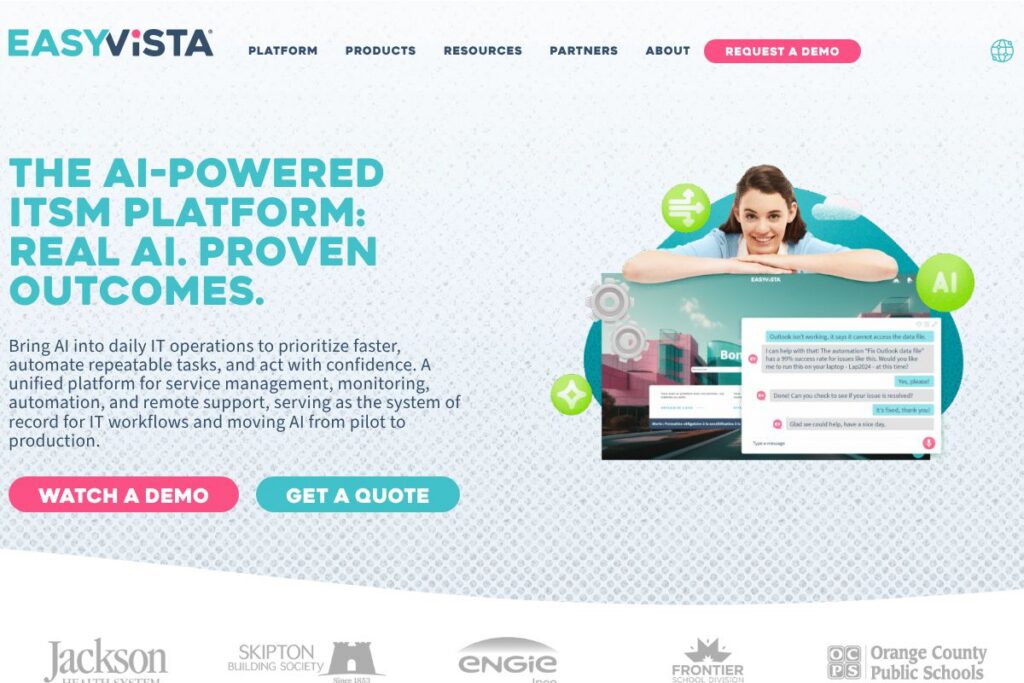
EasyVista is an enterprise IT service management platform built to combine service management, automation, monitoring, and remote support in a single system of record. It applies LLM-based automation and conversational AI to prioritize incidents, automate repeatable tasks, and provide intelligent recommendations that help IT teams operate with fewer manual steps.
Compared with ServiceNow, EasyVista emphasizes faster, lower-friction implementations and no-code configuration that shorten time to value for mid-market and enterprise customers. Against BMC Helix, EasyVista focuses on integrated citizen-facing self-service and lower total cost of ownership. Compared with Freshservice, EasyVista offers a broader blend of monitoring and orchestration capabilities on the same platform.
All of this makes EasyVista particularly useful for organizations that want a single vendor for ITSM, monitoring, remote support, and automation while keeping configuration accessible to non-developers. It suits IT operations, service desks, and organizations planning to move AI from pilots into production workflows.
How EasyVista Works
EasyVista presents a unified data model where incidents, requests, assets, and monitoring events feed a central service record so automation and reporting run from the same source of truth. Incoming tickets and alerts can be triaged by AI to suggest priorities, routing, and automated responses, while playbooks execute routine remediations.
Implementation typically uses EasyVista’s no-code app builder to model service processes, self-service portals, and forms. Teams connect discovery and monitoring feeds into the platform, map orchestration steps to runbooks, and then surface conversational assistants for end users and technicians to accelerate resolutions.
EasyVista features
EasyVista’s platform bundles ITSM, monitoring, automation, remote support, and discovery into a single product to reduce context switching and duplicated data. Recent emphasis has been on LLM-based automation, conversational assistants, and extending no-code builders to operations teams.
The platform includes several powerful capabilities worth highlighting:
AI-driven automation
AI-driven automation uses large language models to analyze incidents and suggest or run remediation steps. This reduces manual effort for common tickets, accelerates mean time to repair, and helps less experienced staff follow consistent recovery procedures.
Service management
The service management layer includes incident, problem, change, request, and SLA tracking with configurable workflows and approvals. It supports structured CMDB relationships so service impact is visible during triage and reporting.
Orchestration and playbooks
Orchestration provides connectors and runbooks to automate multi-step IT operations, from service restarts to provisioning. Playbooks can be executed from tickets or monitoring alerts so routine tasks are automated end to end.
Remote support
Integrated remote support tools allow technicians to view and control endpoints, transfer files, and run diagnostic scripts from within the same interface. That reduces the need for separate remote-control products and centralizes audit trails.
Discovery and inventory
Discovery scans and inventory capture hardware, software, and service relationships to populate the CMDB. Continuous discovery helps keep asset records current and supports impact analysis during outages.
IT infrastructure monitoring
Monitoring collects telemetry from networks, servers, and cloud resources and correlates events with service records. Alerts can trigger automated remediations or create prioritized incidents for service teams.
Digital experience monitoring
Digital experience monitoring tracks end-user performance metrics and application availability so teams can connect user complaints to backend issues. These metrics feed dashboards and SLAs for service quality reporting.
No-code app builder and self-service
The no-code builder lets teams create forms, workflows, and catalog items without development resources, while the self-service portal offers knowledge articles and conversational assistants for end users. That lowers configuration time and increases service adoption.
With these capabilities combined, the biggest benefit is a single operational platform that reduces data handoffs, shortens resolution cycles, and provides a consistent place to run automation and reporting.