Genesys Cloud: An Overview
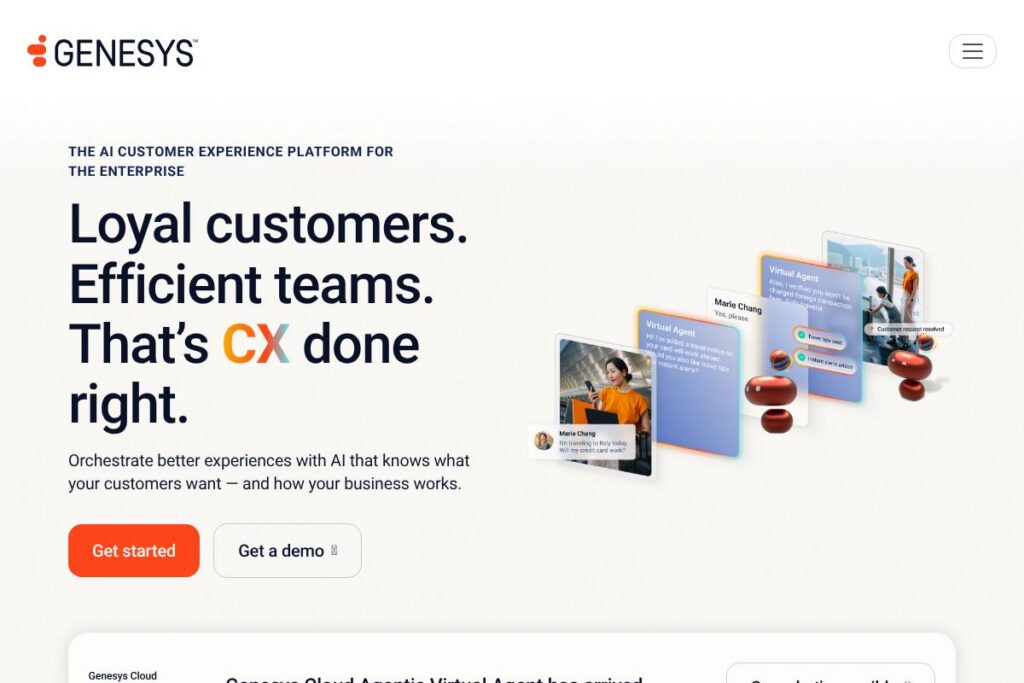
Genesys Cloud is a cloud-native platform for enterprise customer experience and contact center operations. It consolidates omnichannel routing, conversational AI, workforce engagement, and analytics into a single platform so organizations can manage voice, chat, messaging, and social interactions from one place. The product targets midsize to large enterprises and business process outsourcing (BPO) operations that need scale, reliability, and feature depth.
Compared with Amazon Connect, Genesys Cloud is positioned as a full-featured CX suite with packaged workforce engagement and analytics capabilities rather than a primarily infrastructure-focused service. Against Twilio Flex, Genesys Cloud provides a more out-of-the-box contact center experience with configurable flows and management tools instead of Flex’s more developer-centric, customizable canvas. Versus NICE CXone, Genesys Cloud competes closely on omnichannel routing and workforce optimization, with different strengths across integrations and enterprise support models.
All of this makes Genesys Cloud particularly well suited to large customer service organizations and BPOs that need integrated AI, compliance controls, and enterprise-grade reporting. It excels at orchestrating digital and human interactions while providing tools to measure and improve customer satisfaction across channels.
How Genesys Cloud Works
The platform runs as a multi-tenant cloud service with modular components for routing, AI, analytics, and workforce engagement. Administrators configure contact flows, routing policies, and channel-handling rules through a web-based admin console, while agents use a unified desktop for handling interactions across channels.
Genesys Cloud applies AI at multiple points in the customer journey: intent classification and sentiment analysis for routing, virtual assistants for self-service, and AI-assisted agent responses for faster handling. Orchestration ties automation and live agents together so a virtual assistant can escalate to a human with context intact.
Typical workflows include inbound routing that detects channel and customer intent, automated pre-triage by a virtual assistant, contextual routing to the right skill group, and post-interaction analytics feeding into quality management and coaching. The platform integrates with CRM systems and other enterprise apps to personalize interactions and log activity to downstream systems.
What does Genesys Cloud do?
Genesys Cloud is organized around omnichannel customer engagement, AI-driven automation, workforce optimization, and analytics. Core capabilities include multichannel routing, conversational AI, workforce management, quality management, and real-time analytics. Recent investments emphasize Genesys Cloud AI for unified automation and generative assistance across agent and self-service interactions.
Let’s talk Genesys Cloud’s Features
Omnichannel routing
Genesys Cloud consolidates voice, web chat, SMS, messaging apps, and social channels into a single routing fabric. Routing policies evaluate customer data, channel, and agent skills to match contacts to the best available resource, reducing handle time and improving first-contact resolution.
AI and automation
AI capabilities include virtual assistants, natural language understanding, intent detection, and AI-assisted agent suggestions that reduce manual effort. These tools automate routine questions, surface relevant knowledge to agents, and enable conditional escalation from bot to human with full context.
Workforce engagement
Workforce engagement tools cover forecasting, scheduling, real-time adherence, and agent performance monitoring to optimize staffing and agent productivity. Built-in coaching and quality management let supervisors score interactions and provide targeted feedback to improve service consistency.
Analytics and reporting
Real-time dashboards, historical reporting, and interaction analytics provide operational visibility and customer experience metrics. Supervisors can build custom reports and alerts to monitor SLAs, agent performance, and trending contact drivers.
Integrations and APIs
Genesys Cloud exposes REST and event-driven APIs for deep integrations with CRM, ticketing, and data platforms. Prebuilt connectors and a developer ecosystem make it straightforward to link Genesys Cloud with systems like Salesforce and Microsoft Dynamics to keep customer context synchronized.
Security and compliance
Enterprise security features include role-based access control, encryption in transit and at rest, and support for compliance frameworks required by regulated industries. The platform also supports audit trails and logging for operational and regulatory needs.
With Genesys Cloud you get a unified platform for digital-first and voice interactions, where AI and human workforces are orchestrated to reduce friction, improve agent productivity, and provide measurable CX outcomes.
Genesys Cloud pricing
Genesys Cloud follows an enterprise subscription and consumption model with custom pricing tailored to organization size, channel volume, and optional add-ons. Pricing typically covers per-seat licensing, channel or usage-based components for telephony and messaging, and optional modules such as advanced AI, workforce engagement, or premium support.
For specific plan options and to understand how features and consumption affect costs, check the Genesys Cloud product page or contact their sales team for a tailored quote. Pricing discussions commonly consider seat counts, telephony usage, AI credits or add-ons, integration requirements, and SLA levels.
What is Genesys Cloud Used For?
Genesys Cloud is used to run contact centers that handle high volumes of customer interactions across phone, chat, messaging, and social media. Organizations use it to centralize customer communications, implement IVR and virtual assistants, and provide agents with a single interface for multichannel work.
The platform is also used for workforce planning and compliance-sensitive operations where forecasting, recording, and quality assurance are essential. Typical users include enterprise customer service teams, BPOs, utilities, financial services, and healthcare providers that need both scale and regulatory controls.
Pros and Cons of Genesys Cloud
Pros
- Comprehensive omnichannel platform: Offers routing, AI, WFO, and analytics in a single product, reducing the need for stitching multiple vendors together.
- Strong AI capabilities: Built-in conversational AI and agent assist features accelerate automation of routine contacts and improve agent efficiency.
- Enterprise-grade reliability: Designed for large-scale operations with compliance, security controls, and high-availability architectures.
- Extensive integrations: Provides APIs and prebuilt connectors for CRM, collaboration, and telephony ecosystems to maintain customer context.
Cons
- Custom pricing model: Requires sales engagement to get accurate costs, which can lengthen procurement cycles for smaller buyers.
- Feature complexity: The depth of functionality can require more implementation and admin resources compared to lightweight contact center solutions.
- Migration effort for legacy systems: Moving from on-prem or mixed environments can require careful planning and professional services for large deployments.
Does Genesys Cloud Offer a Free Trial?
Genesys Cloud provides demos and trial evaluations through sales and partner channels rather than a public free tier. Prospective customers can request a demo or proof-of-concept to test specific flows, AI features, and integrations under supervised evaluation. Contacting Genesys or a certified partner is the usual route to arrange a hands-on evaluation.
Genesys Cloud API and Integrations
Genesys Cloud exposes a comprehensive set of REST and WebSocket APIs and an event-driven architecture for developers. The Genesys Cloud developer center documents APIs for routing, conversations, workforce management, and analytics, along with SDKs and sample projects.
Common enterprise integrations include CRM systems such as Salesforce and Microsoft Dynamics, collaboration platforms like Microsoft Teams, and cloud providers for telephony and speech services. Prebuilt connectors and a marketplace of third-party integrations simplify common enterprise workflows.
10 Genesys Cloud alternatives
Paid alternatives to Genesys Cloud
- Amazon Connect — A scalable contact center service with pay-as-you-go pricing and deep integration into the AWS ecosystem, suitable for cloud-native deployments.
- Twilio Flex — A programmable contact center platform that prioritizes developer customization and integration flexibility for bespoke agent experiences.
- NICE CXone — An enterprise CX suite with strong workforce optimization and analytics capabilities aimed at large contact centers.
- Five9 — Cloud contact center software focused on inbound and blended interactions with a strong set of contact routing and reporting tools.
- Cisco Unified Contact Center — A long-standing enterprise solution that integrates tightly with Cisco collaboration and networking products.
- Zendesk — A customer service platform that includes omnichannel support and simplified contact center functionality for service teams.
Open source alternatives to Genesys Cloud
- Asterisk — A widely used open source telephony framework for building custom PBX and contact center systems on-premise.
- FreeSWITCH — An open telephony platform for routing and bridging voice, video, and text communications in custom contact center solutions.
- VICIdial — An open source contact center suite focused on predictive dialing and inbound/outbound campaign management, commonly used by smaller operations.
- OpenSIPS — An open source SIP server that provides routing and service building blocks for telephony and contact center infrastructure.
Frequently asked questions about Genesys Cloud
What is Genesys Cloud used for?
Genesys Cloud is used for omnichannel contact center operations and customer experience management. It centralizes routing, AI, workforce engagement, and analytics to run enterprise-scale service operations across voice and digital channels.
Does Genesys Cloud have an API?
Yes, Genesys Cloud provides a full developer API surface and SDKs. The Genesys Cloud developer center includes REST APIs, WebSocket events, and sample code for common integration scenarios.
Can Genesys Cloud handle AI-based virtual assistants?
Yes, Genesys Cloud supports virtual assistants and conversational AI. Built-in AI features cover NLU, intent classification, bot-to-agent escalation, and agent assist to streamline both self-service and assisted experiences.
How does Genesys Cloud charge for usage?
Genesys Cloud uses an enterprise subscription and consumption model with custom pricing. Costs typically depend on seat licensing, telephony or messaging usage, optional modules like advanced AI, and support level, so vendors provide tailored quotes.
Is Genesys Cloud suitable for regulated industries?
Yes, Genesys Cloud supports enterprise security and compliance controls required by regulated sectors. The platform includes role-based access, encryption, audit logs, and features that help meet industry-specific regulatory requirements.
Final verdict: Genesys Cloud
Genesys Cloud excels as an enterprise-grade CX platform that bundles omnichannel routing, AI automation, workforce engagement, and analytics into a unified service. It is especially strong for organizations that need integrated tooling for large agent populations, deep reporting, and scheduled workforce planning, while also applying AI across self-service and agent-assisted channels.
Compared to Amazon Connect, which offers a pay-as-you-go infrastructure-first approach, Genesys Cloud provides a more comprehensive packaged experience with enterprise features and managed services, but it relies on a customized subscription and add-on pricing model rather than simple usage pricing. For large enterprises that value prebuilt capabilities, regulatory controls, and vendor-managed support, Genesys Cloud is a strong candidate; for teams that prefer consumption-based billing and maximum developer flexibility, alternatives like Amazon Connect or Twilio Flex may be worth evaluating.