What is Gupshup
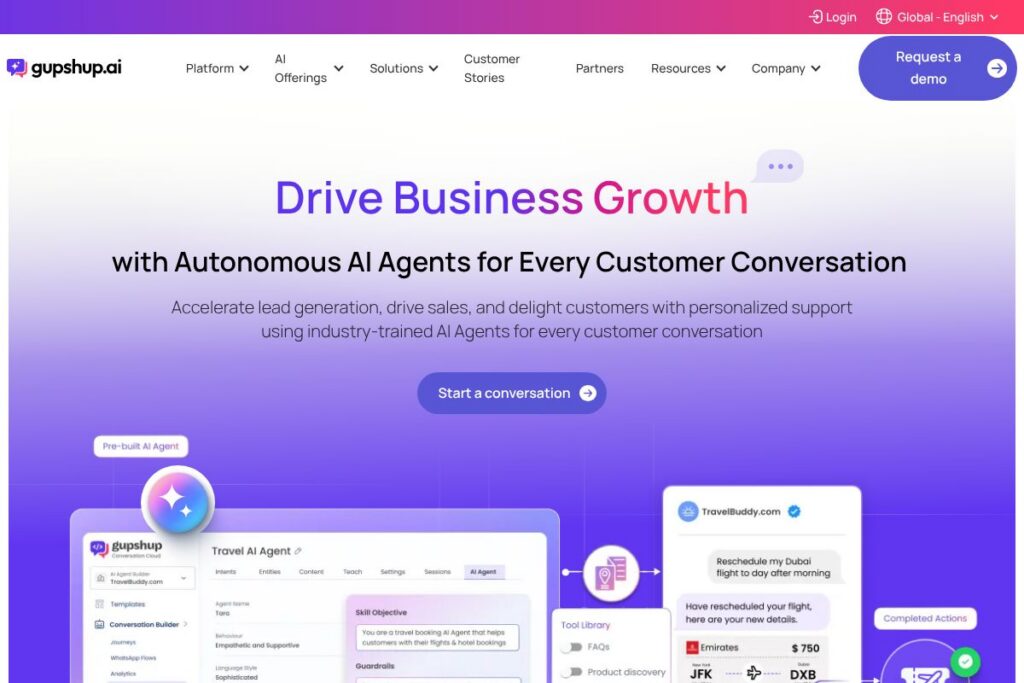
Gupshup is a conversational AI platform and messaging infrastructure designed to run autonomous AI Agents across multiple messaging channels. It combines a purpose-built Conversation Cloud, a fine-tuned ACE LLM, and tools for campaign orchestration, escalation to human agents, and analytics so teams can handle high-volume customer conversations with context and continuity.
Compared with Twilio, which is primarily a programmable messaging and communications API platform, Gupshup bundles industry-trained conversational models and prebuilt agent workflows that reduce the amount of custom model training and orchestration work needed. Versus Intercom, which focuses on in-app messaging and sales/support workflows, Gupshup emphasizes omnichannel reach across WhatsApp, SMS, RCS, and social messaging along with enterprise-grade message routing and escalation.
Gupshup works well for enterprises and teams that need high-volume, multichannel customer engagement, including banks, retail brands, telcos, and travel companies. Its strengths are agent automation at scale and channel coverage, making it suitable for organizations that must maintain 24/7 conversational presence and integrate with backend systems for order, billing, and support workflows.
How Gupshup Works
Gupshup routes inbound messages from supported channels into the Conversation Cloud where intent detection and signal processing happen in real time. Messages are matched to industry-trained AI Agents or to workflow rules that trigger actions, such as fetching account data, sending offers, or creating support tickets.
When a conversation requires human judgment, Gupshup provides AI-assisted escalations and a co-pilot interface that surfaces suggested replies, conversation summaries, and context from prior interactions. Campaigns and drip sequences are orchestrated by event triggers and signals, so outreach can be timed to behavior like clicks, reads, or purchase milestones.
What does Gupshup do?
Gupshup’s core capabilities center on autonomous AI Agents, omnichannel message routing, workflow orchestration, campaign automation, and agent augmentation. The platform also includes real-time intent scoring, industry-specific templates, and tools to escalate complex issues to human teams while preserving conversational context. Recent product focus emphasizes improved LLM fine-tuning, expanded channel adapters, and campaign event triggers to increase conversion and reduce support load.
The Features That Make Gupshup Shine
Autonomous AI Agents
Deploy industry-trained agents that handle routine queries, lead qualification, and simple transactions without full custom model development. These agents use intent signals to move conversations forward, reducing agent load and keeping interactions consistent across channels.
ACE LLM (Fine-tuned Model)
Gupshup’s proprietary ACE LLM is tuned for conversational tasks and domain adaptation, producing responses that match industry tone and terminology. That reduces the need for extensive prompt engineering when building vertical-specific agents.
Omnichannel Messaging
Support for channels such as WhatsApp, Instagram, SMS, RCS, and other rich messaging platforms lets teams meet customers where they already communicate. Channel adapters manage delivery, templates, and compliance differences between providers.
Conversation Cloud and Workflow Orchestration
The Conversation Cloud centralizes message routing, context storage, and event-driven actions so workflows can be executed in real time. Teams can configure triggers that call APIs, update CRM records, or start campaigns based on conversational signals.
AI Co-Pilot for Agents
The integrated co-pilot suggests replies, drafts summaries, and highlights key customer signals to speed agent response and improve consistency. Human agents can take over with full context and leverage suggested actions to resolve cases faster.
Automated Campaigns and Drip Sequences
Orchestrate multi-step campaigns that react to customer behavior such as reads, clicks, and journey progression. Sample, industry-tuned templates accelerate campaign setup and reduce the work needed to run targeted outreach.
Security, Compliance, and Enterprise Controls
Enterprise features include message encryption, role-based access controls, compliance tooling for regulated channels, and audit logs to meet governance requirements. These controls are designed to support large-scale deployments and enterprise security standards.
With these capabilities, Gupshup is focused on reducing repetitive work while preserving conversational context and channel compliance, enabling teams to scale customer conversations without losing relevance.
Gupshup pricing
Gupshup offers flexible enterprise-focused pricing rather than a one-size-fits-all public rate sheet, with options that reflect channel usage, agent volume, and required integrations. Organizations typically choose a plan based on message volumes, channels used, and SLAs for support and uptime.
For current pricing arrangements and plan options tailored to your needs, check the Gupshup pricing and plans on the official site or contact their sales team through the Gupshup Conversation Cloud pages for enterprise enquiries.
What is Gupshup used for?
Gupshup is used to automate customer-facing conversations across marketing, sales, and support functions. Typical uses include lead capture and qualification via messaging, conversational commerce for product discovery and checkout prompts, and 24/7 support for routine inquiries that would otherwise consume human agent time.
Teams also use Gupshup to run behavior-driven campaigns that trigger offers and follow-ups based on intent and journey stage, to centralize messaging workflows across channels, and to ensure consistent escalation paths to human agents for complex issues. The platform is appropriate for both high-volume transactional interactions and personalized lifecycle messaging across industries.
Pros and cons of Gupshup
Pros
- Extensive channel coverage: Gupshup supports a wide set of messaging channels, which helps businesses reach customers where they already interact without managing separate vendors.
- Industry-tuned conversational models: The ACE LLM and prebuilt agent templates reduce setup time and improve response relevance for vertical use cases.
- Enterprise orchestration and controls: The Conversation Cloud provides routing, audit logs, and compliance features suitable for regulated industries and high-volume deployments.
- Agent augmentation tools: The integrated co-pilot and escalation workflows increase human agent productivity and preserve conversational context during handoffs.
Cons
- Custom pricing model: Enterprise-oriented pricing and negotiated contracts can make it harder for small teams to estimate costs without a sales engagement.
- Implementation effort for complex integrations: Tighter coupling with backend systems and CRMs may require integration work and professional services for large deployments.
- Learning curve for advanced orchestration: Building event-driven campaigns and custom agent logic can take time for teams without prior conversational design experience.
Does Gupshup Offer a Free Trial?
Gupshup offers a developer tier for testing and trial access along with enterprise plans for production deployments. The developer tier lets teams prototype agents and test messaging flows; for production use and SLA-backed deployments, enterprise plans are available and can be discussed with sales through the Gupshup homepage.
Gupshup API and Integrations
Gupshup provides developer APIs and SDKs to send and receive messages, manage templates, and integrate conversational agents with backend systems. The Gupshup developer documentation explains endpoints, SDKs, and webhook patterns for building agents and connecting external services.
Common integrations include WhatsApp Business API, Instagram messaging, SMS gateways, CRM platforms like Salesforce, and support systems such as Zendesk, enabling conversation-driven actions across data sources and enterprise apps.
10 Gupshup alternatives
Paid alternatives to Gupshup
- Twilio — Programmable messaging and voice API platform with pay-as-you-go billing and a broad developer ecosystem for custom communication stacks.
- Intercom — Customer messaging platform focused on in-app and web chat workflows for support, sales, and product engagement with built-in automation and routing.
- MessageBird — Omnichannel cloud communications platform that provides APIs for SMS, WhatsApp, voice, and chat flows with global carrier reach.
- Zendesk — Customer support suite that includes chat and messaging channels integrated with ticketing, knowledge base, and analytics.
- Ada — A conversational AI platform optimized for automated customer support that emphasizes no-code bot building and agent handoffs.
- Salesforce Service Cloud — Enterprise customer service platform with messaging channel support, automation, and deep CRM integration for case management.
- Freshchat — Messaging software from Freshworks for customer engagement, in-app support, and campaign automation across channels.
Open source alternatives to Gupshup
- Rasa — Open source conversational AI framework for building contextual assistants with on-premise deployment and custom NLU pipelines.
- Botpress — Modular open source bot building platform with visual conversation flows and developer extensibility for custom channels.
- Chatwoot — Open source customer engagement suite that supports messaging channels, team inboxes, and automation for customer support.
- Rocket.Chat — Open source communication platform that can be extended to handle messaging and integrations for customer conversations.
- OpenDialog — Conversation design platform for building complex conversational experiences with rule-based orchestration and integrations.
Frequently asked questions about Gupshup
What is Gupshup used for?
Gupshup is used to deploy conversational AI Agents and orchestrate omnichannel customer messaging. It handles lead qualification, support automation, campaign orchestration, and escalations to human agents across channels.
Does Gupshup integrate with WhatsApp and Instagram?
Yes, Gupshup connects to WhatsApp, Instagram, SMS, RCS, and other messaging channels. Channel adapters manage templates, delivery rules, and compliance nuances for each platform.
Can Gupshup handle enterprise compliance and security?
Yes, Gupshup includes enterprise security controls such as role-based access, audit logging, and compliance tooling. These features support regulated industries and large-scale deployments.
How do I build custom AI Agents on Gupshup?
You can build agents using Gupshup’s developer APIs and industry templates. The Gupshup developer documentation provides guidance on endpoints, SDKs, and webhook integration patterns.
Is Gupshup suitable for high-volume messaging at scale?
Yes, Gupshup is designed for high-volume conversational workloads and enterprise deployments. The Conversation Cloud and channel orchestration tools are built to manage billions of messages annually and support global operations.
Final Verdict: Gupshup
Gupshup is a strong choice for organizations that need enterprise-grade conversational infrastructure and pre-tuned AI Agents across many messaging channels. It combines a purpose-built Conversation Cloud, ACE LLM tuning, and campaign orchestration to reduce manual effort while keeping conversations contextual and compliant.
Compared to Twilio, which uses a pay-as-you-go communications API model, Gupshup bundles conversational models and workflow tooling that reduce integration and training overhead for businesses focused on customer engagement. For teams evaluating cost and customization, Twilio may offer more granular billing control, while Gupshup provides more out-of-the-box conversational capabilities for enterprise use cases.
Overall, Gupshup is best for medium to large companies that require omnichannel reach, industry-aware agents, and enterprise controls for secure, automated customer interactions. For developers or small teams looking for purely raw messaging APIs, a platform like Twilio or an open source framework such as Rasa may be a better fit depending on integration and pricing needs.