What is Veradigm
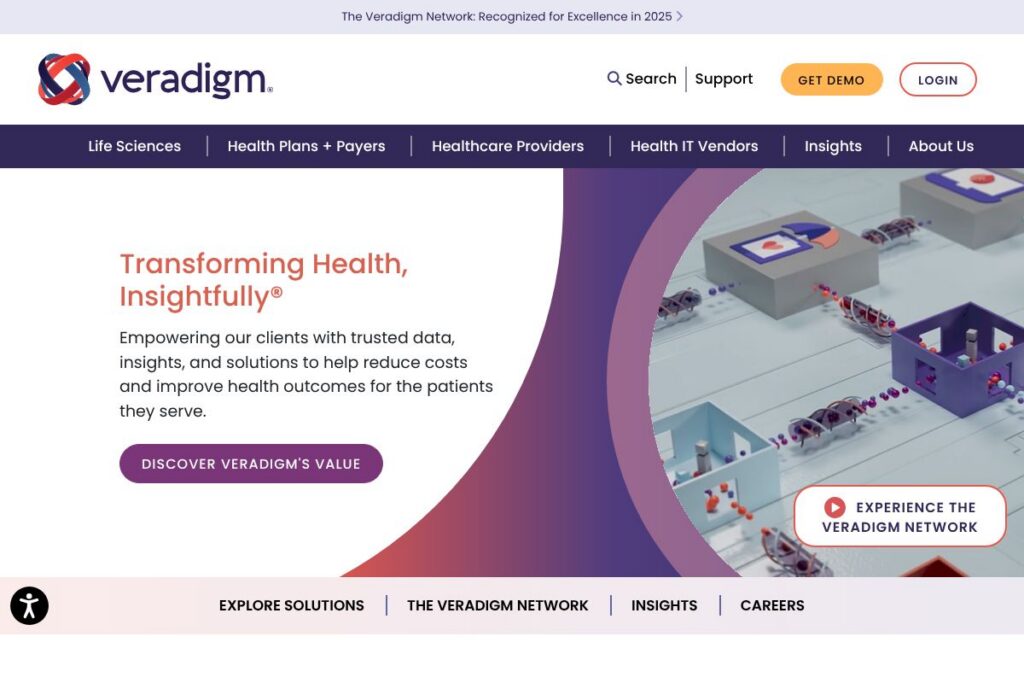
Veradigm is a healthcare technology company that delivers EHR software, practice management, and data-driven analytics to clinical providers, payers, and life-science customers. The platform emphasizes validated clinical data, interoperability, and a partner ecosystem known as the Veradigm Network that brings together third-party solutions and AI capabilities to support care, research, and operational decisions. Explore the Veradigm homepage to see core products and use cases.
Compared with competitors, Veradigm sits at the intersection of clinical systems and healthcare data services. Optum focuses heavily on claims aggregation, payer services, and population health at large scale, while IQVIA concentrates on commercial life-science data and analytics for drug development and market access. Epic is dominant in inpatient and large health system EHRs with a deep focus on clinician workflows; Veradigm distinguishes itself by combining practice-level EHR and management systems with a dataset and marketplace approach that supports research and payer analytics.
All of this makes Veradigm well suited for organizations that need integrated clinical data and analytics without building an internal data pipeline from scratch. It is particularly useful for ambulatory practices, health plans seeking clinical insight tied to outcomes, and life-science teams pursuing real-world evidence and cohort discovery through a connected network of data partners.
How Veradigm Works
Veradigm aggregates clinical and operational data from its EHR and practice management products and from partner sources, then normalizes and enriches that data for analytics, reporting, and downstream applications. Data flows into a centralized platform where tools perform de-identification, mapping to standards such as FHIR, and cohort extraction for research and quality programs.
Teams typically deploy Veradigm by connecting their practice EHR or by licensing access to curated de-identified datasets. Operational workflows include real-time clinical decision support, revenue cycle analytics, and population health reporting, while life-science users leverage patient cohorts and longitudinal data for study design and post-market surveillance. The Veradigm Network extends these workflows by providing partner apps and AI tools that plug into the platform.
Veradigm features
Veradigm combines software products, data services, and a partner ecosystem into a single platform. Core capabilities include ambulatory EHR and practice management, real-world data and analytics, interoperability and APIs, patient engagement tools, and revenue cycle services. Recent emphasis has been on expanding the Veradigm Network and adding analytics that support life-science research and payer analytics.
Key functionality includes:
Ambulatory EHR and practice management
Veradigm’s EHR and practice management modules support scheduling, documentation, billing, and patient workflows for outpatient practices. These systems are designed to reduce administrative friction for smaller practices while providing data that feeds analytics and reporting across the platform.
Real-world data and analytics
The platform provides curated, longitudinal clinical datasets for cohort discovery, outcomes analysis, and quality measurement. These datasets are designed for researchers and commercial teams that need patient-level trends and aggregated metrics for studies and product planning.
Veradigm Network and partner ecosystem
The Veradigm Network connects third-party solutions, analytics partners, and AI tools to the core platform, enabling customers to extend functionality without heavy custom integration. This marketplace-style model helps organizations pick best-of-breed solutions for specific workflows like telehealth, risk stratification, and clinical trial recruitment.
Interoperability and FHIR-based APIs
Veradigm supports standards-based exchange, enabling data sharing with other EHRs, payer systems, and analytics platforms. API access and FHIR mappings facilitate integrations for population health, reporting, and custom application development; see the developer portal for technical details.
Patient engagement and outcomes tools
Patient-facing capabilities include communication workflows, secure messaging, and portals that collect patient-reported outcomes and support care management. These features feed clinical and quality analytics to help close care gaps and measure outcomes across populations.
Revenue cycle and practice performance analytics
Revenue cycle modules provide claims tracking, billing optimization, and financial reporting to improve collections and operational efficiency. Practice performance dashboards aggregate administrative and clinical KPIs to support business decisions.
AI and advanced analytics
The platform includes model-driven analytics and AI use cases for risk prediction, care gap identification, and cohort selection. These capabilities help payer and provider teams prioritize interventions and design value-based programs.
With this mix of features, the biggest benefit of Veradigm is access to validated clinical data combined with extensible tools and partner integrations that let organizations run analytics, support care delivery, and power research from a single platform.
Veradigm pricing
Veradigm uses enterprise and subscription pricing tailored to the needs of providers, payers, and life-science organizations rather than public, fixed-price plans. Pricing typically varies by product mix, deployment scope, data access levels, and support requirements.
Enterprise and subscription
Enterprise solutions: Custom pricing (EHR, practice management, data licensing, analytics)
Data services and research: Custom pricing (dataset access, de-identification, RWE projects)
For specific, up-to-date cost information and quotes, contact Veradigm directly through their contact page or review the offerings on the Veradigm solutions pages.
What is Veradigm Used For?
Veradigm is used for clinical documentation and practice administration at ambulatory clinics, for connecting clinical data to payer analytics, and for supporting life-science research with real-world evidence. Provider organizations use the platform to streamline scheduling, documentation, billing, and quality reporting while capturing data for downstream analytics.
Payers use Veradigm’s datasets and analytics to enhance care management, risk adjustment, and utilization review by combining clinical signals with claims-based information. Life-science teams use cohort discovery and longitudinal clinical data to run studies, support product launch planning, and monitor post-market safety.
Pros and Cons of Veradigm
Pros
- Integrated clinical and data platform: Veradigm combines ambulatory EHR, practice management, and curated datasets in one ecosystem, simplifying data access and analytics for providers and researchers.
- Strong real-world evidence capabilities: The platform offers longitudinal clinical datasets useful for cohort discovery and outcomes research, which benefits life-science teams and payer analytics.
- Partner ecosystem access: The Veradigm Network provides a marketplace of third-party apps and AI tools that extend core functionality without heavy custom development.
- Standards-based interoperability: FHIR APIs and connectivity options make it feasible to exchange data with other systems and integrate with analytics tools.
Cons
- Enterprise focus with custom pricing: Organizations seeking straightforward, per-user SaaS pricing may find Veradigm’s enterprise-structured commercial model less transparent and in need of sales engagement for quotes.
- Primarily ambulatory and data-centric: Large inpatient health systems that rely on Epic or Cerner for inpatient workflows may need additional integration work to combine inpatient and ambulatory data.
- Implementation and integration effort: As with many enterprise platforms, successful deployment requires planning for data mapping, workflow changes, and training to realize analytical value.
Does Veradigm Offer a Free Trial?
Veradigm offers paid, enterprise solutions with custom pricing and does not publish a public free plan. Prospective customers can request demos, pilots, or proof-of-concept engagements that provide scoped access to product functionality and datasets; contact Veradigm sales through the contact page to arrange a demo or pilot.
Veradigm API and Integrations
Veradigm provides developer APIs and supports standards such as FHIR to enable integrations with external systems and analytics tools. The developer portal contains technical documentation, endpoints, and guidance for common integration scenarios.
Key integrations include connectivity with major EHRs and analytics platforms, and common partners cover Epic, Cerner, Athenahealth, Snowflake, Tableau, Google Cloud, and AWS for data warehousing and BI workflows. Integration options range from direct API connections to packaged adapters provided through the Veradigm Network.
10 Veradigm alternatives
Paid alternatives to Veradigm
- Optum — Offers broad claims, clinical, and population health solutions with deep payer and provider analytics, strong at large-scale data aggregation.
- IQVIA — Focused on life-science data, real-world evidence, and commercial analytics for clinical development and market access.
- Epic — Large health system EHR with extensive inpatient and outpatient capabilities and integrated analytics for clinical operations.
- Cerner (Oracle Cerner) — Enterprise EHR platform with hospital and ambulatory modules and strong interoperability tools.
- Health Catalyst — Analytics and data platform that centralizes clinical and operational data to support quality improvement and cost reduction.
Open source alternatives to Veradigm
- OpenEMR — Open-source electronic medical record and practice management system suitable for clinics that want a self-hosted solution.
- OpenMRS — A modular, community-driven medical record system often used in research and low-resource settings for longitudinal clinical data collection.
- HAPI FHIR — An open-source FHIR server and toolkit for teams that want to build standards-based clinical data integrations and APIs.
Frequently asked questions about Veradigm
What is Veradigm used for?
Veradigm is used for EHR and practice management, data analytics, and real-world evidence. It supports ambulatory workflows, payer analytics, and life-science research through curated clinical datasets and connected partner tools.
Does Veradigm integrate with Epic or Cerner?
Yes, Veradigm supports standards-based integrations and custom connections. The platform uses FHIR and other interoperability approaches to exchange data with major EHR systems like Epic and Cerner, often via APIs or middleware.
How much does Veradigm cost?
Veradigm uses enterprise and subscription pricing tailored to customer needs. Pricing depends on selected products, data access levels, deployment scope, and service agreements; contact Veradigm sales for a quote via the contact page.
Does Veradigm offer an API for developers?
Yes, Veradigm provides developer APIs and documentation. Developers can consult the developer portal for API endpoints, authentication details, and integration guides.
Can Veradigm be used for real-world evidence and clinical research?
Yes, Veradigm provides longitudinal clinical datasets and cohort discovery tools for RWE. Life-science teams and researchers use these datasets for study design, observational research, and post-market surveillance.
Final Verdict: Veradigm
Veradigm is a pragmatic choice for organizations that need validated clinical data combined with practice-level EHR capabilities and extensible analytics. Its strength lies in bringing curated, longitudinal clinical datasets together with practice workflows and a partner marketplace that accelerates analytics, research, and operational improvements.
Compared with a competitor like Optum, both platforms rely on enterprise pricing and custom engagement, but they emphasize different data domains: Optum is oriented toward claims and payer-scale analytics, while Veradigm emphasizes EHR-derived clinical datasets and a partner network for life-science and ambulatory-focused use cases. For provider groups, payers, or life-science teams seeking clinical data tied closely to ambulatory workflows and an extensible ecosystem, Veradigm is a strong option; for organizations prioritizing claims aggregation at the national level, Optum may be the better fit.