What is FeatureOS
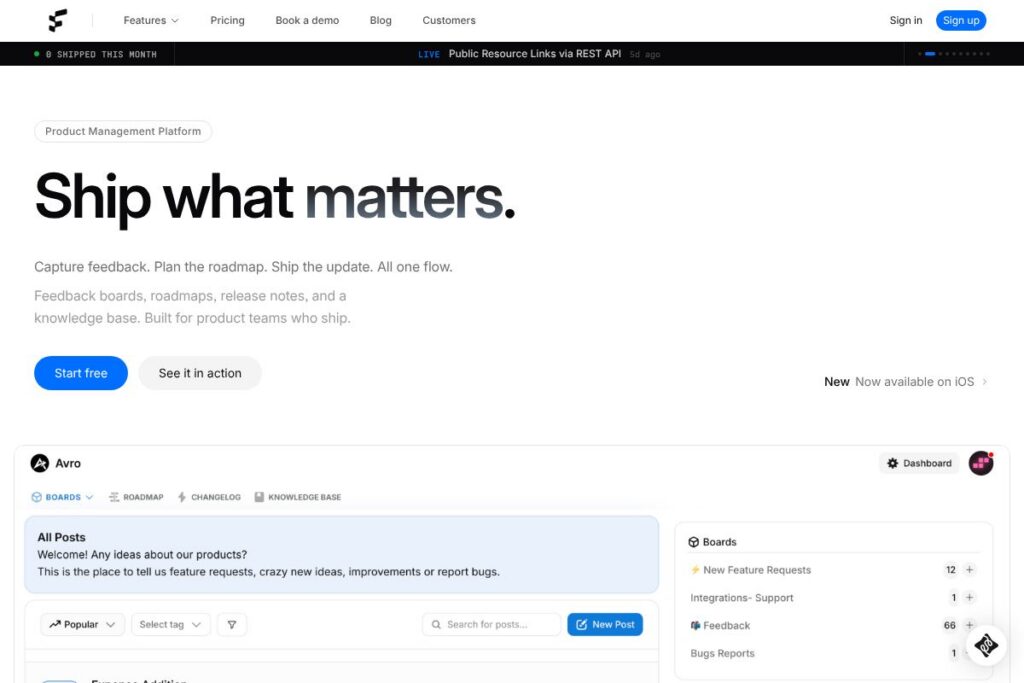
FeatureOS is a customer feedback and product management platform built to centralize user input and convert it into prioritized work on a shared roadmap. It combines feedback boards, drag-and-drop roadmaps, release notes, embeddable widgets, and a multilingual help center so product teams stop juggling Slack, spreadsheets, and issue trackers.
FeatureOS competes directly with purpose-built product feedback tools such as Productboard, Canny, and Aha!. Compared with Canny, FeatureOS places a stronger emphasis on integrated documentation and release communication. Against Productboard, FeatureOS focuses on unified feedback collection and lightweight roadmapping rather than deep discovery research. Versus Aha!, FeatureOS aims for a simpler, feedback-driven workflow suitable for smaller teams while still scaling to enterprise needs.
All of this makes FeatureOS especially useful for product teams that want a single, traceable flow from customer signal to shipped release. It is most appropriate for product-led companies, customer success teams capturing feature requests, and engineering teams that want fewer context switches when turning feedback into work.
How FeatureOS Works
FeatureOS captures feedback from many places into one system, then converts those inputs into actionable posts that product teams can prioritize and place on a roadmap. Inputs can be collected from embeddable widgets, in-app messages, email, and integrations with tools like Slack and Intercom, and AI helps deduplicate and surface trends.
Once feedback is captured, teams tag and prioritize requests, drag items onto a visual roadmap, and publish release notes or changelogs when work lands. The platform provides closed-loop communications, so users see status updates, planned improvements, and the changelog without needing to hunt through multiple systems.
Implementation typically starts with embedding a feedback widget or importing existing data from other systems, connecting key integrations, and configuring product areas, tags, and permissioning. From there, product managers can run prioritization sessions, share a public or private roadmap, and use the built-in knowledge base to reduce support volume.
FeatureOS features
FeatureOS groups feedback collection, product planning, documentation, and release communication into one product lifecycle platform. Core capabilities include omnichannel feedback boards, drag-and-drop roadmaps, release notes and changelogs, an embeddable knowledge base, and AI-assisted categorization and writing.
Feedback Boards
Feedback boards centralize user suggestions into a searchable, voteable list that product teams can triage. Boards can be embedded in web apps or linked from product pages so users contribute without leaving the product, and administrators can tag, merge, and prioritize requests.
Roadmaps
Roadmaps are visual and fully shareable, with drag-and-drop reordering, custom lanes, and the ability to switch between timeline and list views. Roadmaps serve as the single source of truth for priorities and can be made public or restricted to internal stakeholders.
Release Notes and Changelogs
Built-in release notes let teams publish changelogs and link releases back to the items on the roadmap, closing the feedback loop with users. The release flow supports segmented visibility so some updates remain internal while others are published publicly.
Knowledge Base
The knowledge base provides self-serve documentation with Google-like search, collections, and multilingual support, reducing support tickets and helping users discover features and fixes. It includes custom branding and can live on a custom domain, matching product aesthetics.
AI Copilot and Pattern Recognition
AI features automatically detect duplicates, categorize feedback by product area and sentiment, and surface trends across channels to reduce manual triage. AI also assists with drafting release notes and help articles using product context.
Integrations and API
FeatureOS connects with common tools used by product teams such as Slack, Jira, Linear, Intercom, and Salesforce, allowing feedback to flow into existing workflows. The platform also exposes developer APIs and webhooks for custom automation and deeper system integration.
Embeddable Widgets
Embeddable widgets allow feedback boards, roadmaps, and changelogs to be placed directly inside your product or website with a few lines of code. Widgets are customizable to match branding and can collect structured responses via forms.
Forms & Surveys
Structured forms with conditional logic and custom fields let teams capture targeted feedback and run surveys without external tools. Responses can be auto-summarized by AI and converted into feedback posts for prioritization.
Customization & Branding
FeatureOS supports custom domains, white-labeling for boards and changelogs, and fine-grained control over public versus internal content. Teams can match the product experience to their brand and control the narrative around releases.
With these capabilities, the biggest benefit is a single, traceable workflow from user signal to shipped outcome that reduces context switching and improves stakeholder visibility across the product lifecycle.
FeatureOS pricing
FeatureOS offers flexible pricing tailored to different team sizes and deployment needs, with options that scale from single-product teams to enterprise accounts. For the most accurate and up-to-date plan details, view the current pricing options on FeatureOS homepage or contact their sales team for an enterprise quote.
What is FeatureOS Used For?
FeatureOS is used to centralize customer feedback, convert raw responses into prioritized product work, and communicate releases back to users. Product managers use it to run planning sessions, surface high-impact requests, and publish roadmaps that stakeholders can follow.
Support and customer success teams use the platform to reduce ticket volume by publishing help center articles and linking support threads to roadmap items. Engineering teams benefit from clearer requirements and fewer lost requests because everything is tracked within the same system.
Pros and Cons of FeatureOS
Pros
- Unified feedback to roadmap flow: Centralizes inputs from widgets, email, and integrations so product decisions are traceable from request to release. This reduces spreadsheet dependency and keeps stakeholder conversations in one place.
- AI-assisted triage and writing: Automates duplicate detection, categorization, and draft generation for release notes and help articles, saving time on routine tasks. AI features speed up triage and help maintain consistent messaging.
- Built-in communication tools: Release notes, changelogs, and an embeddable knowledge base close the feedback loop and improve adoption when features ship. Segmenting visibility helps control what is public versus internal.
- Scalable and brandable: Custom domains, white-labeling, and multilingual support make it suitable for teams of one or thousands while preserving brand consistency.
Cons
- Enterprise-focused features may add complexity: Advanced customization, integrations, and migration options add setup steps that smaller teams may not need immediately. New users should plan for an onboarding session to configure the workflow.
- Less emphasis on deep discovery research: Teams that need advanced qualitative research and discovery tools may find some limitations compared with platforms purpose-built for discovery and customer insights.
Does FeatureOS Offer a Free Trial?
FeatureOS offers a free tier and allows you to start without providing a credit card. The free access is designed to let teams collect feedback, embed widgets, and evaluate core features; enterprise onboarding and migration support are available with paid plans.
FeatureOS API and Integrations
FeatureOS provides APIs and webhooks for programmatic access and automation, enabling teams to sync items with internal systems and to push updates back into other tools. See the API documentation for endpoint details and example usage.
The platform includes native integrations with a range of tools including Slack, Jira, Linear, Intercom, and Salesforce, and maintains an integrations list for additional connectors and automation options. Explore the FeatureOS integrations list to see supported connections and setup instructions.
10 FeatureOS alternatives
Paid alternatives to FeatureOS
- Productboard – Centralizes customer insights into prioritized roadmaps with discovery features and deep product analytics.
- Canny – Feedback boards and voting that are simple to set up and focused on user-facing feedback collection and internal triage.
- Aha! – Comprehensive product management suite with strategy, release management, and detailed roadmapping for large product organizations.
- airfocus – Prioritization and roadmap tool that emphasizes weighted scoring and collaboration across product teams.
- Roadmunk – Visual roadmapping platform with multiple roadmap views and stakeholder-sharing capabilities.
- Pendo – Product analytics and in-app guidance platform that also collects qualitative feedback and drives feature adoption.
Open source alternatives to FeatureOS
- Fider – Open source feedback board that allows self-hosted suggestion voting and basic tagging for smaller teams.
- OpenProject – Project management platform with issue tracking and public project boards that can be adapted for feedback workflows.
- Discourse – Open source community forum that teams use to collect feedback, enable voting, and build public roadmaps with extensions.
Frequently asked questions about FeatureOS
What types of teams use FeatureOS?
FeatureOS is used by product teams, customer success, and support organizations that need a unified feedback-to-release workflow. It scales from single-product startups to enterprise product organizations.
Does FeatureOS integrate with Jira and Slack?
Yes, FeatureOS integrates with Jira and Slack. Integrations allow feedback to be pushed into issue trackers and notifications or commands to be used inside Slack channels.
Can FeatureOS host a knowledge base on a custom domain?
Yes, FeatureOS supports custom domains for changelogs, feedback boards, and help centers. This enables full branding control and consistent user experience across product properties.
Does FeatureOS support multiple languages?
Yes, FeatureOS includes multilingual support across the platform. The product supports 21+ languages out of the box for help center content and interface localization.
Is there API access for automating workflows in FeatureOS?
Yes, FeatureOS provides an API and webhooks for automation. Developers can connect feedback items to internal systems and automate status updates between tools.
Final Verdict: FeatureOS
FeatureOS is a practical choice for teams that want a single platform to collect customer feedback, prioritize features, and communicate releases without stitching together multiple tools. Its combined feedback boards, roadmapping, release notes, and knowledge base remove common handoffs and reduce lost context during product planning.
Compared with Productboard, FeatureOS places more emphasis on a unified feedback loop and built-in release communication, while Productboard focuses on robust discovery and insight workflows. For pricing, FeatureOS offers flexible tiers and enterprise options that scale with usage; check the current pricing options on FeatureOS homepage to compare plans and confirm which model fits your team.
Overall, FeatureOS is best for product-led teams that need a traceable, closed-loop system from user voice to shipped work, and for organizations that value integrated documentation and release communication alongside prioritization tools.