Khoros: An Overview
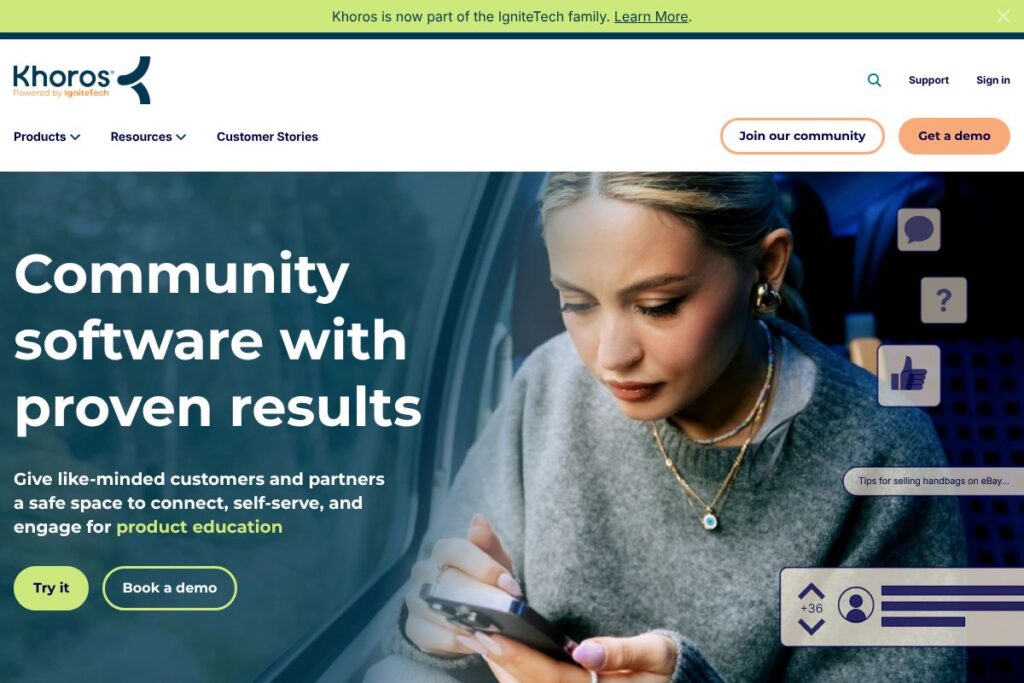
Khoros is a customer engagement platform that combines community forums, digital service automation, and social media management into a single product set for enterprises. Organizations use Khoros to host branded community sites, reduce support costs through self-service, and coordinate social campaigns across global teams.
Khoros is often compared with large CX and community platforms such as Salesforce Experience Cloud, Zendesk, and Discourse. Compared with Salesforce Experience Cloud, Khoros bundles purpose-built community capabilities with social and service workflows rather than treating community as an add-on to CRM. Against Zendesk, Khoros places more emphasis on peer-to-peer community and large-scale moderation. Versus open source platforms like Discourse, Khoros offers enterprise governance, built-in analytics, and vendor support at the cost of vendor-managed deployment.
All of this makes Khoros well suited to large brands and enterprises that need a supported, scalable solution for customer engagement, community-led support, and coordinated social operations. It is especially appropriate for teams that expect high traffic, require compliance controls, and want vendor guidance on community strategy and moderation.
How Khoros Works
Khoros provides separate but integrated modules for Communities, Service, and Social Media Management that share a single identity and analytics layer. The Communities module hosts discussion forums, Q&A, knowledge bases, and member profiles while moderation tools control content quality and trust and safety workflows.
Khoros Service connects community contributions with agent workflows and automation, routing cross-channel inquiries into a unified queue and enabling bots or automation to handle common requests. The Social Media Management tools centralize publishing, listening, and campaign coordination for distributed teams. Typical implementations combine a branded community site with automation for common support flows and a social command center for campaign execution and crisis monitoring.
Khoros features
Khoros focuses on community health, digital service automation, and social operations. Core capabilities include hosted community sites, moderation and trust controls, AI-driven automation for service, unified analytics across channels, and integrations with enterprise systems. The platform has evolved toward stronger automation and analytics to help enterprises scale with fewer support headcount.
What Makes Khoros Stand Out
Hosted Community Platform
Khoros hosts fully branded community sites that include discussion boards, Q&A, idea management, and knowledge articles. These sites are optimized for search and member engagement, enabling brands to deflect support requests and surface community knowledge to new customers.
Moderation and Trust & Safety
Built-in moderation workflows, role-based access, and trust scoring help teams manage large communities while maintaining a safe environment. Moderation tools support both human reviewers and workflow automation to triage content and enforce policies at scale.
AI-Powered Service Automation
The Service module includes automation for common support tasks, chatbots, and agent assist features that surface suggested responses and relevant community content. Automation reduces repetitive work for agents and speeds resolution for common inquiries.
Social Media Management
Khoros consolidates publishing, listening, and performance tracking for global social accounts into a single interface. Teams can schedule cross-channel campaigns, monitor brand mentions, and measure campaign impact using unified reporting.
Analytics and Reporting
Centralized analytics combine community behavior, service metrics, and social performance into dashboards and reports. These analytics enable teams to measure deflection, engagement, revenue impact, and member lifetime value.
Integrations and APIs
Khoros provides APIs and prebuilt integrations to connect with CRM, single sign-on, reporting, and third-party moderation tools. Integration points let enterprises synchronize user identities, ticketing systems, and analytics platforms for a cohesive CX stack.
With these capabilities Khoros helps enterprises reduce support costs through self-service, improve response consistency with automation, and measure the business impact of community and social programs.
Khoros pricing
Khoros uses a custom enterprise pricing model tailored to organization size, deployment needs, and required modules. Pricing typically depends on traffic volumes, number of agent seats, integration requirements, and service levels, rather than fixed per-user tiers.
For specific quotes and plan options contact Khoros for tailored estimates or request a demonstration of the platform. See the Khoros platform pages for details on each solution and to initiate a sales conversation via the Khoros Communities platform page or the contact sales form.
What is Khoros Used For?
Enterprises use Khoros to host customer and partner communities that enable peer-to-peer support, product feedback, and member engagement. Those communities are typically used to deflect support volume, capture product suggestions, and surface user-generated content for marketing and product development.
Khoros is also used to centralize digital service and social operations. Support teams use the Service module to automate common inquiries and route complex issues to agents. Marketing and social teams use the Social module to coordinate campaigns and monitor brand health at scale.
Pros and Cons of Khoros
Pros
- Enterprise-grade moderation and governance: Comprehensive moderation workflows, role management, and compliance controls make it suitable for large, regulated brands.
- Integrated community and service: Combining community, service automation, and social management reduces silos and helps teams share knowledge across channels.
- Scalable performance for high traffic: The platform is built to handle high-volume community sites and large social programs without significant performance degradation.
- Strong analytics for business impact: Unified dashboards help quantify deflection, engagement, and revenue outcomes tied to community activity.
Cons
- Custom pricing and procurement: Enterprise pricing and procurement processes can be lengthy, which may not suit small teams or fast pilots.
- Vendor-managed model: Brands that require full control over code and hosting may prefer open source options for self-hosting and customization.
- Implementation resource needs: Large deployments often require professional services for configuration, migration, and moderation strategy, adding to total cost of ownership.
Does Khoros Offer a Free Trial?
Khoros provides demos and custom pilot opportunities rather than a public free plan. Prospective customers can request a demo or pilot through the Khoros contact channels to evaluate features, traffic handling, and integration approaches before committing to a purchase.
Khoros API and Integrations
Khoros offers developer APIs and a set of prebuilt integrations for common enterprise systems. The Khoros developer documentation describes available endpoints, authentication, and examples for syncing users, content, and metrics.
Common integrations include CRM systems, single sign-on providers, analytics platforms, and ticketing systems. Teams frequently connect Khoros with systems such as Salesforce, Zendesk, and enterprise analytics tools to centralize customer data and reporting.
10 Khoros alternatives
Paid alternatives to Khoros
- Salesforce Experience Cloud – A CRM-integrated community solution that works well for organizations already on the Salesforce platform, with deep CRM ties and lifecycle data.
- Zendesk – Customer support platform with community and help center features that integrate closely with ticketing and agent workflows.
- Sprinklr – Large-scale social engagement and CX platform aimed at enterprises with extensive social listening and workflow needs.
- Higher Logic – Community and engagement platform focused on member organizations, associations, and B2B communities.
- Influitive – Advocate and engagement platform that focuses on customer advocacy programs and referral-driven growth.
- Sprout Social – Social media management for publishing, listening, and reporting, with a user-friendly interface for marketing teams.
- Hootsuite – Social media scheduling and monitoring with integrations for team workflows and analytics.
Open source alternatives to Khoros
- Discourse – Modern open source forum software with features for trust levels, moderation, and integrations; suitable for teams that want self-hosted control.
- Flarum – Lightweight, extensible forum platform designed for performance and simplicity, suitable for smaller communities and developers.
- NodeBB – Real-time forum platform built on Node.js with plugin-driven architecture for customization.
- phpBB – Long-established open source forum software with a large ecosystem of plugins and extensions.
Frequently asked questions about Khoros
What is Khoros used for?
Khoros is used to build and manage enterprise customer communities, automate digital service, and coordinate social media operations. Organizations deploy Khoros to increase self-service, improve support efficiency, and run centralized social campaigns.
Does Khoros have an API?
Yes, Khoros provides developer APIs for integrating content, users, and metrics. The Khoros developer documentation outlines endpoints, authentication, and integration patterns.
How much does Khoros cost?
Khoros uses custom enterprise pricing based on deployment scope and needs. For a tailored quote or to explore licensing options, contact Khoros through the contact sales form or request a demo on the product pages.
Can Khoros replace a contact center?
Khoros can supplement and automate many customer service functions but is typically used alongside contact center platforms. Its Service module handles automation and routing, while complex voice-based contact center needs may still require a dedicated telephony platform integrated with Khoros.
Is Khoros suitable for small businesses?
Khoros is primarily targeted at mid-market and enterprise customers with substantial traffic and governance requirements. Small businesses may find lighter weight or open source community platforms more cost effective for initial pilots.
Final Verdict: Khoros
Khoros excels at delivering a bundled solution for community, service automation, and social media management that is engineered for enterprise scale and governance. Its strengths lie in moderation and trust tools, unified analytics, and the ability to reduce support volume through managed self-service communities.
Compared with Salesforce Experience Cloud, Khoros typically offers deeper, vendor-supported community features combined with purpose-built social and service modules, while Salesforce can be more attractive for organizations that prefer a CRM-native community tightly integrated with their existing Salesforce licenses. Because Khoros uses custom enterprise pricing, organizations should evaluate both platforms through demos or pilots to compare total cost of ownership and which feature set matches their operating model best.