Kore.ai: An Overview
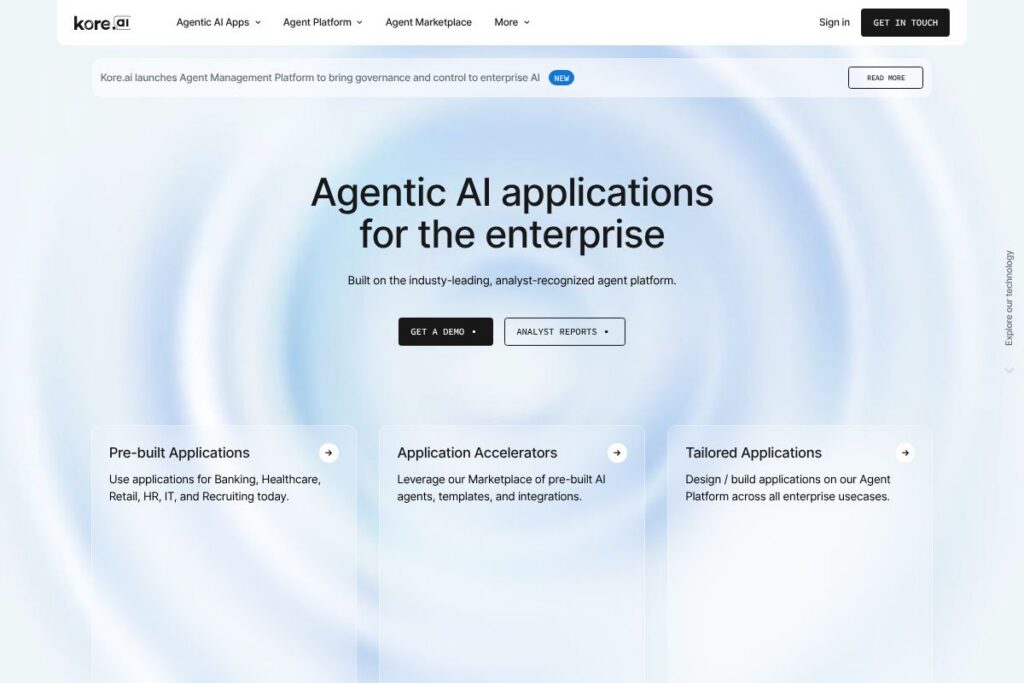
Kore.ai provides an enterprise-grade agent platform and a catalog of agentic AI applications designed to deliver conversational support, automated workflows, and task orchestration across customer service, HR, IT, and other business functions. The platform pairs multi-agent orchestration with a search and data layer, pre-built connectors, and governance controls so enterprises can deploy AI agents that operate with context and regulatory compliance.
Compared with Google Cloud Dialogflow, Kore.ai emphasizes multi-agent collaboration and enterprise observability rather than single-agent conversational flows. Against Microsoft Power Virtual Agents, Kore.ai focuses more on agent orchestration, enterprise search, and integration into contact center ecosystems. Compared to Amazon Connect and Amazon Lex, Kore.ai packages pre-built industry use cases, compliance tooling, and no-code plus pro-code design tools aimed at large regulated organizations.
All of this makes Kore.ai particularly well suited for large enterprises in banking, healthcare, telecommunications, retail, and B2B services that need governed AI behavior, deep integrations with legacy systems, and measurable ROI from automation. The platform is built to help customer service, employee productivity, and process automation teams deliver production-grade agentic AI applications at scale.
How Kore.ai Works
Kore.ai builds agentic applications by combining no-code agent designers, pro-code extensions, and a model-hub layer that lets teams choose or bring their own AI models. Agents are composed of dialog components, tools, and connectors, then orchestrated so multiple agents can collaborate, share memory, and escalate or hand off to humans when necessary.
In a typical deployment, teams connect Kore.ai to enterprise systems like Salesforce, SAP, or Epic for structured data, and to SharePoint, Slack, or Google Drive for unstructured content. The platform uses agentic retrieval-augmented generation to keep agents context-aware and accurate, while tracing, audit logs, and analytics provide observability for tuning and compliance.
Workflows often start with a pre-built agent from the Kore.ai Marketplace, then teams customize prompts, attach connectors, and configure governance rules. Agents can run across channels including web chat, voice, social messaging, and contact center integrations so the same agentic logic supports both self-service and human-assisted interactions.
Kore.ai features
Kore.ai groups capabilities needed to build governed, enterprise-grade agentic AI applications, including agent orchestration, a search and data layer with RAG support, no-code and pro-code development tools, and comprehensive governance and observability features. The platform also provides pre-built industry accelerators in the Kore.ai Marketplace to shorten deployment timelines.
Multi-Agent Orchestration
Multi-agent orchestration lets several AI agents interact, share session memory, and coordinate to resolve requests that require multiple domain skills or sequential decision steps. This reduces handoffs, ensures consistent context across sub-tasks, and supports complex automation such as claims processing or loan origination.
Search + Data AI
The search and data AI layer enables agentic RAG workflows and fast retrieval from both structured systems and unstructured content, with more than 100 connectors pre-built for common enterprise sources. That capability improves response accuracy, reduces hallucination risk, and allows agents to reference documents, knowledge bases, and past interactions.
No-Code + Pro-Code Tools
Designers can assemble agents and conversational flows using visual, no-code tools while developers use pro-code extensions and SDKs to create custom logic and integrations. This hybrid approach accelerates delivery for business users while preserving developer control for complex integrations and custom behavior.
Control + Observability
Built-in tracing, real-time analytics, event monitoring, and detailed audit logs provide visibility into agent decisions, performance, and usage patterns. Those tools help operations and risk teams detect regressions, tune agents, and produce compliance evidence during audits.
AI Security + Governance
Policy engines, access controls, and compliance tooling allow administrators to enforce data handling rules, guardrails, and ethical constraints across agents and channels. Governance features are designed to meet regulatory needs in industries such as finance and healthcare.
AI Engineering Tools
Model Hub, Prompt Studio, and Evaluation Studio support model selection, prompt optimization, and continuous performance testing to iterate on agent behavior quickly. These tools let teams compare commercial and open models, refine prompts for accuracy and tone, and measure performance in real time.
Marketplace and Pre-built Agents
The Kore.ai Marketplace provides hundreds of pre-built agents, templates, and accelerators for common industry scenarios, which reduces implementation time and provides tested starting points for customization. Marketplace assets cover domains such as banking, healthcare, HR, IT support, and retail.
Connectors and Channel Support
Pre-built connectors simplify access to CRMs, ERP systems, knowledge stores, contact center platforms, and collaboration tools, while channel adapters enable deployment across chat, voice, social, and email. These integrations let agents act on transactions and update systems directly from conversations.
With these capabilities, Kore.ai emphasizes delivering governed, production-ready agentic AI that integrates into existing enterprise stacks and supports measurable business outcomes.
Kore.ai pricing
Kore.ai uses a flexible enterprise pricing model tailored to deployment scale, integration complexity, and required governance or support levels; public list prices are not published. Organizations typically engage with Kore.ai sales for custom quotes that reflect seat counts, connector usage, contact center integrations, and service-level needs.
For specific pricing options, enterprise contracts, and marketplace licensing, check Kore.ai’s enterprise solutions and contact options or request a tailored quote via their sales channels.
What is Kore.ai Used For?
Kore.ai is used to build conversational AI applications that handle customer service queries, automate back-office processes, and assist employees across functions such as IT, HR, and recruiting. Agents can run 24/7 to resolve routine requests, and they can escalate to human agents with shared context for complex cases.
Typical deployments include virtual assistants for banking customers with compliance controls, HIPAA-ready patient engagement bots for healthcare, retail assistants that support transactions and order tracking, and IT service bots that reduce ticket volume. The platform targets enterprise teams that need governed automation, deep integrations, and observability at scale.
Pros and Cons of Kore.ai
Pros
- Enterprise governance and compliance: Kore.ai provides policy enforcement, audit logs, and controls suitable for regulated industries, helping meet internal and external requirements.
- Multi-agent orchestration: The ability for agents to collaborate and share memory handles complex workflows that single-agent systems struggle with, improving first-contact resolution rates.
- Marketplace accelerators: Hundreds of pre-built agents and templates reduce implementation time and provide industry-specific starting points for common use cases.
- Hybrid development model: No-code tools let business teams prototype quickly while pro-code extensions and SDKs give engineers the flexibility to implement custom integrations and logic.
- Rich integrations: Pre-built connectors for CRMs, contact centers, and content sources enable agents to act on enterprise data and complete transactions from conversations.
Cons
- Enterprise orientation: The platform is optimized for large organizations, which can make onboarding and licensing less accessible for very small teams or simple use cases. This means smaller teams may face more complex setup and governance requirements.
- Custom implementation effort: Deep integrations and regulatory configurations require professional services or dedicated engineering resources to reach production-grade deployments, which can extend timelines.
- No public pricing transparency: Pricing is tailored and not listed publicly, so procurement cycles typically involve sales engagement and custom proposals.
Does Kore.ai Offer a Free Trial?
Kore.ai offers enterprise trials and proof-of-concept engagements. Prospective customers can request evaluation access, proofs of concept, or demos that include platform features, agent templates, and connectors by contacting Kore.ai or starting through the Kore.ai Marketplace and sales channels.
Kore.ai API and Integrations
Kore.ai provides developer APIs, SDKs, and webhook hooks to extend agent behavior, integrate with enterprise systems, and automate workflows; developer resources and integration guides are available through the Kore.ai developer portal. Key integrations include Salesforce, SAP, Epic, SharePoint, Slack, Confluence, Google Drive, NICE, Genesys, and contact center adapters for Amazon Connect and Microsoft Teams.
Pre-built connectors and channel adapters simplify common integration tasks, while API hooks and SDKs enable custom adapters and enterprise workflows. For developer documentation and API reference, see the Kore.ai developer resources.
10 Kore.ai alternatives
Paid alternatives to Kore.ai
- IBM Watson Assistant — Conversational AI with strong enterprise tooling and integrations into IBM Cloud services, suitable for large organizations requiring hybrid deployments.
- Google Cloud Dialogflow — A developer-focused conversational platform that integrates with Google Cloud services and supports NLU and fulfillment for custom bots.
- Microsoft Power Virtual Agents — Part of the Microsoft Power Platform, useful for organizations invested in Microsoft 365 and Azure with low-code authoring and Teams integration.
- Amazon Lex / Amazon Connect — AWS-native conversational and contact center services that work well for organizations already building on Amazon Web Services.
- Salesforce Einstein Bots — Conversational capabilities embedded in the Salesforce ecosystem, optimized for CRM-driven workflows and service cloud automation.
- LivePerson — Customer engagement platform with conversational AI, messaging-first experiences, and analytics for large customer service operations.
- Ada — Customer service automation focused on no-code experiences and live agent handoffs for digital support channels.
Open source alternatives to Kore.ai
- Rasa — Open source conversational AI framework for building contextual chatbots with on-premise deployment and developer control over models and data.
- Botpress — Open source conversational platform offering a visual flow builder and modular architecture for self-hosted deployments.
- OpenDialog — A conversational application framework focused on complex dialog and layered conversational design, available for self-hosting.
Frequently asked questions about Kore.ai
What is Kore.ai used for?
Kore.ai builds agentic AI applications for customer service, employee support, and process automation. Enterprises use the platform to deploy conversational assistants, orchestrate multi-step workflows, and integrate agents with business systems.
Does Kore.ai offer APIs and SDKs?
Yes, Kore.ai provides developer APIs, SDKs, and webhook hooks. These resources let engineering teams extend agent behavior, create custom connectors, and embed agents into applications and contact centers.
Can Kore.ai meet regulatory and compliance requirements for healthcare and finance?
Yes, the platform includes governance, audit logs, and compliance controls designed for regulated industries. Kore.ai offers features and configurations to help meet requirements such as HIPAA and financial services regulations.
How does Kore.ai integrate with contact centers and CRMs?
Kore.ai integrates with major contact center platforms and CRMs using pre-built connectors and channel adapters. Supported integrations include systems like NICE, Genesys, Salesforce Service Cloud, Amazon Connect, and Microsoft Teams.
Is there a way to test Kore.ai before committing to a purchase?
Kore.ai offers proof-of-concept and trial engagements for enterprise evaluations. Organizations can request demos or POC access through Kore.ai’s Marketplace and sales channels to validate agents, connectors, and governance workflows.
Final Verdict: Kore.ai
Kore.ai is a strong option for organizations that need enterprise-grade, governed agentic AI capable of orchestrating multiple agents, accessing enterprise data, and satisfying compliance requirements. Its strengths are multi-agent orchestration, marketplace accelerators, and comprehensive observability and governance tooling that support production deployments in regulated industries.
Compared with Microsoft Power Virtual Agents, Kore.ai places more emphasis on multi-agent collaboration, enterprise search, and contact center integrations, while Microsoft may offer tighter pricing and native advantages for organizations heavily invested in Microsoft 365. For enterprises that require deep integrations, compliance controls, and pre-built industry applications, Kore.ai provides a purpose-built platform that balances no-code productivity with developer extensibility.