Labguru: An Overview
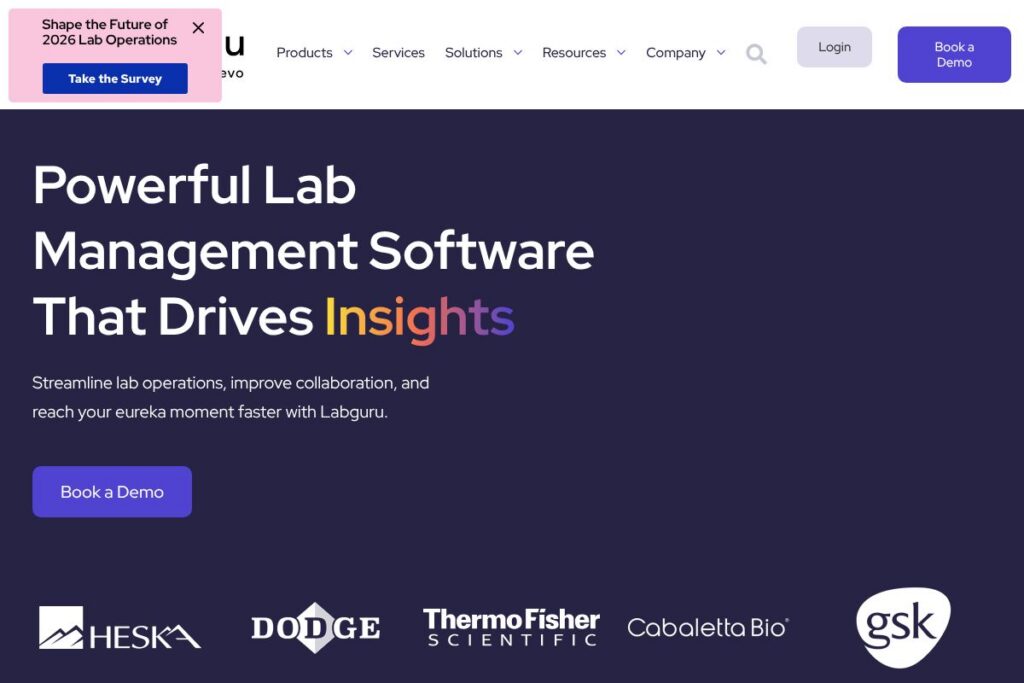
Labguru is a laboratory information management platform that brings an electronic lab notebook, LIMS, inventory, automation, and informatics together in a single cloud-hosted system. It targets academic labs, biotech companies, CROs, and R&D groups that need consistent experiment documentation, sample tracking, and reproducible workflows.
Compared with specific competitors, Labguru emphasizes an integrated ELN plus LIMS approach. Benchling focuses strongly on modern molecular biology workflows and sequence-centric features, while Quartzy prioritizes reagent ordering and inventory for smaller labs. Dotmatics targets large-scale informatics and data visualization needs. Labguru sits between these products by offering both experiment-centric documentation and operational LIMS functions in one platform.
What Labguru does especially well is provide a combined ELN, sample and inventory management, and automation tools in a validated cloud environment, making it suitable for regulated labs that require audit trails and electronic signing. This makes it a practical choice for research teams that want one system to manage daily lab activity and long-term data governance.
How Labguru Works
Labguru centralizes research activity by letting teams create projects and experiments in a digital lab notebook, link those records to samples and inventory items, and apply workflows that automate routine steps. Experiment entries can include protocols, attachments, images, and structured result fields that are searchable across projects.
Sample and inventory records are tracked with location metadata and low-stock alerts, and can be cross-referenced to experimental records to preserve data lineage. Automation rules and the Lab Scripter let teams trigger actions, update records, or standardize steps across experiments, while user permissions and signatures support regulated audit trails.
Implementation typically begins with data import of legacy notebooks and inventories, configuration of project templates and workflows, and role-based access setup. The platform supports collaborative review, version history, and project-level dashboards for visibility into ongoing work.
What does Labguru do?
Labguru combines core lab management capabilities into one platform so teams can document experiments, manage samples and inventory, automate routine processes, and keep results searchable. Recent emphasis has been on automation tooling, validated cloud hosting, and stronger informatics features to help scale R&D operations.
Let’s talk Labguru’s Features
Electronic Lab Notebook (ELN)
The ELN lets researchers plan and record experiments with structured templates, attachments, and rich text entries. It supports version history, electronic signatures for compliance, and cross-linking to samples and inventory so experimental context and materials are preserved.
Laboratory Information Management System (LIMS)
LIMS functionality covers sample tracking, storage location mapping, chain of custody, and equipment scheduling. Users can create sample hierarchies, log processing steps, and generate visual reports for certifications or audits.
Integrated Inventory Management
Inventory centralizes ordering, stock levels, and storage locations, with automated low-stock notifications and consolidated purchase histories. This reduces duplicate orders and helps labs control reagent spend and sample accessibility.
Automation and Workflows
Automation allows users to create triggers and multi-step workflows that reduce manual data entry and enforce standard operating procedures. The platform includes a Lab Scripter to add custom scripts and connect steps to external systems where required.
Data Search and Collaboration
Full-text and structured search across notebooks, samples, and inventory helps teams locate past experiments and reagents quickly. Role-based sharing, commenting, and project-level dashboards support distributed collaboration and review.
Regulatory Compliance and Validated Cloud
Labguru supports audit trails, electronic witnessing, and signing to align with FDA CFR 21 part 11 requirements. The validated cloud hosting uses SOC-compliant infrastructure, enabling regulated labs to meet data integrity and security needs.
Equipment and Maintenance Management
Equipment records, maintenance logs, and booking calendars let labs coordinate instrument use, schedule preventive maintenance, and attach calibration certificates to relevant experiments.
Analytics and Dashboards
Custom dashboards and exportable reports summarize experiment progress, inventory consumption, and workflow throughput to inform project planning and resource allocation.
With these capabilities Labguru helps labs reduce manual tasks, preserve experimental context, and maintain regulatory-grade records while enabling teams to find and reuse data across projects.
Labguru pricing
Labguru uses a subscription-based, enterprise-oriented pricing model with plans and configurations tailored to customer size, regulatory needs, and required modules. Public, fixed-price tiers are not published, and deployments are typically sized and quoted for each organization.
For specific pricing, module options, and licensing models, see the official Labguru website to request a quote or view available deployment options.
What is Labguru Used For?
Labguru is used to document experiments and maintain reproducible lab records that link methods, reagents, and results. Research groups use the ELN to standardize protocols, record outcomes, and preserve metadata needed for publications and audits.
Operationally, the platform is used for sample management, inventory control, and equipment scheduling to reduce lost samples and duplicate purchasing. Its automation features are applied to routine processes such as sample registration, plate handling, and reporting to reduce human error and speed throughput.
Pros and Cons of Labguru
Pros
- Integrated ELN and LIMS: Combines experiment-centric documentation with sample and inventory tracking to preserve data lineage and reduce tool fragmentation.
- Regulatory support: Provides audit trails, electronic signatures, and validated cloud hosting that help labs meet FDA CFR 21 part 11 and other compliance needs.
- Automation capabilities: Workflow rules and a scripting interface let teams automate repetitive tasks, improving consistency and reducing manual steps.
- Strong onboarding and support: Professional services and application scientists assist with migration, template setup, and process design to accelerate adoption.
Cons
- Enterprise orientation: Implementation typically requires configuration and onboarding support, which may be heavier than simpler point solutions aimed at individual labs.
- Custom pricing model: Public pricing is not published, so prospective buyers need to request a tailored quote to compare costs across vendors.
- Feature breadth may require configuration: The wide range of modules means some labs will need time and expertise to enable only the features they require.
Does Labguru Offer a Free Trial?
Labguru offers demo and trial options for prospective customers. Organizations can request a product demonstration and trial access through the official Labguru website to evaluate modules, templates, and workflows before committing to a subscription.
Labguru API and Integrations
Labguru provides API access and supports integrations to connect instruments, data sources, and third-party services. The platform can exchange data with LIMS workflows, inventory systems, and laboratory automation tools to maintain synchronized records.
For technical details and developer resources, consult the Labguru contact channels or request API documentation through the official Labguru website.
10 Labguru alternatives
Paid alternatives to Labguru
- Benchling — Modern R&D platform with sequence-aware ELN, molecular biology tools, and enterprise informatics for life science teams.
- Dotmatics — Informatics and data visualization suite that specializes in chemistry and biology data integration at scale.
- LabArchives — ELN-focused solution for notebooks and teaching labs, with academic pricing and simple collaboration features.
- SampleManager — Enterprise LIMS from Thermo Fisher Scientific, designed for high-throughput sample management and regulated labs.
- Quartzy — Inventory and order management platform aimed at smaller labs and academic groups for reagent purchasing and tracking.
- PerkinElmer Signals — Laboratory informatics platform combining ELN, LIMS, and analytics for large R&D organizations.
Open source alternatives to Labguru
- eLabFTW — Open source electronic lab notebook designed for personal and small team use, with local hosting and basic inventory features.
- LabKey Server — Open platform for integrating, analyzing, and sharing biomedical research data with extensible modules.
- openBIS — Data management system for experimental biology that supports heterogeneous data types and sample tracking.
- Bika LIMS — Open source LIMS focused on lab workflows, sample management, and analytical traceability.
Frequently asked questions about Labguru
What is Labguru used for?
Labguru is used to document experiments, manage samples and inventory, and standardize lab workflows. Teams rely on it for ELN entries, LIMS tracking, and operational dashboards to maintain reproducible research.
Does Labguru have an API?
Yes, Labguru provides API access for integrations. Developers can connect instruments, automation platforms, and data sources to synchronize records and automate data flows.
Can Labguru meet FDA 21 CFR Part 11 requirements?
Labguru supports FDA CFR 21 part 11 compliance features such as audit trails and electronic signatures. The platform is offered in a validated cloud configuration suitable for regulated environments.
Does Labguru offer training and support?
Yes, Labguru provides professional onboarding and support from application scientists. Services include data migration, template setup, and process configuration to accelerate deployment.
How does Labguru handle data ownership?
Labguru customers retain full ownership of their data. Data export and access options allow organizations to retrieve records and maintain control over intellectual property.
Final verdict: Labguru
Labguru is a comprehensive lab management platform that blends ELN capabilities with LIMS, inventory control, automation, and compliance tooling. It is well suited to regulated research environments and teams that need a single system to maintain experimental records, track samples, and automate recurring tasks. The validated cloud hosting and professional support options make it a practical choice for organizations with audit and quality requirements.
Compared with Benchling, which emphasizes sequence and molecular biology workflows and typically follows an enterprise pricing model, Labguru presents a balanced ELN plus operational LIMS approach that is particularly strong for labs needing sample and inventory control alongside experimental documentation. Both vendors use custom, enterprise-oriented pricing, so teams should request quotes from each via their respective sites to compare module coverage and total cost of ownership.
Overall, Labguru is a good fit for research organizations that need an integrated platform for lab data, process automation, and regulatory compliance. To learn more or request a tailored quote and demo, visit the official Labguru website.