LabVantage: An Overview
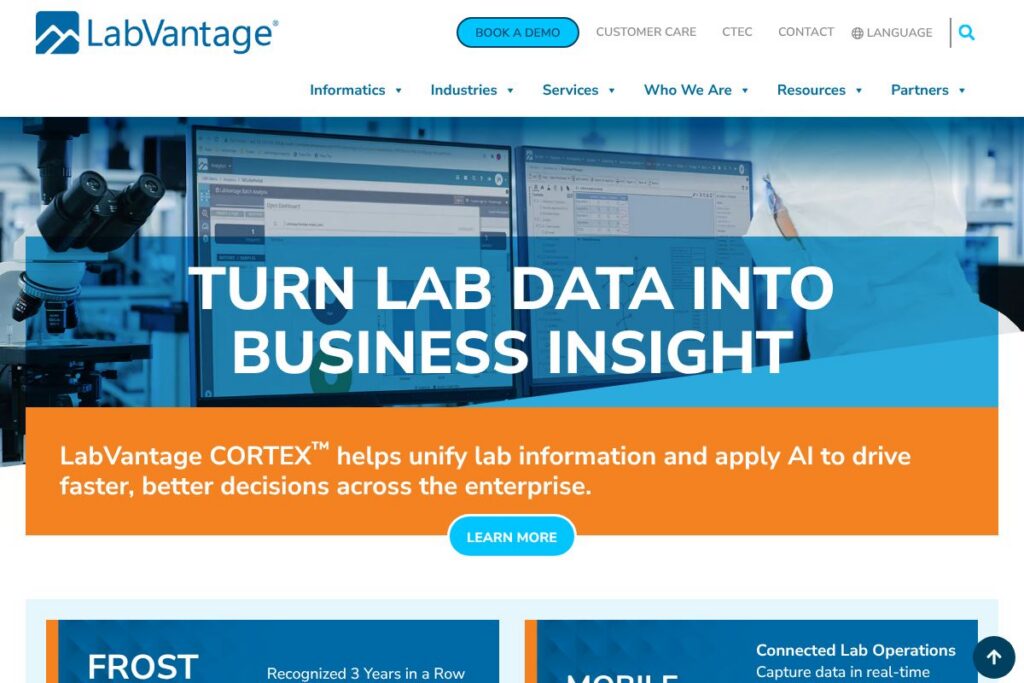
LabVantage provides a full-stack laboratory informatics platform that covers sample and inventory management, instrument connectivity, workflow automation, quality control, and enterprise reporting. It is designed for organizations that need validated data handling across research labs, QC testing sites, and manufacturing support functions.
Compared with competitors, LabVantage emphasizes an integrated platform approach. LabWare is a long-established LIMS vendor with extensive configuration flexibility and many legacy onsite deployments; Thermo Fisher SampleManager LIMS combines LIMS with a broad instrument and services ecosystem from Thermo Fisher Scientific; STARLIMS targets high-throughput regulated labs with strong analytics. LabVantage typically positions itself as a cloud-capable, enterprise LIMS with deep connector and analytics capabilities that reduce manual steps for lab operators and managers.
All of this makes LabVantage well suited to medium and large organizations in pharmaceuticals, biotech, chemicals, food and beverage, and other regulated industries that require validated workflows, instrument integration, and executive-level analytics. Its strengths are scalable data capture, configurable workflows, and professional services that support long-term validation and upgrades.
How LabVantage Works
LabVantage centralizes sample and test lifecycle data in a modular LIMS core, where samples, batches, and results are tracked through configurable workflows. Lab users interact via role-based web interfaces, while instruments and benchtop devices connect using drivers and middleware that feed results into the LIMS in real time.
On the back end, the platform provides a database optimized for laboratory data, automation engines for task routing and notifications, and validation-ready configuration tools for regulated environments. Practical workflows include automated sample accessioning, QC test execution with electronic signatures, result review and release, and handoff to ERP systems for lot control and manufacturing traceability.
What does LabVantage do?
LabVantage is organized around managing laboratory operations from sample receipt through result release, and it has expanded to include analytics, ELN-style scientific data capture, and enterprise integrations. Core capabilities include instrument connectivity, workflow automation, audit trails, and role-based dashboards, and the vendor highlights services and validation support to reduce long-term operational risk.
Let’s dive into the standout features:
Instrument Connectivity
LabVantage supports direct instrument integration through drivers and middleware to capture results in real time. This reduces manual transcription, improves data integrity, and lets teams incorporate instrument metadata into sample records for traceability.
Sample and Inventory Management
The platform tracks sample lifecycles, chain of custody, and inventory levels across multiple sites. Centralized sample management helps labs avoid lost samples, simplifies storage logistics, and supports batch release workflows tied to QC results.
Workflow Automation
Configurable workflow engines automate routine lab tasks such as test assignment, approval routing, and sample disposition. Automation speeds throughput, enforces process controls, and reduces human error during repetitive procedures.
Quality Control and Compliance
Built-in audit trails, electronic signatures, and validation support help labs meet regulatory requirements like GLP, GMP, and 21 CFR Part 11. LabVantage provides documentation and utilities to simplify system validation and compliance reporting.
Data Capture and Integration
The platform captures structured and unstructured scientific data and integrates with LIMS, ELN, ERP, and MES systems. Real-time data capture enables downstream analytics and decision support for QA and R&D teams.
Analytics and Reporting
LabVantage includes dashboards, scheduled reports, and ad hoc query tools for operational and executive insights. Reporting can aggregate multi-site data to track KPIs, identify trends, and support release decisions.
Electronic Lab Notebook and Scientific Data Advisory
LabVantage supports ELN-style records and advisory services to help standardize scientific data capture across teams. This helps researchers preserve experiment context and link raw data to formal results.
Enterprise Deployment and Security
The platform is available for cloud and on-premises deployment with role-based access control, encryption, and enterprise identity integration. Those features are intended to support multi-site rollout and centralized IT governance.
LabVantage’s biggest practical benefit is providing a single, validated system of record for lab data that connects instruments, workflows, and enterprise systems. That reduces manual handoffs, improves data integrity, and delivers the operational reporting executives use to make decisions.
LabVantage pricing
LabVantage uses an enterprise licensing model with custom pricing tailored to deployment scale, modules, and support requirements. Pricing varies by number of sites, integration scope, deployment type, and required validation services.
For exact rates and to discuss licensing options for your organization, contact the vendor through the LabVantage contact and sales pages for enterprise pricing details and tailored quotes. Explore the LabVantage homepage for information on deployment models and to request a sales conversation.
What is LabVantage Used For?
LabVantage is commonly used to manage QC testing workflows, sample tracking, and release processes in regulated industries such as pharmaceuticals, biologics, and food and beverage. Quality teams use it to enforce procedures, collect validated results, and generate compliance reports.
R&D and analytical labs use LabVantage to capture experimental data, manage instruments, and link ELN entries with formal LIMS records. At the enterprise level, operations and IT teams rely on the platform for multi-site data aggregation, integration with ERP systems, and executive dashboards that show laboratory performance.
Pros and Cons of LabVantage
Pros
- End-to-end laboratory platform: LabVantage covers sample management, instrument connectivity, workflow automation, and reporting, which reduces the need for multiple point solutions.
- Strong instrument integration: Real-time data capture from instruments and devices improves data integrity and accelerates sample throughput.
- Regulatory support and validation services: The vendor offers validation tools and professional services to help regulated labs meet compliance requirements.
- Scalable enterprise deployment: The platform supports cloud and on-premises deployments, role-based access, and multi-site rollouts for large organizations.
- Professional services and advisory: Proactive services and domain advisory support ongoing success and reduce long-term maintenance burden.
Cons
- Enterprise pricing model: Custom licensing and implementation costs can be significant for smaller labs or organizations with limited budgets.
- Implementation complexity: Deploying LIMS at scale requires planning, configuration, and validation time, which can extend project timelines.
- Customization trade-offs: Extensive customization can increase validation overhead and long-term upgrade complexity.
- Learning curve for users: Operators and analysts may require training to use configured workflows and to adopt standardized processes.
Does LabVantage Offer a Free Trial?
LabVantage is typically offered under enterprise licensing and does not have a public free plan, but the vendor provides demos and pilot engagements. Prospective customers can request a demonstration or a pilot project through the LabVantage contact channels to evaluate the platform in the context of their workflows. Use the LabVantage contact page to request a demo or discuss a pilot implementation.
LabVantage API and Integrations
LabVantage provides APIs and connectivity options for instrument drivers, REST-based integration, and connectors to ERP and manufacturing systems. The platform is designed to integrate with common enterprise systems such as SAP and other lab software to enable end-to-end data flows and traceability.
For technical integration details and developer resources, review LabVantage’s documentation and integration materials on the LabVantage platform and integrations pages. These resources outline supported connectors, recommended middleware, and best practices for instrument interfacing.
10 LabVantage alternatives
Paid alternatives to LabVantage
- LabWare – A widely used LIMS with flexible configuration and a large install base across regulated industries, often chosen for complex, heavily customized deployments.
- Thermo Fisher SampleManager LIMS – Integrates LIMS features with Thermo Fisher’s instrument and services ecosystem for laboratories that already use Thermo Fisher products.
- STARLIMS – Focuses on high-throughput regulated labs with strong analytics and reporting tools for public health and manufacturing environments.
- Benchling – Cloud-native life sciences R&D platform with ELN, inventory, and molecular biology tools aimed at research teams and biotech companies.
- Dotmatics – Scientific informatics suite for R&D data management, visualization, and collaboration with strong chemistry and biology workflows.
- PerkinElmer Signals – Offers linked informatics and lab automation for analysis-driven workflows and enterprise data management.
Open source alternatives to LabVantage
- Bika LIMS – An open source LIMS focused on sample tracking and lab workflows, commonly used by smaller labs and academic institutions.
- Senaite – Built on the Plone CMS, Senaite provides a modular open source LIMS with flexibility for custom lab workflows.
- OpenSpecimen – Open source specimen management software used for biorepositories and clinical specimen tracking with an emphasis on sample lifecycle management.
- LabKey – Open source platform for managing, integrating, and analyzing biological data, often used for research data pipelines and collaboration.
Frequently asked questions about LabVantage
What is LabVantage used for?
LabVantage is used to manage laboratory workflows, sample tracking, instrument data capture, and regulatory reporting. It supports QC, R&D, and enterprise reporting needs across regulated and non-regulated labs.
Does LabVantage offer cloud deployment?
Yes, LabVantage supports cloud and on-premises deployments. Organizations can choose the deployment model that fits their IT policies, validation needs, and integration requirements.
How much does LabVantage cost?
LabVantage uses custom enterprise pricing rather than public list prices. Costs vary by modules, number of sites, integration scope, and required professional services; contact LabVantage through their homepage to request a tailored quote.
Can LabVantage integrate with lab instruments and ERP systems?
Yes, LabVantage provides instrument connectivity and integration options for ERP and other enterprise systems. The platform includes drivers, APIs, and recommended middleware to connect common instruments and enterprise applications.
Is LabVantage suitable for regulated industries?
Yes, LabVantage includes features for compliance such as audit trails, electronic signatures, and validation support. The vendor also offers professional services to assist with system validation and documentation for regulated environments.
Final Verdict: LabVantage
LabVantage is a comprehensive LIMS platform intended for organizations that need integrated sample management, real-time instrument data capture, workflow automation, and enterprise reporting. It does well at consolidating lab operations into a single validated system of record and offers professional services to support long-term deployments.
Compared with LabWare, which also targets enterprise deployments and uses custom pricing, LabVantage often emphasizes cloud capabilities and built-in analytics while LabWare is known for extensive configurability and a large legacy footprint. Both options require enterprise-level investment, so the choice typically comes down to fit for cloud vs onsite preferences, desired out-of-the-box modules, and available implementation resources.
Overall, LabVantage is a strong candidate for medium to large labs and regulated organizations that need a single platform to manage lab operations from benchtop to boardroom. For pricing, demos, and details on modules, request a consultation through the LabVantage contact page.