LabWare: An Overview
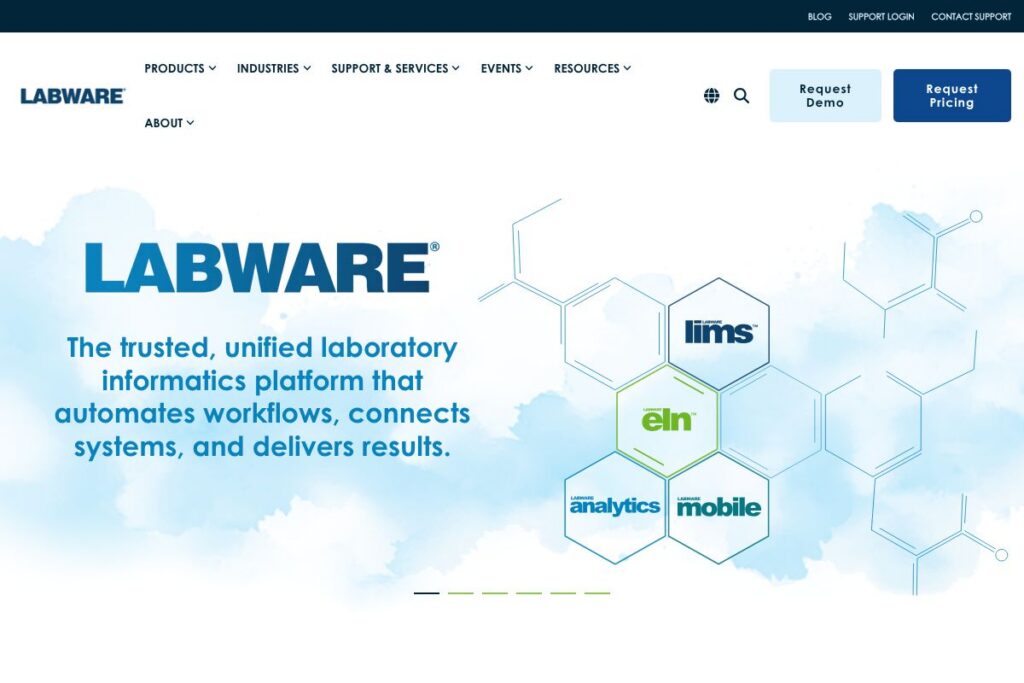
LabWare provides laboratory information management system (LIMS) and electronic lab notebook (ELN) software designed to manage samples, tests, instruments, workflows, and quality records across research, clinical, and manufacturing environments. The platform focuses on configurable workflows, centralized data management, and compliance features such as audit trails and electronic signatures that support regulated industries.
Compared with other enterprise LIMS providers, LabWare emphasizes high configurability and broad instrument connectivity. Thermo Fisher Scientific’s SampleManager LIMS competes on integrated informatics and instrumentation, while LabVantage often positions itself on cloud-first deployments and modern UI. STARLIMS from Abbott is another comparable option that targets enterprise operations with a strong focus on traceability and regulatory workflows. All three competitors overlap in core LIMS functionality, but LabWare is widely used for large, highly customized implementations.
All of this makes LabWare a strong choice for labs that need deep process configuration, wide instrument integration, and formal compliance controls. It is commonly chosen by large pharmaceutical, petrochemical, and clinical laboratories that require robust data governance and scalable deployments. For product details and demonstrations, see LabWare’s official site.
How LabWare Works
LabWare operates as a modular LIMS and ELN platform that maps laboratory processes into configurable workflows, forms, and data models. Users define sample lifecycle stages, test methods, and acceptance criteria, then route work through assignments, instruments, and downstream reporting. The system captures structured data at each step, which keeps traceability and supports analytical queries.
Implementation typically involves configuring the LabWare schema to match an organization’s SOPs, integrating instruments via drivers or middleware, and enabling role-based access and electronic signatures for regulated steps. In day-to-day use, technicians register samples, run assays through connected instruments or manual entry, and generate results that feed into certificates of analysis or batch reports. Lab managers use dashboards and reporting to monitor throughput, trends, and exceptions.
LabWare features
LabWare’s product set centers on LIMS capabilities paired with an ELN, instrument integration, reporting, and compliance controls. Core capabilities include configurable workflows, instrument drivers, audit trails, and report automation for outputs such as certificates of analysis. Recent focus areas include improved analytics, expanded instrument connectivity, and cloud deployment options.
Core LIMS
The LIMS module handles sample registration, chain of custody, test assignments, and result capture. It supports complex sample hierarchies and batching, which helps laboratories manage high throughput while preserving traceability and metadata for each sample.
Electronic Lab Notebook (ELN)
The ELN provides structured and free-text experimental records, linking procedures, reagents, and results to samples and projects. This centralization lets scientists document experiments digitally while preserving timestamps, authorship, and version history for audits.
Reporting and Analytics
Reporting tools consolidate, search, and trend laboratory data and automate common outputs such as certificates of analysis. Built-in query and dashboard functionality supports quality reporting, trend analysis, and regulatory reporting without manual Excel consolidation.
Quality and Compliance Controls
Features include electronic signatures, audit trails, enforced SOP workflows, and controlled document management. These capabilities help labs meet regulatory requirements such as 21 CFR Part 11 and ISO standards by recording who did what and when, and by protecting critical records.
Instrument and Automation Integration
LabWare connects to a broad set of laboratory instruments, automation systems, and middleware to automatically capture results and reduce manual transcription. Integrations can be configured to handle vendor-specific protocols and file formats, improving throughput and reducing error rates.
Data Management and Connectivity
The platform centralizes test results, sample metadata, and process configurations in a searchable data store. It supports integrations with enterprise systems such as LIMS-to-ERP or LIMS-to-ELN connectors to maintain consistent data across business and laboratory systems.
Deployment and Scalability
LabWare supports on-premises and cloud deployment models designed to scale from single-site labs to global, multi-site organizations. Configuration-driven architecture lets teams reconfigure workflows without heavy code changes as processes evolve.
With these capabilities, LabWare helps labs reduce manual work, keep strict auditability, and produce consistent, repeatable laboratory outputs. The strongest single benefit is the ability to map complex, regulated lab processes into a configurable system that preserves data integrity and traceability.
LabWare pricing
LabWare uses an enterprise licensing model with custom pricing tailored to organization size, deployment model, and required modules. Pricing is typically provided through direct engagement with LabWare sales and varies based on the number of sites, user seats, integrations, and support requirements.
For specific cost information or to request a tailored quote, contact LabWare through their official website contact options or request a demo via LabWare’s product demonstration page.
LabWare Use Cases
LabWare is commonly used for regulated manufacturing quality control, method development labs, clinical sample management, and research organizations that require formal recordkeeping. Typical workloads include sample intake, stability testing, batch release, environmental monitoring, and method validation, all tied to controlled workflows and report generation.
Smaller research labs and academic groups may use LabWare’s ELN features for experiment documentation, while large enterprises leverage the full LIMS suite for cross-site sample tracking, instrument integration, and enterprise reporting. Its emphasis on compliance makes it suitable for FDA-regulated environments and ISO-accredited laboratories.
Pros and Cons of LabWare
Pros
- Highly configurable workflows: LabWare can model complex lab processes with configurable forms, sample types, and routing logic, which reduces the need for custom code in many deployments.
- Broad instrument connectivity: Extensive instrument driver libraries and middleware support help automate result capture and reduce manual transcription errors.
- Strong regulatory support: Electronic signatures, audit trails, and document control are built into the platform to support compliance with standards like 21 CFR Part 11 and ISO.
- Scalable for large enterprises: Architecture and deployment options are designed to support multi-site and multi-national laboratory networks with centralized governance.
- Robust reporting: Native capabilities to generate certificates of analysis, trend reports, and dashboards make it easier to meet QA/QC reporting needs.
Cons
- Enterprise-focused pricing and procurement: Licensing and implementation typically require negotiations and a formal procurement process, which can be a barrier for very small labs.
- Implementation effort: Deep configurability often results in longer implementation timelines and the need for experienced consultants or internal LIMS specialists.
- User interface complexity: The breadth of functionality can result in a steeper learning curve for end users compared with simpler, niche ELN products.
- Customization maintenance: Heavy customization may increase ongoing maintenance when upgrading or migrating deployments.
Does LabWare Offer a Free Trial?
LabWare offers custom enterprise licenses and does not provide a public free plan or self-service trial. Prospective customers can request a demonstration or pilot through LabWare’s demo request process to evaluate the platform in the context of their workflows.
LabWare API and Integrations
LabWare provides APIs and integration frameworks to connect instruments, automation systems, and enterprise applications. The platform supports common integration patterns for data exchange, and customers can work with LabWare or partners to implement connectors for ERP, MES, and analytical instruments.
For technical integration guidance, review LabWare’s resources on integration and connectivity available on LabWare’s support and resources pages.
10 LabWare alternatives
Paid alternatives to LabWare
- Thermo Fisher SampleManager LIMS – Enterprise LIMS that integrates closely with Thermo Fisher’s instrument ecosystem and offers sample management, ELN add-ons, and analytics.
- LabVantage – Cloud-capable LIMS and ELN focused on modern interfaces and rapid deployment for mid-to-large labs.
- STARLIMS – Enterprise-grade LIMS with strong traceability and compliance features for regulated and public health labs.
- Benchling – Research-focused ELN and molecular biology platform that combines registry, workflows, and collaboration features for R&D teams.
- PerkinElmer Signals Notebook – ELN and informatics platform with integrations into PerkinElmer analytics and instrument software.
- Core LIMS (various vendors) – Vendors offering modular LIMS solutions focused on sample tracking, QC workflows, and instrument connectivity for mid-sized enterprises.
Open source alternatives to LabWare
- Bika LIMS – An open source LIMS with modules for sample management, analysis, and reporting; suitable for organizations willing to self-host and customize.
- LabKey Server – Open source data management platform for research and clinical labs, with strong support for datasets, workflows, and analysis pipelines.
- OpenLabFramework – Community-driven framework for building LIMS-like capabilities that can be extended for specific laboratory needs.
Frequently asked questions about LabWare
What is LabWare used for?
LabWare is used to manage laboratory samples, tests, workflows, and records. Organizations use it to centralize sample tracking, capture results from instruments, and automate QA/QC reporting.
Does LabWare have an API for instrument and system integration?
Yes, LabWare provides APIs and integration frameworks. These interfaces are used to connect laboratory instruments, automation, and enterprise systems for automated data exchange.
How much does LabWare cost?
LabWare uses custom enterprise pricing tailored to each customer’s deployment and needs. For a specific quote, contact LabWare through their official contact channels.
Can LabWare support regulated environments like pharmaceutical manufacturing?
Yes, LabWare includes compliance features such as audit trails and electronic signatures. These controls are designed to support regulatory requirements including 21 CFR Part 11 and relevant ISO standards.
Is LabWare suitable for small research labs?
LabWare can be deployed for smaller labs but is primarily designed for enterprise and regulated environments. Smaller teams often evaluate LabWare’s ELN functionality or choose lighter-weight ELNs if they need a simpler, lower-cost solution.
Final Verdict: LabWare
LabWare is a mature, highly configurable LIMS and ELN platform that excels at mapping complex laboratory workflows into a centrally governed system, connecting instruments, and preserving compliance-grade audit trails. Its reporting and automation capabilities are well suited to organizations that require traceability, certificates of analysis, and enterprise-scale sample management.
Compared with LabVantage, LabWare similarly targets enterprise customers with custom pricing and extensive feature sets; both vendors require a formal procurement and implementation effort. LabWare stands out for deployments that demand deep customization and broad instrument connectivity, while LabVantage may be preferred where cloud-first adoption and modern UI are higher priorities. For purchasing or to arrange a demo, visit LabWare’s official site.