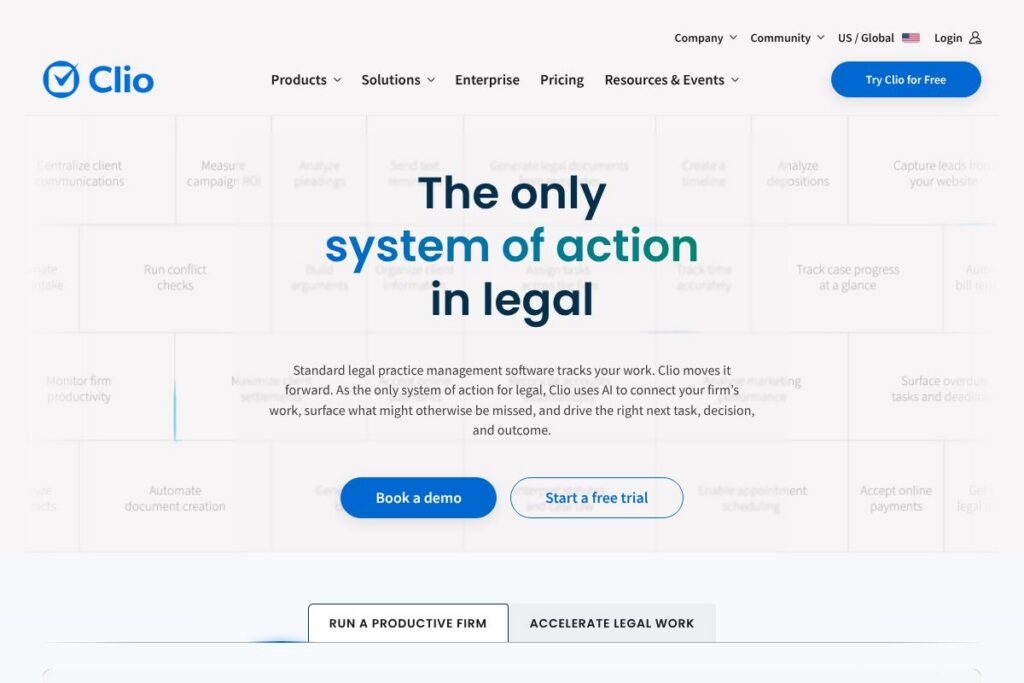
What is Clio
A cloud-native legal practice management platform, Clio combines matter and client management, billing and trust accounting, document storage and automation, and integrated legal research into a single interface. It is designed for solo practitioners through large firms and legal departments that need a consolidated system to run the business of law alongside substantive legal work.
Clio positions its platform around context-aware AI that works with a firm’s own matters and preferences to assist with intake, drafting, and research while maintaining data controls. Compared with legacy on-premise practice management systems, Clio emphasizes a connected workflow across intake, casework, document production, and invoicing. Against competitors like PracticePanther and MyCase, Clio is often chosen for broader integrations and enterprise-grade security; versus feature-focused tools such as Smokeball, Clio is typically selected for its larger ecosystem and analytics capabilities.
All of this makes Clio a strong fit for firms that want a single system to handle day-to-day operations and to apply AI and automation across workflows. It is particularly useful for firms that need centralized billing, secure client portals, and the ability to scale from solo to multi-office operations.
How Clio Works
Clio organizes firm work around matters and clients, with a unified record that links contacts, correspondence, documents, time entries, expenses, and invoices. Users create matters, capture time through timers or manual entries, attach documents to matters, and generate billing using built-in templates and trust accounting controls.
The platform layers automation and AI on top of those records to streamline repetitive tasks. For example, intake forms can populate matter fields automatically, AI-assisted drafting can generate initial document drafts from matter context, and automated workflows can create tasks or reminders based on case milestones. Firms typically deploy Clio by migrating contacts and matters, connecting email and calendars, and integrating complementary apps through the integrations directory.
Clio features
The platform groups core capabilities needed to run a legal practice, with recent emphasis on AI-assisted drafting and expanded integrations. Core modules include matter management, billing and trust accounting, document automation, client intake, reporting, and a permissions-first security model.
Let’s talk Clio’s Features
Matter Management
Matter records consolidate client contact details, case notes, associated documents, calendars, and task lists into a single timeline. This centralization reduces data entry and makes it easier for teams to see matter history, role assignments, and upcoming deadlines without switching tools.
Time Tracking and Billing
Built-in timers, rate-setting, and billing templates let firms capture billable time and generate invoices with trust accounting support. The system supports progressive billing, payment plans, and online payments to accelerate collections and maintain compliance with client trust rules.
Client Intake and CRM
Custom intake forms and client portals provide a frictionless way to capture new matters and share documents securely with clients. Intake data can automatically create matters, assign workflows, and populate key fields to speed onboarding and reduce duplicate entry.
Document Management and Automation
Document storage, versioning, and template-based automation keep drafting consistent and auditable across a firm. Integration with Microsoft Word and document assembly tools enables firms to produce court-ready pleadings and client letters while preserving metadata and matter links.
Clio AI and Legal Research
Context-aware AI works against your matters and firm data to draft documents, summarize case files, and support basic legal research tasks without training models on your content. The platform also connects to trusted legal research resources to surface citations and references within workflows.
Reporting and Analytics
Built-in reports track revenue, realization, collections, and matter profitability, while dashboards provide visibility into firm capacity and bottlenecks. Custom reports help managing partners and finance teams measure KPIs across practice areas and offices.
Security and Compliance
Role-based permissions, encryption at rest and in transit, and independent audits are part of Clio’s security posture. The platform meets common standards and is designed to support HIPAA, PCI compliance, and other regulatory requirements for legal data handling.
Integrations and Extensibility
Clio connects to popular productivity and practice tools through a wide integrations catalog, and exposes developer APIs for deeper automations. This lets firms link email, calendaring, accounting, e-signature, and court-filing solutions into a single workflow.
With these capabilities, Clio’s biggest benefit is consolidating the administrative and substantive sides of legal work into a single, auditable system. That consolidation reduces context switching, improves billing accuracy, and makes it easier to apply automation and AI intelligently across firm processes.