What is Lightspeed
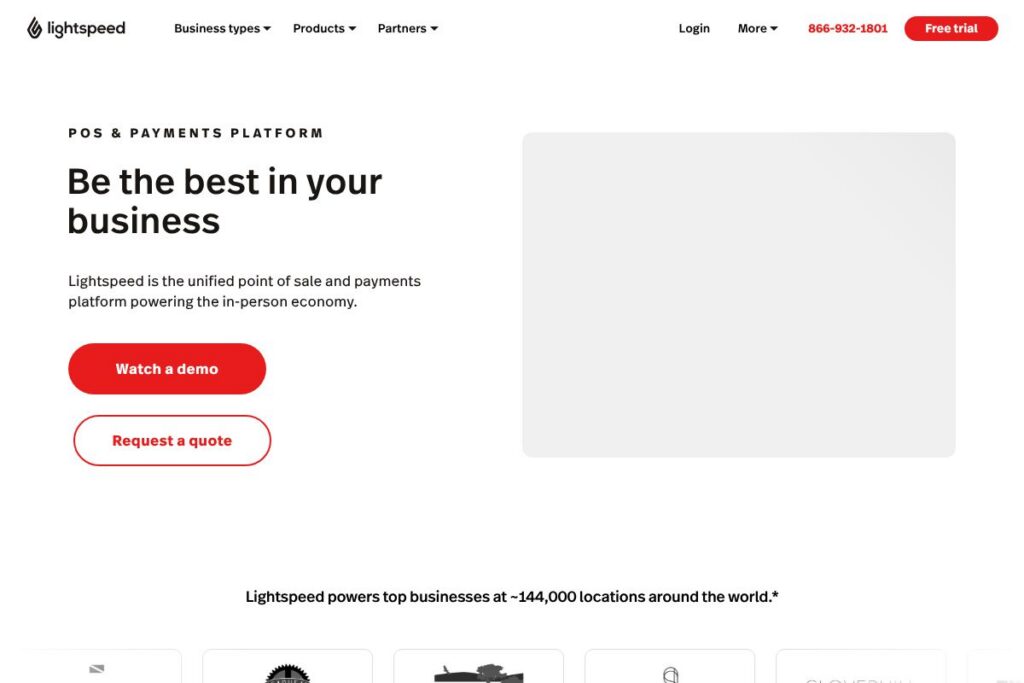
Lightspeed is a cloud-native point of sale and commerce platform built for businesses that sell in-person and online. It combines POS terminals, payments processing, inventory and supplier workflows, reporting, and eCommerce into a single configurable system usable across multiple locations.
Compared with competitors, Lightspeed sits between full commerce platforms like Shopify and hospitality-first systems like Toast. It offers deeper inventory, wholesale and multichannel features than entry-level POS systems such as Square, while remaining more focused on retail and hospitality than pure eCommerce platforms.
Lightspeed does particularly well at multichannel inventory and complex product catalogs, and it is best suited for medium-sized merchants, multi-location retailers, and hospitality groups that need a single system to manage in-store sales, online stores, purchasing and reporting.
How Lightspeed Works
Lightspeed runs as a cloud-hosted POS application accessed from web and native terminal apps and mobile devices. Staff log into a location-specific POS interface to ring sales, process payments, and manage orders, while inventory changes and sales data sync to a central account.
Back-office users access a web admin to manage product catalogs, supplier purchase orders, locations, and user permissions. Sales, margins and inventory reports are available in real time so managers can make quick merchandising and staffing decisions.
Typical workflows include creating purchase orders from recommended reorder points, receiving shipments into inventory, and having stock levels immediately reflected across in-store and online channels. For restaurants, workflows cover tableside ordering, kitchen routing, modifiers and integrated payments to reduce reconciliation time.
What does Lightspeed do?
Lightspeed organizes retail and hospitality operations around three core capabilities: point of sale and payments, inventory and purchasing, and omnichannel commerce. Recent product additions have focused on deeper wholesale workflows, enhanced reporting and more robust API connectivity for third-party apps.
Key functionality includes:
POS and Payments
Lightspeed provides touchscreen and tablet POS interfaces with support for custom menus, modifiers, discounts and integrated card readers. Built-in payments reduce reconciliation steps, and the platform supports offline mode so transactions can continue if connectivity is interrupted.
Inventory Management
The system handles multi-variant SKUs, serialized items, stock transfers, and low-stock alerts, enabling automated reorder suggestions and batch receiving. Inventory updates sync across locations and online storefronts to avoid overselling and to speed up purchasing.
Omnichannel Commerce
Lightspeed links in-person sales to an online store so merchants can sell, fulfill and report from a single product catalog. The platform supports buy online pick up in store (BOPIS), centralized product listings, and channel-specific pricing.
Reporting and Analytics
Real-time dashboards and customizable reports provide sales trends, margin analysis and labor metrics across locations. Reports help identify top sellers, slow-moving stock and opportunities to optimize pricing or promotions.
Supplier and Wholesale Tools
Lightspeed includes purchase order automation, supplier catalogs, and the ability to import purchase orders from partner marketplaces. Those features reduce manual PO entry and accelerate replenishment for wholesale-oriented retailers.
Multilocation Management
Centralized admin controls let operators manage users, inventory transfers and pricing across many outlets from a single account. Cloning menus, promotions or item setups to new locations reduces setup time when scaling.
Staff and Shift Management
Employee profiles, role-based permissions and shift reporting are available to track labor costs and access limits. Time-clock integration and sales-per-employee metrics make labor decisions more data-driven.
API and Integrations
Lightspeed exposes APIs for inventory, orders, customers and payments to extend workflows and connect third-party systems. Those APIs support integrations with accounting, eCommerce platforms and operational tooling to automate repetitive tasks.
With these capabilities combined, Lightspeed aims to reduce manual reconciliation, centralize inventory control and provide actionable insights across in-store and online channels.
Lightspeed pricing
Lightspeed uses a subscription pricing model for its POS and commerce software combined with payments processing fees for transactions. Pricing is commonly tailored to industry, number of locations, and the specific feature set requested rather than being presented as a single public price list.
For current subscription tiers, payments rates and enterprise options, see Lightspeed’s official contact and sales pages for the most accurate options and to request a quote from the vendor: explore the Lightspeed main site or use the Lightspeed contact and demo page to speak with sales.
What is Lightspeed Used For?
Retailers use Lightspeed to run point of sale operations, manage complex inventories and connect in-store sales with online storefronts. It is particularly useful for businesses that need multichannel stock visibility, purchase order automation and supplier management.
Restaurants and hospitality groups use Lightspeed for tableside ordering, integrated payments and labor reporting that reduce service friction and speed reconciliation. Clubs, golf courses and specialty stores use industry-specific modules to manage bookings, F&B operations and membership or wholesale workflows.
Pros and Cons of Lightspeed
Pros
- Extensive inventory control: Lightspeed supports multi-variant SKUs, serial tracking, purchase orders and automatic reorder points, which helps businesses reduce stockouts and overstock situations.
- Unified commerce: Manage in-store sales, online stores and wholesale buying from a single system to improve accuracy and reduce manual syncing across platforms.
- Industry modules: Built-in templates and features for restaurants, retail, golf and wholesale speed deployment for specific verticals and reduce the need for heavy custom configuration.
- Scales across locations: Centralized management of locations, cloned menus and multi-outlet reporting simplifies operations for chains and franchise groups.
Cons
- Custom pricing and complexity: Larger feature sets and multilocation deployments often require sales quotes and implementation support, which can increase upfront costs and negotiation time.
- Learning curve for power features: The depth of inventory and wholesale tools can require more training for staff compared to simpler, entry-level POS systems.
- Dependence on integrations for some workflows: Certain back-office or accounting workflows may require third-party integrations or API work to match existing processes.
Does Lightspeed Offer a Free Trial?
Lightspeed offers demos and trial options through its sales process. Prospective customers can request a product demo, trial access or a guided walkthrough directly through Lightspeed’s contact and demo pages to evaluate the platform before committing.
Lightspeed API and Integrations
Lightspeed provides a developer API that exposes endpoints for products, orders, inventory, customers and payments; developers can consult the Lightspeed API documentation for authentication, endpoint examples and SDKs. The Lightspeed API documentation provides technical reference and integration guides.
The platform connects with common business tools such as Shopify, accounting systems like QuickBooks and Xero, automation platforms like Zapier, and analytics services to create end-to-end commerce workflows.
10 Lightspeed alternatives
Paid alternatives to Lightspeed
- Shopify: Commerce-first platform with strong online store features and POS options for retailers who prioritize eCommerce and need integrated online hosting and payments.
- Square: Entry-level POS and payments suite that is easy to set up and often preferred by single-site merchants and small hospitality operators because of simple pricing and bundled hardware.
- Toast: Restaurant-focused POS with deep kitchen routing, online ordering and hospitality-specific reporting for full-service and quick-service restaurants.
- Clover: Flexible POS hardware and app marketplace for merchants who want pre-built app integrations and modular hardware configurations.
- Revel Systems: Enterprise-oriented POS with strong integrations and offline-first architecture for high-volume retail and hospitality environments.
- NCR Silver: Established POS platform with a focus on retail and hospitality, especially for businesses that need robust hardware and service options.
Open source alternatives to Lightspeed
- Odoo: Open source ERP with a POS module, inventory, purchasing and eCommerce components that can be self-hosted and customized for complex workflows.
- uniCenta: Open source POS that supports multi-terminal deployments and basic inventory features for retailers seeking a low-cost self-hosted option.
- Floreant POS: Open source restaurant POS that covers table management, kitchen printing and order routing for small to mid-sized foodservice operations.
- ERPNext: Open source ERP with POS, inventory and accounting modules, suitable for businesses that want a single self-hosted system covering finance and operations.
Frequently asked questions about Lightspeed
What is Lightspeed best used for?
Lightspeed is best used to centralize POS, inventory and omnichannel commerce for retail and hospitality businesses. It helps multi-location merchants manage stock, orders and sales across in-store and online channels.
Does Lightspeed integrate with QuickBooks and Xero?
Yes, Lightspeed offers integrations with accounting platforms such as QuickBooks and Xero. Those integrations synchronize sales and inventory data to simplify bookkeeping and financial reporting.
Can Lightspeed handle multiple locations and inventory transfers?
Yes, Lightspeed supports multilocation management including inventory transfers, location-level reporting and centralized product catalogs. That makes it suitable for chains and franchise operations.
Is Lightspeed suitable for restaurants and bars?
Yes, Lightspeed provides restaurant-specific features such as tableside ordering, modifiers and kitchen routing. It also supports payments integration to reduce reconciliation time.
Does Lightspeed provide developer APIs for custom integrations?
Yes, Lightspeed provides a documented API for products, orders, customers and payments. Developers can use the Lightspeed API documentation to build custom integrations and automation.
Final verdict: Lightspeed
Lightspeed is a comprehensive commerce platform that combines POS, payments, inventory and omnichannel operations in a single system, making it a strong choice for medium and multi-location retailers and hospitality groups. Its strengths are deep inventory control, wholesale and purchasing workflows, and centralized reporting that reduce manual reconciliation and speed decision making.
Compared to Shopify, which is often chosen by merchants focused primarily on eCommerce and known for clear published plan tiers, Lightspeed provides more specialized in-store and wholesale capabilities and typically requires a tailored subscription for larger deployments. For businesses that need both advanced in-person operations and centralized inventory across channels, Lightspeed delivers the breadth of features needed to scale operations.