Appear: An Overview
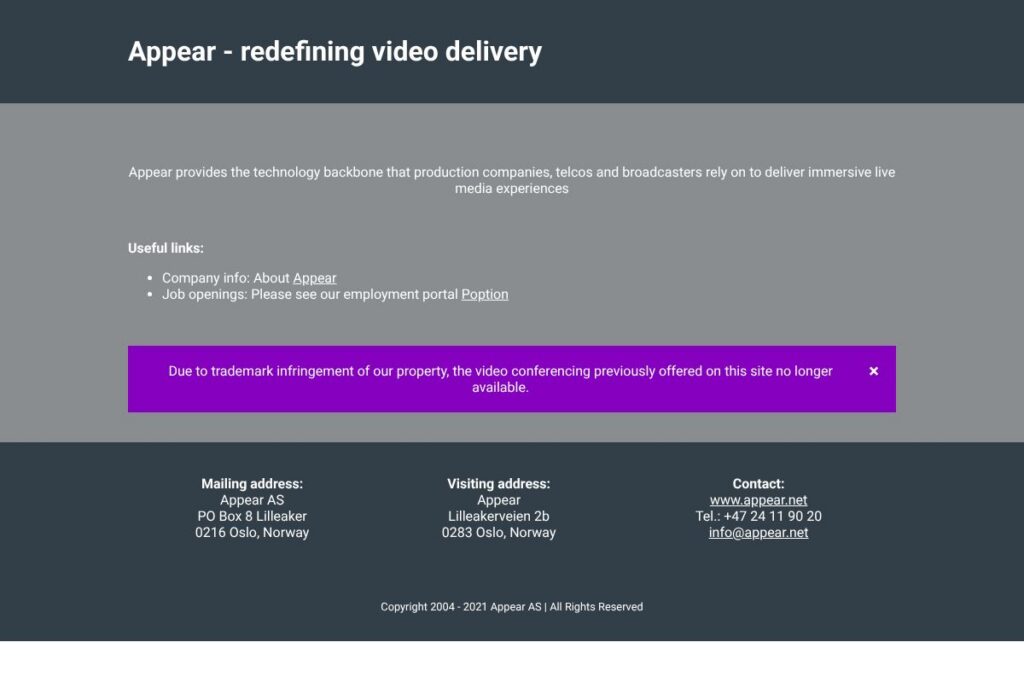
Appear designs and manufactures equipment and end-to-end solutions for professional video contribution, remote production, distribution, and OTT streaming. The company builds encoder/decoder hardware, contribution appliances, and management systems that are intended to work in mixed-IP and satellite environments and to integrate with existing broadcast infrastructures.
Compared with competitors like Evertz, Grass Valley, and Synamedia, Appear places emphasis on compact, contribution-focused hardware and streamlined remote-production workflows. Evertz is known for large-scale routing and virtualization, while Grass Valley focuses on production switchers and cameras; Synamedia targets content protection and video delivery at scale. Appear’s product set aims to bridge contribution and edge distribution with lower operational complexity for live events and point-to-point feeds.
All of this makes Appear particularly well suited for broadcasters, production companies, and telcos that need reliable, field-deployable equipment and managed workflows for live events, news contribution, and OTT channels. For background on the company and its mission, see the About Appear page.
How Appear Works
Appear’s systems deploy at contribution points, production hubs, and edge locations to handle encoding, format conversion, and secure transport. Field units typically connect cameras and local encoders to Appear appliances or software modules that package streams for low-latency contribution over public or private IP links.
At the production side, Appear supports remote production by providing stream switching, clean switching, and multiview outputs that integrate with NDI, SMPTE IP standards, and cloud-based playout systems. Operators manage streams through a centralized management interface that exposes status, logs, and basic automation for failover.
For distribution and OTT, Appear integrates with CDNs and packaging stacks so contribution feeds can be transmuxed into HLS, DASH, or CMAF. Monitoring and compliance features help maintain quality-of-service and content-adjacent metadata for downstream services.
Appear features
Appear’s feature set is organized around contribution reliability, remote production workflows, and downstream distribution. Core capabilities include contribution encoders and decoders, remote production tools, monitoring and management, and integrations with CDN and playout systems.
Contribution Encoders and Decoders
High-efficiency encoders and decoders support multiple codecs and transport protocols, with options for hardware-accelerated H.264 and H.265 to reduce bandwidth while preserving quality. These units typically include redundancy options and AES encryption for secure links, which helps production teams maintain consistent feeds from remote locations.
Remote Production Tools
Remote production features include multiview outputs, tally and control signalling, and stream switching designed to be operated from a centralized facility. These capabilities let producers mix and cut live sources without requiring full crew presence at every location, reducing travel and logistical overhead for events.
OTT Packaging and CDN Integration
Appear can package contribution feeds into streaming-friendly formats such as HLS, DASH, and CMAF and hand off to CDNs or origin servers. This simplifies the path from live capture to OTT distribution and works with standard CDN and cloud workflows to reach audiences across devices.
Monitoring and Management
A central management interface provides real-time health metrics, alarms, and logging for deployed units, enabling operations teams to spot degradations and perform remote restarts or configuration updates. SNMP and API hooks support integration into existing NMS platforms for large-scale deployments.
Security and Compliance Features
Support for encryption, secure key management, and captioning/subtitle insertion helps meet broadcast compliance requirements and regional content rules. These capabilities are important for news, sports, and regulatory-driven broadcast environments.
With these capabilities, Appear focuses on reliable live contribution and remote production across mixed networks, making live workflows easier to operate while maintaining broadcast-grade quality.
Appear Pricing
Appear offers custom pricing tailored to broadcasters, telcos, and production companies rather than standard public plans. Pricing typically depends on hardware configurations, software modules, support level, and deployment scale, so costs are quoted per project or per managed service engagement.
For specific commercial options and quotes, consult the Appear homepage or contact their sales team to discuss deployment size, support SLAs, and additional services.
What is Appear Used For?
Appear is commonly used for live sports, news contribution, remote event production, and point-to-point video feeds between venues and broadcast centers. Its equipment and systems are chosen when low-latency, reliability, and simple field operations are required for live programming.
Service providers and telcos also use Appear technology to offer managed contribution and streaming services to customers, packaging contribution, monitoring, and CDN handoff into solutions that support linear channels and OTT streaming.
Pros and Cons of Appear
Pros
- Broadcast-focused hardware and workflows: Appear’s equipment is purpose-built for contribution and remote production, providing resilient links and field-friendly features for live events.
- Integrated remote production support: The product line reduces the complexity of remote production by offering switching, multiviews, and control features designed for centralized operation.
- Flexible distribution options: Support for HLS, DASH, and CMAF, plus CDN integration, simplifies the transition from contribution to OTT distribution.
- Operational monitoring and management: Centralized management and monitoring tools help operations teams maintain availability and quickly troubleshoot issues.
Cons
- Enterprise-focused pricing model: Pricing is typically custom and geared toward broadcast and telco customers, which can be a barrier for smaller studios or independent creators.
- Hardware dependency for some workflows: Certain remote and contribution features require dedicated Appear appliances, which increases capital and logistics considerations compared with purely cloud-native solutions.
- Limited visibility into consumer-oriented features: For teams focused exclusively on OTT feature sets such as analytics or subscriber management, additional third-party systems are usually required.
Does Appear Offer a Free Trial?
Appear does not offer a public free plan or trial. Product evaluation and testing are typically arranged through project-based demos, pilot deployments, or lab evaluations coordinated with Appear’s sales and engineering teams to validate hardware and workflow compatibility.
Appear API and Integrations
Appear provides management APIs and integration points for operational workflows, including RESTful endpoints and SNMP for monitoring and control. The API and integration capabilities enable automation of provisioning, status checks, and basic orchestration with third-party systems.
Key integrations commonly include CDNs, playout systems, NMS platforms, and broadcast automation systems. For integration details and developer resources, review the About Appear materials or contact Appear for technical documentation.
10 Appear alternatives
Paid alternatives to Appear
- Evertz — A wide portfolio of routing, processing, and virtualization products for broadcast facilities and live production that scale from small stations to global networks.
- Grass Valley — Production switchers, cameras, and end-to-end broadcast systems aimed at live production and newsrooms with deep integration into production workflows.
- Synamedia — Focuses on content delivery, conditional access, and OTT distribution with tools for large-scale service providers and carriers.
- Harmonic — Offers encoder, origin, and cloud-native solutions for multiscreen streaming and live OTT workflows with emphasis on large-volume distribution.
- Imagine Communications — Provides playout, ad insertion, and routing solutions for broadcasters and carriage providers with strong systems integration capabilities.
- MediaKind — Specializes in video delivery and streaming platforms for operators and content owners, including encoding and managed services.
- Dalet — Combines media asset management, production, and distribution tools aimed at broadcasters and content organizations.
Open source alternatives to Appear
- OBS Studio — A free live production and streaming application that handles capture, mixing, and simple streaming workflows for smaller-scale live events.
- FFmpeg — A command-line toolset for media encoding, transmuxing, and packetization that can be used to build custom contribution and packaging pipelines.
- Nginx with RTMP module — A lightweight open source option for ingest and simple streaming distribution that can be part of a DIY contribution-to-OTT chain.
- Janus Gateway — An open source WebRTC server that can be used for low-latency streaming and selective forwarding in custom remote-production setups.
Frequently asked questions about Appear
What is Appear used for?
Appear is used for professional video contribution, remote production, distribution, and OTT streaming. Broadcasters and production companies use its hardware and systems to capture, transport, and prepare live feeds for playout or streaming.
Does Appear offer cloud-native streaming services?
Appear provides integrations for cloud and CDN workflows but focuses on hardware-plus-software solutions. It commonly hands off packaged streams to cloud origins and CDNs rather than offering a standalone OTT platform for end users.
Can Appear equipment be managed remotely?
Yes, Appear includes centralized monitoring and management tools for remote operation. These tools expose status metrics, alarms, and control interfaces that can be integrated with network management systems.
How does Appear handle low-latency live contribution?
Appear supports low-latency codecs and transport protocols with options for hardware acceleration and encryption. This reduces round-trip delay for live events and helps maintain synchronization across distributed production environments.
Is Appear suitable for telcos and service providers?
Yes, Appear’s product design targets broadcasters, telcos, and managed-service providers. The company supplies equipment and support models suitable for multi-site deployments and operator-grade SLAs.
Final Verdict: Appear
Appear stands out as a practical option where reliable, field-ready contribution hardware and remote production workflows are required. Its equipment and management tools reduce the operational friction of sending live feeds from venues to central production, and its packaging options make it straightforward to hand feeds off to OTT and CDN systems.
Compared with a competitor like Evertz, Appear follows an integrated, contribution-focused approach with custom enterprise pricing, while Evertz offers a broader catalog of modular broadcast infrastructure and productized pricing for specific systems. For organizations that prioritize compact contribution gear and simplified remote production integration, Appear is a solid choice; for very large facilities that need extensive routing and virtualization, Evertz may offer a wider range of product choices.