LiveChat: An Overview
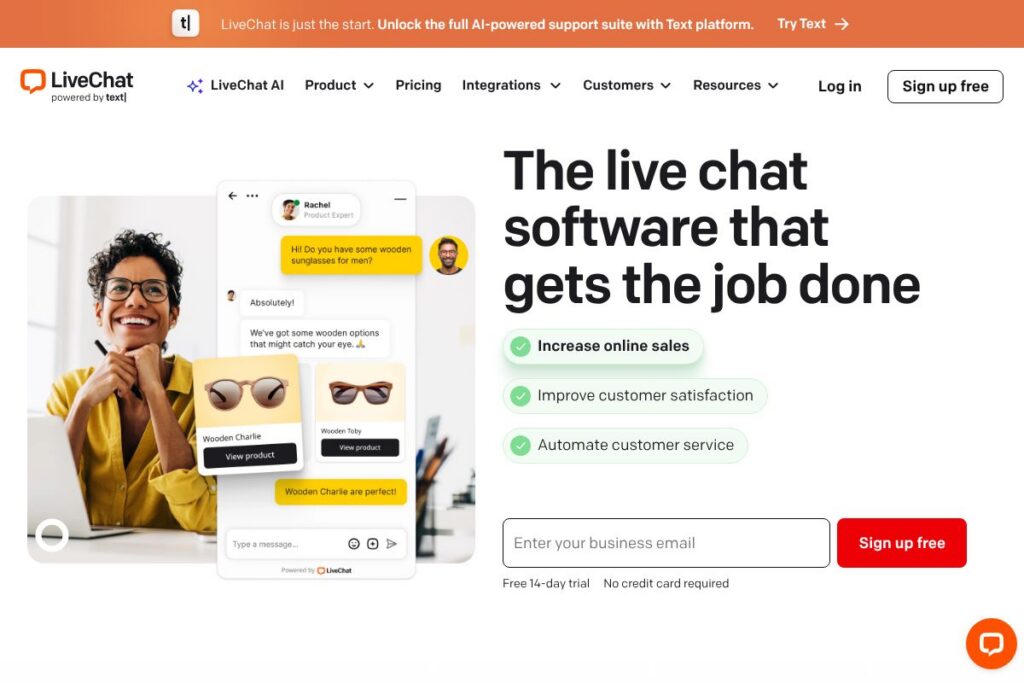
LiveChat is a live chat platform built to connect website visitors with support and sales teams in real time. It combines agent-facing chat tools, chatbot automation, and analytics to help ecommerce stores and B2B sites convert visitors, resolve issues faster, and centralize customer communication.
Compared with Intercom, Zendesk, and Drift, LiveChat focuses on a fast setup, a lightweight agent console, and a broad library of ecommerce integrations. Intercom emphasizes in-app messaging and product-led growth workflows, Zendesk packages chat into a broader ticketing suite, and Drift centers on account-based marketing features. LiveChat sits between those approaches by offering robust chat features and integrations at an accessible entry level while supporting advanced automation and reporting for growing teams.
LiveChat does particularly well at straightforward web chat deployment for online stores and small to mid-market support teams. Its combination of chatbots, agent assistance, and out-of-the-box ecommerce integrations makes it a practical choice for teams that need immediate web coverage and measurable impact on conversions and response times.
How LiveChat Works
Agents install a JavaScript widget on the website and handle incoming visitor conversations in the LiveChat web app, desktop app, or mobile apps. Chats can be routed to specific teams, assigned to agents, and augmented with pre-chat forms so agents get key context before answering.
Automation is available through rule-based triggers and AI chatbots that take initial inquiries, answer common questions, or hand off complex cases to human agents. LiveChat also surfaces customer data from integrated CRMs and ecommerce platforms inside the chat window so agents can personalize recommendations and close sales faster.
LiveChat features
LiveChat centers on live chat, automation, and analytics. Core capabilities include a lightweight agent console, AI-powered chatbots, agent Copilot assistance, ecommerce integrations, and reporting tools that track response times, conversion impact, and customer satisfaction. The platform continues to expand AI features and third-party connections to reduce repetitive work and improve agent productivity.
The platform includes several powerful capabilities worth highlighting below:
Real-time chat widget
The website widget supports proactive invitations, customizable greetings, and rich media sharing so agents can send product links, images, and files during conversations. It is optimized for desktop and mobile visitors and can be previewed and configured from the LiveChat admin panel.
Chatbots and automation
Chatbots manage routine questions like shipping status, refund policies, and basic troubleshooting so agents can focus on high-value interactions. Bots can capture lead information, route chats based on intent, and escalate to human agents when needed, which helps reduce average handling time and improve first response metrics.
Copilot AI for agents
Copilot provides on-the-fly suggestions and relevant knowledge snippets to agents while they type, helping craft faster, consistent replies and surface product recommendations. This functionality reduces training time and helps newer agents handle complex inquiries with more confidence.
Ecommerce integrations
Prebuilt connectors to platforms such as Shopify, WooCommerce, and Magento let LiveChat surface order details and product catalogs inside the chat window. Those integrations make it easier to suggest items, check order status, and capture sales without leaving the agent console.
Reporting and analytics
LiveChat offers out-of-the-box reports for chat volume, response time, satisfaction ratings, and conversion impact so teams can measure the business value of live chat. Reports are designed for non-technical users and include filters to track campaign performance, agent efficiency, and revenue linked to chat interactions.
Omnichannel messaging and ticketing
The platform consolidates messages from web chat, Facebook Messenger, Instagram, and other channels into a unified stream so agents can manage conversations from a single interface. When issues require follow-up, chats can convert into tickets that integrate with existing workflows.
With these capabilities LiveChat helps teams reduce friction in web conversations, automate repetitive tasks, and measure how chat affects sales and support KPIs.
LiveChat pricing
LiveChat uses a subscription pricing model with plans that scale from small teams to enterprise deployments, and it offers a free trial for new users. Public pricing starts at an entry-level monthly fee, while larger organizations can request custom enterprise plans with SLAs and advanced support.
Monthly Billing:
- Entry plan – $19/month (core live chat features, basic reporting, standard support)
- Enterprise – Custom pricing (advanced security, SSO, dedicated support, account onboarding)
Annual Billing:
- Entry plan – billed annually at a lower effective monthly rate; contact sales for exact annual pricing and discounts
For details about feature tiers and the latest plan options, review LiveChat’s current pricing options. If you need a high-availability deployment or custom SLAs, request a conversation with their sales team via the enterprise contact form.
What is LiveChat used for
LiveChat is used to provide live support and drive sales on websites by converting visitor intent into conversations. Teams use it to answer product questions, recover abandoned carts, qualify leads, and book appointments, with both human agents and automated bots handling different parts of the flow.
It is especially well suited for ecommerce merchants who need real-time product recommendations, and for customer service teams in B2B companies that require quick answers and integrated CRM context. Marketing and sales teams also use LiveChat to run proactive campaigns and measure chat-driven revenue.
Pros and Cons of LiveChat
Pros
- Fast setup and intuitive agent UI: LiveChat installs via a small snippet and agents can start handling chats quickly without a steep learning curve, which shortens onboarding time.
- Strong ecommerce integrations: Built-in connectors for stores allow agents to view order details and recommend products inside the chat, making it practical for online retailers.
- AI automation and agent assistance: Chatbots and Copilot reduce repetitive work and help agents respond with consistent, relevant information, increasing throughput and reducing response times.
- Clear reporting for non-technical users: The reporting dashboard provides actionable metrics about response time, chat ratings, and conversion impact without needing a data analyst.
Cons
- Advanced automation requires setup: Complex bot flows and custom integrations take time to design and test, which may require developer involvement for full automation scenarios.
- Costs can grow with scale: As chat volume and the number of seats increase, total subscription costs can rise, so high-volume teams should evaluate ROI and enterprise pricing carefully.
- Feature overlap with full-service helpdesks: Organizations already invested in a broader helpdesk platform may see overlapping features and will need to assess integration complexity and redundancy.
Does LiveChat Offer a Free Trial?
LiveChat offers a 14-day free trial with no credit card required. The trial includes access to core chat features, automation options, and reporting so you can test chat workflows and integrations before committing to a subscription.
LiveChat API and Integrations
LiveChat provides an API and developer documentation to extend the platform and build custom integrations. The LiveChat developer documentation describes REST and webhook endpoints for managing chats, agents, and visitors programmatically.
Key prebuilt integrations include ecommerce platforms and collaboration tools such as Shopify, WooCommerce, Magento, Salesforce, and Slack, which help bring customer data and notifications into the chat workflow. For automation, LiveChat connects with third-party bot builders and its own ChatBot product to orchestrate conversational flows.
10 LiveChat alternatives
Paid alternatives to LiveChat
- Intercom — In-app messaging and customer engagement platform focused on product-led growth and lifecycle messaging.
- Zendesk — A full helpdesk suite that includes chat as part of a broader ticketing and customer service product set.
- Drift — Conversational marketing and sales platform built for B2B with strong account-based automation features.
- Freshdesk — Customer support suite with chat, ticketing, and automation tools for teams of varying sizes.
- Tidio — Chat platform that combines bots and live chat with a focus on ecommerce users and simple automation.
- Olark — Lightweight web chat solution for straightforward live support and lead capture.
- HelpCrunch — Messaging platform that blends live chat, email automation, and helpdesk features.
Open source alternatives to LiveChat
- Chatwoot — Open source customer messaging platform with multichannel inbox and self-hosting options.
- Rocket.Chat — Real-time communication platform that can be extended with web chat widgets and self-hosted for full control.
- LiveHelperChat — Open source live chat application designed for websites, with self-hosting and customization capabilities.
- Zammad — Open source helpdesk with multi-channel support including chat, suitable for teams that want to self-host.
Frequently asked questions about LiveChat
What is LiveChat used for?
LiveChat is used to provide real-time chat and messaging on websites to support sales and customer service. Teams use it to answer visitor questions, recover carts, qualify leads, and log interactions for reporting.
Does LiveChat offer chatbot automation?
Yes, LiveChat supports chatbot automation via its ChatBot product and rule-based triggers. Chatbots can handle routine queries, collect customer information, and escalate conversations to human agents when needed.
How much does LiveChat cost per month?
LiveChat plans start at around $19 per month for entry-level subscriptions. Enterprise pricing is available via custom quotes that include advanced security and support options.
Can LiveChat integrate with ecommerce platforms?
Yes, LiveChat integrates with major ecommerce platforms including Shopify, WooCommerce, and Magento. Those integrations surface order and product data inside the chat window to help agents assist shoppers and close sales.
Does LiveChat provide an API for developers?
Yes, LiveChat provides a public API and developer documentation for building custom integrations and automations. The developer guides include REST endpoints, webhooks, and SDKs to connect LiveChat to other systems.
Final verdict: LiveChat
LiveChat is a practical choice for teams that need a straightforward, production-ready live chat solution with strong ecommerce integrations and growing AI capabilities. Its quick deployment, clear reporting, and bot options let small and mid-market teams start measuring chat-driven impact rapidly.
Compared with conversational suites like Intercom, LiveChat typically offers a lower entry point and concentrates on efficient web chat and conversion use cases rather than an expanded product messaging stack. For organizations that need deeper product-led engagement or advanced account-based tooling, Intercom may offer different trade-offs, but LiveChat provides a balanced feature set for sales and support at scale.
For teams deciding between options, evaluate chat volume, required integrations, and desired automation complexity. If you want to try the platform, sign up for the 14-day trial and review the LiveChat developer documentation to explore integrations and automation capabilities.