What is Arena
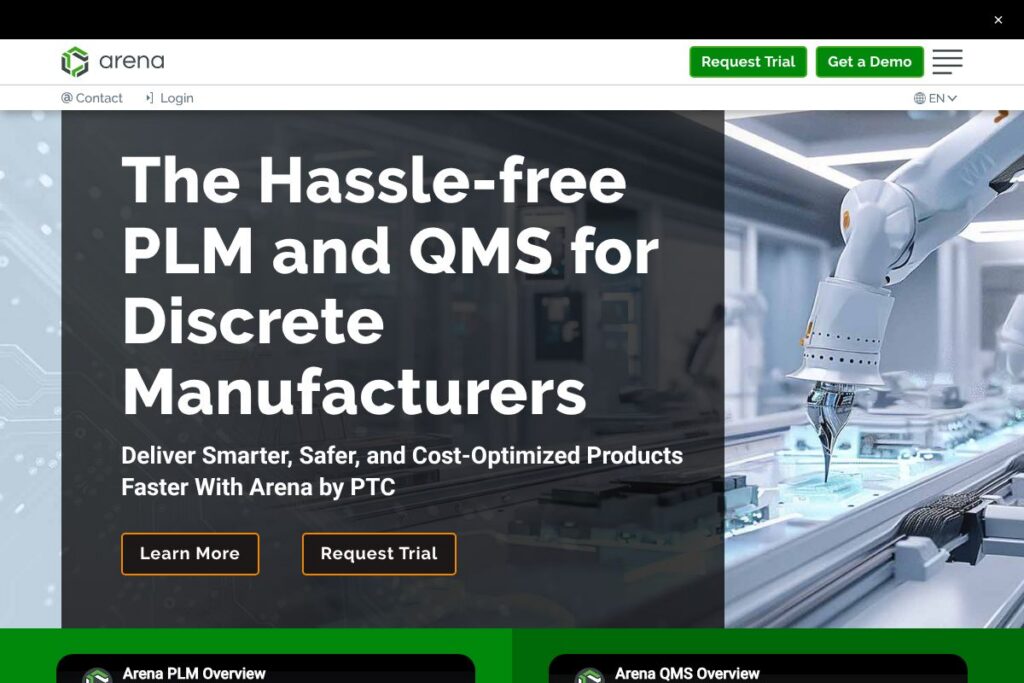
Arena is a cloud-native PLM and QMS platform designed to consolidate product data, engineering change processes, and quality workflows into a single system of record. It stores BOMs, CAD links, supplier data, and quality records so cross-functional teams can coordinate launches, updates, and corrective actions without version confusion.
Arena competes with established on-premises and cloud PLM suites such as PTC Windchill, Siemens Teamcenter, and Autodesk Fusion 360 Manage. Compared with PTC Windchill, Arena emphasizes faster cloud deployment and simpler administration; relative to Siemens Teamcenter, Arena trades some deep engineering customization for a more accessible SaaS experience; when compared with Autodesk Fusion 360 Manage, Arena offers broader built-in QMS capabilities for regulated workflows.
All of this makes Arena particularly well suited for electronics, medical device, aerospace, and CPG companies that need tightly controlled product records and built-in quality management. It excels at connecting CAD, supplier, and manufacturing information in a single workspace so teams can reduce BOM errors, speed approvals, and maintain traceability across product development.
How Arena Works
Arena operates as a centralized, multi-tenant SaaS system where the authoritative product record is stored in the cloud and accessible by product, engineering, quality, and sourcing teams. Users manage item masters, structured BOMs, CAD links, and documentation while change notices and engineering change orders flow through configurable approval workflows.
Typical workflows include creating an ECO, routing it for multi-step approvals, updating BOM revisions, and sending synchronized updates to ERP and sourcing systems. Arena integrates with CAD systems and PLM-friendly CAD platforms to import part metadata and drawings, sync changes, and reduce manual re-entry.
Arena also exposes APIs and webhooks so teams can automate integrations with ERP, MES, and supplier portals, and use analytics to monitor cycle times, nonconformance trends, and supplier performance for continuous improvement.
What does Arena do?
The platform combines PLM and QMS capabilities to manage product structure, change control, quality records, and supplier collaboration in one environment. Core capabilities include BOM management, ECO workflows, nonconformance and CAPA handling, supplier portals, and analytics that translate technical data into operational metrics.
Let’s talk Arena’s Features
Product record and BOM management
Arena stores a single source of truth for items, assemblies, and BOMs with revision control and traceability. This reduces duplicate parts, ensures consistent part numbering, and enables multi-level BOM views for engineering and manufacturing planning.
Engineering change and revision control
Change processes are handled through configurable ECOs and change notices with role-based approvals, signatures, and audit trails. Teams can route changes to stakeholders, attach affected files, and lock related records until the change is complete to prevent conflicting edits.
Quality management (QMS)
Built-in QMS covers nonconformance reporting, corrective and preventive actions (CAPA), training records, and audit trails needed for regulated industries. Quality records link to product and supplier data so teams can trace issues back to parts, batches, or suppliers.
CAD and PLM integrations
Arena links to CAD platforms to import part metadata, CAD files, and bill-of-materials data so design updates propagate into the product record. Integrations with systems like Onshape help eliminate manual syncs and enforce process discipline between CAD and PLM data.
Supplier collaboration and sourcing
Supplier portals allow external partners to view part requirements, respond to requests, and receive controlled data packages. This improves sourcing accuracy and helps reduce procurement lead times and mismatches at production.
Analytics and reporting
Arena Analytics converts PLM and QMS data into dashboards and reports for cycle time, ECO throughput, and quality KPIs. Real-time reporting reduces manual CSV exports and supports faster decision making across teams.
APIs and extensibility
The platform offers REST APIs and webhook support so teams can automate integrations with ERP, MES, and BI tools. Extensibility enables custom connectors and low-code workflows to align Arena to existing enterprise stacks.
With these capabilities, Arena helps teams maintain end-to-end traceability, reduce BOM errors, and accelerate time-to-market while enforcing quality and regulatory controls.
Arena pricing
Arena uses an enterprise SaaS pricing model with custom plans tailored to company size, required modules, and deployment needs. Public, line-item prices are not published, and licensing typically reflects seat counts, module selection (PLM, QMS, Analytics), and integration needs.
For specific plan details and quotes, consult Arena’s website and request a tailored estimate from their sales team. View Arena’s website for contact options and to discuss deployment, support, and implementation services.
What is Arena Used For?
Arena is commonly used to centralize product information management for companies that design, source, and manufacture complex assemblies. Engineering teams use it for controlled ECO processes, quality teams use it for CAPA and audit readiness, and sourcing teams use it to share accurate BOMs with suppliers.
Typical users include electronics OEMs, medical device manufacturers, aerospace suppliers, and contract manufacturers who must maintain traceability, manage supplier change, and meet regulatory obligations such as ISO 13485 or AS9100.
Pros and Cons of Arena
Pros
- Unified PLM and QMS: Arena combines product structure and quality workflows in one system so teams avoid data fragmentation and duplicate records.
- Cloud-native deployment: Rapid provisioning and centralized maintenance reduce IT overhead while simplifying updates and remote access for distributed teams.
- Strong integration posture: Flexible APIs and prebuilt connectors enable syncing with CAD systems, ERP platforms, and other enterprise applications to reduce manual rework.
- Traceability and compliance: Built-in audit trails, training records, and CAPA workflows help regulated companies maintain compliance and prepare for audits.
Cons
- Enterprise pricing model: Custom pricing and seat-based licensing can be more expensive for very small teams, and organizations must budget for implementation and configuration costs.
- Less deep CAD customization than heavy PLM suites: Organizations needing highly specialized, low-level CAD engineering workflows may find purpose-built on-premises PLM systems offer deeper customization.
- Change management overhead: Implementing disciplined PLM and QMS processes requires organizational change and governance to realize full benefits, which can lengthen time to ROI.
Does Arena Offer a Free Trial?
Arena offers product demos and trial discussions through its sales team. Prospective customers can request a demo or limited trial tailored to their workflows, typically by contacting Arena to arrange access and a walkthrough of PLM and QMS capabilities.
Arena API and Integrations
Arena provides REST APIs and webhook support to automate data flows between PLM, ERP, MES, and reporting tools. The API layer enables programmatic access to items, BOMs, ECOs, and quality records for synchronization and automation.
Key integrations include CAD platforms such as Onshape for direct design-to-BOM synchronization, and ERP systems like NetSuite and SAP for downstream execution. For partner and connector details, see Arena’s solutions and partner pages on their site at Arena’s website.
10 Arena alternatives
Paid alternatives to Arena
- PTC Windchill – Enterprise-grade PLM with deep CAD integration and complex change management for heavy engineering organizations.
- Siemens Teamcenter – Comprehensive PLM platform with advanced configurability and integration for large, regulated manufacturers.
- Autodesk Fusion 360 Manage – Cloud-based PLM that integrates closely with Autodesk CAD tools and offers a simpler SaaS approach to product records.
- Propel – Salesforce-native PLM and QMS focused on integrating product data with CRM and go-to-market processes.
- Omnify PLM – Cloud PLM targeted at electronics and medical device teams with lifecycle and compliance features.
- OpenBOM – Cloud BOM and inventory collaboration with integrations for CAD and ERP workflows for small to mid-sized manufacturers.
Open source alternatives to Arena
- Aras Innovator – Flexible PLM platform with a community edition and model-based architecture that supports heavy customization.
- Odoo (PLM module) – Open source ERP with a PLM module that offers basic versioning and BOM management inside a broader business suite.
- ERPNext – Open source ERP that includes basic PLM features, BOM tracking, and change control suitable for small manufacturers.
- OpenPLM – Community-driven PLM focused on document and product record management suitable for organizations willing to self-host and extend functionality.
Frequently asked questions about Arena
What is Arena used for?
Arena is used to manage product records, BOMs, change control, and quality processes. Organizations use it to centralize data, run controlled ECO processes, and maintain traceability across product development.
Does Arena integrate with Onshape?
Yes, Arena integrates with Onshape for CAD-to-PLM synchronization. The integration helps synchronize parts, assemblies, and BOM metadata to keep design and product records aligned.
How much does Arena cost?
Arena uses custom enterprise pricing based on seats, modules, and integration needs. For a tailored quote and deployment options, contact Arena through their website to discuss requirements and get a proposal.
Can Arena support regulated industries like medical devices and aerospace?
Yes, Arena supports regulated workflows and compliance needs such as CAPA, training records, and audit trails. Customers use Arena to help meet standards like ISO 13485 and AS9100 while maintaining traceability.
Does Arena provide an API for automation?
Yes, Arena provides REST APIs and webhook capabilities for automation and system integration. Developers can use the API to sync items, BOMs, ECOs, and quality records with ERP, MES, and analytics tools.
Final verdict: Arena
Arena stands out as a cloud-first PLM and QMS platform that reduces data silos by combining product lifecycle and quality processes in one environment. Its strengths are rapid deployment, supplier collaboration features, and built-in quality workflows that appeal to regulated manufacturers and hardware-centric companies.
Compared with PTC Windchill, which often requires larger on-premises investments and specialized administration, Arena offers a more streamlined SaaS approach and faster time to value, while PTC provides deeper engineering customization for large enterprises. Organizations seeking a managed cloud PLM with integrated QMS and modern APIs will find Arena a practical choice; for very large engineering organizations with bespoke CAD workflows, a heavier PLM like PTC Windchill or Siemens Teamcenter may be more appropriate.
For implementation options, integration guides, and to request a demo or quote, visit Arena’s website.