Adobe Commerce: An Overview
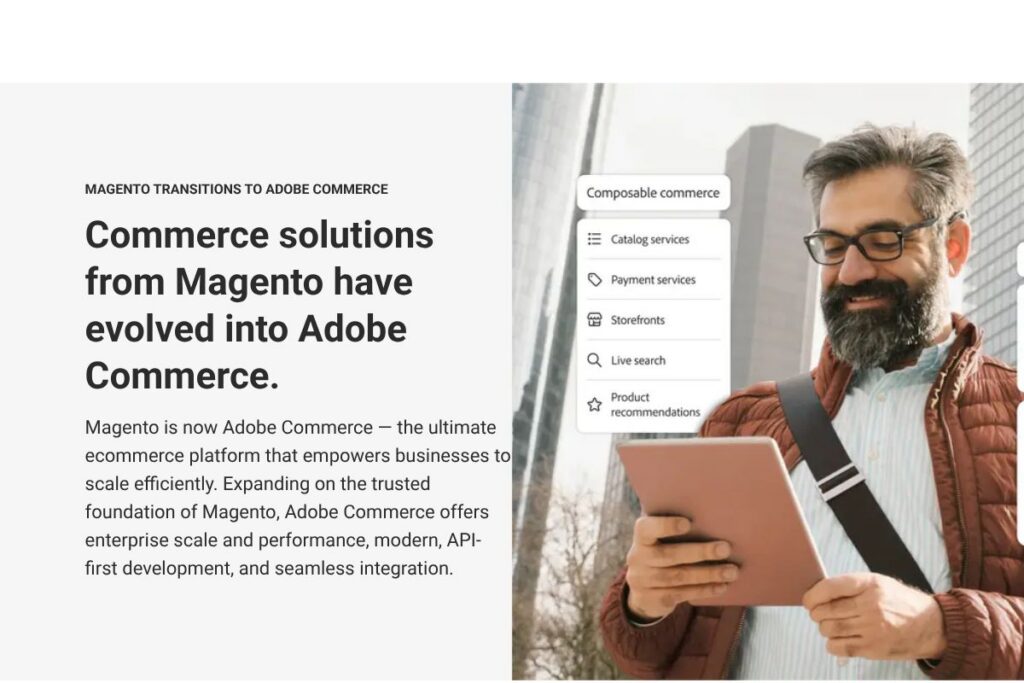
Adobe Commerce continues the evolution of Magento by combining the extensible Magento architecture with managed cloud capabilities and first-party integrations from Adobe Experience Cloud. The platform supports complex catalog models, B2B functionality, and headless storefronts while adding performance and scaling options suited to larger merchants. For developers and merchants who previously used Magento, Adobe Commerce preserves the same extension model and developer workflows while offering additional enterprise services and support.
Compared with competitors Adobe Commerce targets larger merchants and brands that require deep customization. Shopify Plus focuses on rapid time-to-market and hosted simplicity but is less flexible for heavily customized back-end workflows. Salesforce Commerce Cloud offers strong omnichannel and CRM-aligned commerce, but Adobe Commerce stands out when teams need a self-hosted or hybrid approach and the ability to run bespoke integrations. BigCommerce Enterprise provides a middle ground with hosted enterprise features, however Adobe Commerce emphasizes tighter integration with Adobe Experience Manager and Adobe Analytics for content-driven commerce.
All of this makes Adobe Commerce a strong fit for enterprises and fast-growing retailers that need a customizable platform integrated with the Adobe stack, and for developer teams that want full control over code and deployment while leveraging managed cloud services and enterprise support.
How Adobe Commerce Works
Adobe Commerce runs on the Magento codebase and can be deployed as a managed cloud service or on a self-managed infrastructure. Developers build modules and themes using PHP and modern front-end patterns; store logic, product catalogs, and checkout flows are exposed via REST and GraphQL APIs for headless implementations.
Operational workflows typically separate content and commerce: marketing teams use Adobe Experience Manager and Adobe Analytics to create and measure content, while commerce teams manage SKUs, pricing, and promotions in Adobe Commerce. Integrations with payment gateways, ERP systems, and order management systems are common; day-to-day operations include catalog updates, indexing, cache management, and automated deployments for releases.
Adobe Commerce features
Adobe Commerce combines Magento’s modular e-commerce capabilities with cloud services and Adobe Experience Cloud integrations. Core strengths include catalog and product management, flexible checkout, B2B features, headless APIs, and enterprise tools for performance and security. Recent emphasis has been on cloud performance, personalization via Adobe tools, and developer experience improvements including GraphQL and progressive web app support.
Cloud hosting and scalability
Managed cloud hosting provides autoscaling, CDN integration, and optimized caches to handle traffic spikes. This reduces infrastructure overhead for merchants and offers predictable performance for large catalogs and peak events. The managed service includes operational tooling for backups and monitoring to support uptime at scale.
Personalization and Adobe Experience Cloud integration
Native connections to Adobe Experience Manager, Adobe Analytics, and Adobe Target enable server-side and client-side personalization based on behavioral and content signals. Marketers can coordinate campaigns and content with catalog data to create targeted shopping experiences. This integration helps drive higher conversion through data-driven merchandising and testing.
B2B commerce capabilities
Features for B2B include company accounts, shared catalogs, custom price lists, requisitions, and role-based purchasing. These features address common wholesale workflows such as negotiated pricing, purchase orders, and account hierarchies. Combined with APIs, businesses can automate large enterprise purchasing and invoicing flows.
Headless commerce and PWA support
Adobe Commerce exposes REST and GraphQL APIs to support headless front-ends and progressive web apps. This enables teams to build decoupled storefronts for performance and flexibility, and to reuse commerce services across web, mobile, and IoT channels. A headless approach reduces front-end constraints and enables modern development cycles.
Merchandising, promotions, and catalog management
Advanced catalog tools let merchants manage complex product relationships, custom attributes, and layered navigation. Promotions and pricing engines handle tiered discounts, coupon campaigns, and customer-segmented pricing. Catalog indexing and search integrations ensure product discovery remains fast for large inventories.
Security, compliance, and enterprise operations
Adobe Commerce includes features for PCI compliance, role-based access control, and security patches managed through Adobe. Enterprise-grade logging, monitoring, and support SLAs are available for larger customers. Built-in tools help enforce secure deployments and streamline compliance workflows.
With Adobe Commerce you get a platform that supports complex, content-driven commerce at enterprise scale while maintaining the flexibility developers expect from Magento.
Adobe Commerce pricing
Adobe Commerce uses a custom enterprise pricing model tailored to merchant size, required services, and deployment options. Pricing typically factors in the chosen deployment mode, expected traffic, support level, and added Adobe Experience Cloud services. For organizations comparing options, it is common to evaluate total cost including cloud hosting, implementation, and third-party integrations.
Enterprise
Enterprise – Custom pricing (Includes enterprise features, managed cloud options, Adobe integrations, and SLAs). For specific licensing and service costs, consult the Adobe Commerce product page to request a quote and review packaging options.
View the Adobe Commerce product page for current enterprise packaging and contact options.
What is Adobe Commerce Used For?
Adobe Commerce is used to build and run ecommerce sites that require flexible product models, complex promotions, and deep integrations with content and analytics tools. Retailers use it to manage large catalogs, multi-store setups, and to implement tailored checkout and fulfillment flows.
It is also used by B2B suppliers for account-based purchasing workflows, by brands that need integrated content and commerce experiences, and by development teams that want control over customizations while retaining enterprise support and cloud operations.
Pros and cons of Adobe Commerce
Pros
- Extensibility: The modular Magento architecture allows deep customization and third-party integrations, enabling bespoke commerce solutions that align with unique business processes.
- Adobe ecosystem integration: Tight connections to Adobe Experience Manager, Adobe Analytics, and Adobe Target provide unified content and personalization capabilities across marketing and commerce teams.
- B2B feature set: Built-in support for company accounts, shared catalogs, and custom pricing covers common wholesale and enterprise procurement needs.
- Headless and API-driven: REST and GraphQL APIs support decoupled front-ends, enabling PWAs and multi-channel experiences with modern developer workflows.
- Managed cloud options: Adobe offers managed hosting and operational services that reduce infrastructure management for large merchants.
Cons
- Complex implementation: Setting up Adobe Commerce for enterprise use often requires substantial development and project management resources, which increases time to launch.
- Cost variability: Total cost of ownership can be high once hosting, integrations, and implementation services are included; pricing is custom and requires vendor engagement.
- Maintenance overhead for self-hosted: If a merchant chooses self-managed deployment, they must handle scaling, security patches, and performance tuning in-house.
- Steep learning curve: Development and operations teams need familiarity with Magento architecture and best practices to implement efficient, maintainable solutions.
Does Adobe Commerce Offer a Free Trial?
Adobe Commerce uses enterprise licensing and does not offer a public free plan; Magento Open Source is free to use. Magento Open Source is available for developers to download and self-host and can be accessed through the Magento Open Source repository on GitHub. For enterprise trials, reach out via the Adobe Commerce product page to discuss demo and evaluation options.
Adobe Commerce API and Integrations
Adobe Commerce provides REST and GraphQL APIs for catalog, checkout, orders, and customer data, and extensive developer documentation is available in the Adobe Commerce developer documentation. The APIs make it possible to build headless storefronts, integrate order management systems, and automate merchandising workflows.
Common integrations include Adobe Experience Manager, Adobe Analytics, Adobe Target, payment providers such as PayPal and Stripe, and ERP or OMS systems like NetSuite or SAP. For API reference and developer guides, consult the Adobe Commerce developer documentation.
10 Adobe Commerce alternatives
Paid alternatives to Adobe Commerce
- Shopify Plus — A hosted enterprise offering focused on fast launch, integrated hosting, and managed scaling with a simplified extension model.
- Salesforce Commerce Cloud — Commerce solution with deep CRM and omnichannel capabilities geared toward large retailers and brands.
- BigCommerce Enterprise — Hosted platform with enterprise-grade features and extensibility for large catalogs and multi-store deployments.
- commercetools — API-first, headless commerce platform designed for composable commerce architectures and rapid front-end iteration.
- Oracle Commerce — Enterprise commerce with strong personalization, search, and large-catalog management capabilities.
- SAP Commerce Cloud — Enterprise solution well-suited to complex B2B and B2C scenarios with heavy backend integrations to SAP ERP systems.
- VTEX — Cloud-native commerce platform with marketplace capabilities and a focus on global retailers.
Open source alternatives to Adobe Commerce
- Magento Open Source — The underlying open-source Magento edition for merchants and developers who want a self-hosted, no-license-cost starting point; available on GitHub.
- Saleor — Modern, GraphQL-first open source ecommerce platform built with a focus on headless storefronts and developer experience.
- PrestaShop — Open source ecommerce platform with a large module ecosystem and a strong European user base.
- WooCommerce — WordPress-based ecommerce plugin suitable for content-driven stores and smaller catalogs.
- Reaction Commerce — API-driven open source platform designed for real-time commerce experiences and flexible integrations.
Frequently asked questions about Adobe Commerce
What is Adobe Commerce used for?
Adobe Commerce is used to build enterprise-grade ecommerce sites and multi-store setups. Organizations use it for complex catalogs, B2B workflows, integrated content and personalization, and custom checkout and fulfillment processes.
How does Adobe Commerce relate to Magento?
Adobe Commerce is the enterprise product built on the Magento codebase while Magento Open Source remains available for self-hosting. Adobe Commerce adds managed services, enterprise support, and first-party Adobe integrations to the Magento foundation.
Does Adobe Commerce have a free version?
Magento Open Source is free to download and use, while Adobe Commerce requires enterprise licensing. Developers can use Magento Open Source from the official repository for self-hosted projects, and enterprises can request pricing and trials for Adobe Commerce.
Can Adobe Commerce be hosted in the cloud?
Yes, Adobe offers managed cloud hosting for Adobe Commerce and the platform can also be self-hosted or deployed on private cloud infrastructure. Managed hosting includes operational services, scaling, and CDN support to handle peak traffic events.
Does Adobe Commerce provide APIs for headless implementations?
Yes, Adobe Commerce exposes REST and GraphQL APIs for commerce operations. These APIs support headless front-ends, PWAs, and integrations with third-party systems for orders, inventory, and customer data.
Final verdict: Adobe Commerce
Adobe Commerce is a robust enterprise commerce platform that preserves Magento’s flexibility while adding managed cloud options and deep integrations with Adobe’s marketing and analytics tools. It excels when teams need a customizable platform that can scale to large catalogs, complex B2B requirements, and content-driven commerce scenarios.
Compared with Shopify Plus at around $2,000/month for a hosted enterprise setup, Adobe Commerce follows a custom enterprise pricing model and typically requires a larger implementation investment but delivers greater flexibility and tighter integration with Adobe Experience Cloud. For organizations prioritizing control, extensive customization, and Adobe-native personalization, Adobe Commerce is a strong option; for teams that prefer a faster hosted path with predictable monthly pricing, Shopify Plus or BigCommerce Enterprise may be better fits.
For enterprise licensing, demos, and to discuss deployment options, visit the Adobe Commerce product page.