MarketMan: An Overview
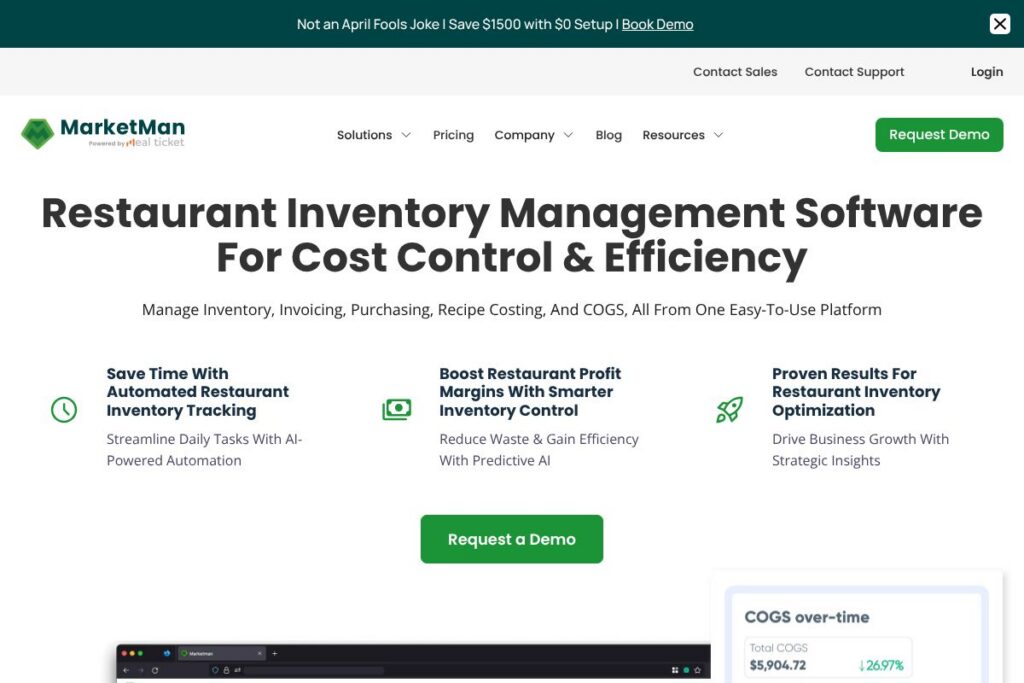
MarketMan is a cloud-first restaurant inventory and purchasing platform built to centralize back-of-house operations. It combines inventory tracking, vendor ordering, recipe costing, invoice matching, and COGS reporting so operators can see food cost and profitability in near real time.
Compared with competitors, MarketMan focuses tightly on procurement and inventory workflows rather than acting primarily as a POS. For example, Toast bundles POS and front-of-house features with optional inventory modules that may require additional fees and integrations. CrunchTime targets larger enterprise groups with broad operational analytics and typically higher implementation costs, while BlueCart emphasizes supplier marketplace and order consolidation for multi-site operators.
MarketMan does especially well at linking purchasing to recipe-level costing and vendor performance, making it a practical choice for single-location restaurants up through multi-unit chains that need tighter control over food spend and automated ordering recommendations. The platform suits operations that want to reduce manual paperwork, improve order accuracy, and lower COGS through predictive ordering and waste tracking.
How MarketMan Works
MarketMan runs as a web and mobile application that maps your menu items to inventory items and vendor SKUs. Users enter or import supplier catalogs, set par levels, and create recipes that automatically calculate ingredient costs, then MarketMan updates inventory on purchases, transfers, and waste entries.
Day-to-day workflows include taking quick mobile inventory counts, receiving and matching invoices against purchase orders, and using suggested order quantities generated from historical usage and predictive analytics. Reporting surfaces live COGS, menu item profitability, and vendor price changes so managers can act on anomalies and renegotiate as needed.
Implementation typically involves data migration for inventory items and vendor catalogs, mapping recipes to ingredients, connecting POS and accounting integrations, and staff training to standardize receiving and waste logging procedures. Once configured, teams use the mobile app for counts and the web app for purchasing, vendor management, and reporting.
MarketMan features
MarketMan’s core capabilities center on inventory accuracy, procurement automation, and recipe-level cost visibility. The platform adds AI-backed ordering recommendations, mobile ordering and counting, invoice matching, and integrations with POS and accounting systems to reduce manual reconciliation.
Web & Mobile Restaurant Inventory Management
Inventory can be accessed and updated from any device, enabling counts on tablets or phones and centralized inventory visibility across locations. That mobility reduces counting time and keeps inventory records current for COGS reporting.
Recipe Costing and Menu Profitability
Recipes are built from inventory ingredients so every menu item’s cost is calculated automatically as input prices change. This makes it straightforward to identify low-margin dishes and adjust pricing or menu mix accordingly.
AI Ordering and Predictive Analytics
AI-powered ordering suggests quantities based on usage patterns, upcoming demand, and par levels to help minimize overbuying and reduce waste. These forecasts aim to lower food spoilage and tighten inventory turns.
Purchasing, PO Management, and Invoice Matching
Create and send purchase orders to suppliers, then match invoices to POs to catch price discrepancies and reduce manual bookkeeping. Centralized PO history provides audit trails for vendor performance and dispute resolution.
Vendor and Price Tracking
Track vendor price changes and shortages so purchasing teams can react quickly to cost spikes or supply issues. Alerts and historical pricing help when negotiating or switching suppliers.
Accounting and POS Integrations
MarketMan integrates inventory and purchase data into accounting systems and connects with major POS platforms so sales and inventory flow into unified cost reporting. This reduces duplicate data entry and improves COGS accuracy.
With these features, the biggest benefit is streamlined back-of-house operations: fewer manual spreadsheets, faster inventory cycles, and clearer visibility into food cost drivers that directly affect profitability.
MarketMan pricing
MarketMan uses a tiered subscription model aimed at different operator sizes, with clear monthly plan options and a custom enterprise tier for complex deployments. The pricing shown here reflects the published monthly tiers and a custom enterprise option.
Monthly Billing:
Starter – $199 /monthly (Web & Mobile App, Placing & Receiving Purchase Orders, Price Tracking & Alerts, Live Inventory Management, POS & Accounting Software Integrations)
Growth – $249 /monthly (All Starter features plus Automatic Vendor Management, Inventory Waste Tracking, Unlimited AI-Powered Recipe Creation, Real-Time Recipe Costing, Automatic COGS)
Enterprise
Enterprise – Custom (All Growth features plus AI Ordering, included vendor integrations, Order By Recipe, Open API access, and advanced onboarding and support)
For tailored quotes, demo scheduling, and the latest plan details, see the MarketMan homepage for current commercial options and enterprise contact channels.
What is MarketMan Used For?
MarketMan is used to centralize inventory control, automate purchasing, and calculate recipe costs so restaurants understand and manage their food cost drivers. Typical tasks include mobile inventory counts, PO creation, invoice reconciliation, and tracking waste or transfers across locations.
The platform is suitable for coffee shops, quick-service restaurants, full-service dining, bars, ghost kitchens, and hospitality groups. It supports single-location operators looking to replace spreadsheets, and multi-unit groups that require consolidated purchasing, vendor management, and cross-location reporting.
Pros and Cons of MarketMan
Pros
- Real-time inventory visibility: Provides current stock levels across locations, which helps managers make faster purchasing and menu decisions.
- Integrated recipe costing: Automatically ties ingredient prices to menu items, enabling accurate COGS and margin analysis at the dish level.
- Automated purchasing recommendations: Predictive ordering reduces manual calculations, lowers waste, and streamlines vendor ordering workflows.
- Mobile-first workflows: Counting, receiving, and ordering can be done from tablets and phones, reducing time spent on paperwork and improving data accuracy.
Cons
- Monthly subscription for core features: Smaller operators on tight budgets may find the $199 /monthly Starter plan a notable recurring expense compared with manual spreadsheets or simpler apps.
- Enterprise onboarding complexity: Multi-location rollouts with custom integrations require implementation and training time, which can extend time-to-value for large groups.
- Learning curve for staff: Restaurants replacing ad-hoc processes must invest in training to ensure consistent receiving, waste logging, and recipe management practices.
Does MarketMan Offer a Free Trial?
MarketMan offers a free demo rather than a perpetual free plan. The company provides a no-obligation demo with a MarketMan specialist who walks through the platform, reviews reporting, and answers questions specific to your operation; contact options are available on the MarketMan homepage.
MarketMan API and Integrations
MarketMan provides developer-friendly integration options and connects with major POS systems, accounting platforms, and food distributors to synchronize sales, purchasing, and inventory data. See the MarketMan integrations information for a list of supported partners and setup guidance.
The platform includes open API access for Enterprise customers, enabling custom workflows such as ERP integration, automated order routing, and two-way synchronization between MarketMan and third-party systems.
10 MarketMan alternatives
Paid alternatives to MarketMan
- Toast — POS-first platform with add-on inventory and vendor management modules, commonly used by full-service and quick-service restaurants.
- CrunchTime — Enterprise-focused operations and inventory management with deep analytics for large multi-unit restaurant groups.
- BlueCart — Purchasing and supplier marketplace that centralizes orders and streamlines supplier communication for multi-site operations.
- Upserve — Restaurant management suite with POS, analytics, and inventory features geared to independent restaurants and small chains.
- xtraCHEF — Invoice processing and inventory tools focused on automating invoice capture and cost reconciliation for restaurants.
- Orderly — Costing and inventory workflow tools designed to simplify invoice tracking and vendor communication.
- SimpleOrder — Inventory and purchasing tool that emphasizes recipe costing and supplier order automation for growing restaurants.
- BevSpot — Inventory and purchasing platform focused on beverage management and cost control for bars and restaurants.
- MarketMan (comparison context) — When evaluating MarketMan, compare required features, integrations, and pricing with the options above to determine the best fit for your operation.
- Revel Systems — Cloud POS with inventory and reporting capabilities for multi-location retailers and restaurants.
Open source alternatives to MarketMan
- SambaPOS — Open source POS with inventory extensions used by smaller operators who prefer self-hosting and customization.
- Odoo (Inventory module) — Open source ERP with inventory and purchasing modules that can be adapted for restaurant use with configuration.
- ERPNext — Open source ERP offering inventory, purchasing, and accounting features suitable for operators who can self-host and customize workflows.
Frequently asked questions about MarketMan
What is MarketMan and how does MarketMan improve restaurant profitability?
MarketMan centralizes inventory, purchasing, and recipe costing to reduce food waste and manual work. By providing real-time COGS and automated purchasing suggestions, restaurants typically see improvements in cost control and reduced time on bookkeeping tasks.
Does MarketMan integrate with my POS and accounting software?
Yes, MarketMan supports integrations with major POS and accounting platforms. These integrations synchronize sales and purchase data so COGS and inventory reports reflect actual activity across systems; consult the MarketMan integrations information for partner details.
How much does MarketMan cost per month?
MarketMan starts at a monthly subscription of $199 for the Starter plan and $249 for the Growth plan, with custom Enterprise pricing available. Contact MarketMan for a demo and a quote tailored to your number of locations and integration needs via the MarketMan homepage.
Can MarketMan handle multi-location restaurant groups?
Yes, MarketMan supports single sites through large multi-unit operations. Features like consolidated purchasing, vendor management, and cross-location reporting are built to scale for groups that require centralized oversight.
Does MarketMan offer an API for automation?
MarketMan provides API access, including open API options for Enterprise customers. These APIs enable custom integrations with ERPs, automated ordering workflows, and deeper data synchronization; reach out through the MarketMan homepage for developer access and documentation.
Final Verdict: MarketMan
MarketMan is a focused back-of-house platform that excels at connecting purchasing, inventory, and recipe costing to give restaurants clearer visibility into food costs. Its strengths lie in PO and invoice management, recipe-level cost tracking, and AI-driven ordering recommendations that reduce waste and free up staff time.
Compared with Toast, MarketMan places more emphasis on purchasing workflows and vendor management rather than acting as a full POS suite. MarketMan’s Starter plan at $199 /monthly provides deeper procurement and cost-control features out of the box, while Toast typically prices POS subscriptions lower but may require additional modules or integrations for comparable inventory and purchasing capabilities. For operators whose primary need is rigorous inventory control and procurement automation, MarketMan is a practical choice; for teams that want an all-in-one POS-centric solution, a POS-first vendor may be preferable.