What is Aspect Workforce
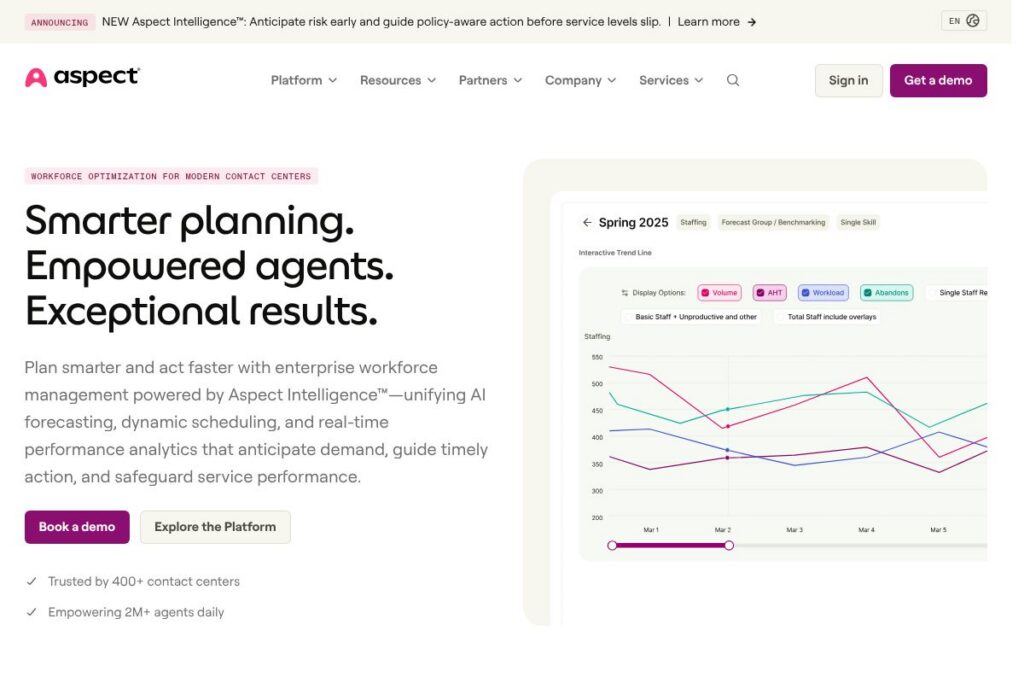
Aspect Workforce is an enterprise workforce management and engagement platform built for contact centers. It combines multi-model forecasting, policy-aware scheduling, intraday adherence tracking, and workforce engagement management in a single platform so large operations can plan, staff, and measure performance across distributed teams.
Aspect positions its solution around intelligence embedded in core workflows, branded as Aspect Intelligence, which proactively adjusts schedules, flags risks, and reduces manual intervention. That approach differentiates it from legacy WFM systems that rely on manual updates and static schedules.
Compared with competitors, Aspect Workforce emphasizes integrated WEM and forecasting: NICE and Verint both offer strong forecasting and analytics but often require separate modules for WEM capabilities, while Genesys focuses on cloud contact center routing and embeds workforce features as part of a broader CX platform. All of this makes Aspect Workforce well suited to large contact centers that need centralized control, embedded AI for forecasting and intraday management, and a single platform for scheduling and agent engagement.
How Aspect Workforce Works
Forecasting begins with multi-model demand prediction that learns from historical interaction data, channel mix, and calendar effects, then produces staffing targets for each interval. Forecasts feed directly into schedule generation, so predicted volumes are translated into shift requirements and coverage plans.
Scheduling uses policy-aware automation to enforce labor rules while supporting shift bidding, trading, and preference-based rostering; managers can run automated optimization and then review or adjust proposed rosters. Intraday management monitors adherence, queue performance, and agent status in real time, with alerts that guide supervisors to intervene before service levels degrade.
Operational workflows are typically implemented during an onboarding phase that connects Aspect Workforce to core systems such as telephony, CRM, and HR platforms. Once connected, the platform runs on Aspect WorkforceOS with open APIs, enabling custom integrations and automated data flows between forecasting, scheduling, payroll, and performance modules.
Aspect Workforce features
Aspect Workforce centers on forecasting, scheduling, intraday management, and workforce engagement, with an architecture that supports cloud, hybrid, or on-premises deployments. Recent platform improvements emphasize AI-driven forecasting, automated schedule adjustments, and tighter integrations with WEM modules for coaching and gamification.
Let’s talk Aspect Workforce’s Features
Multi-model forecasting
Forecasting uses multiple statistical and machine learning models to capture different demand patterns, then blends results to improve accuracy. That increases confidence in staffing plans and reduces the need for reactive intraday changes, which helps maintain service-level agreements.
Automated scheduling and rostering
Policy-aware automation generates schedules that respect labor rules, agent preferences, and business priorities, and it supports shift bidding and trading for greater agent flexibility. Automation reduces manual schedule edits and speeds up planning cycles for large workforces.
Intraday adherence and monitoring
Real-time adherence tracks agent presence, activity state, and performance against schedule targets, while intelligent alerts highlight emerging risks. Supervisors receive actionable signals to reassign staff, adjust breaks, or open overflow to avoid SLA breaches.
Workforce engagement management (WEM)
WEM modules consolidate quality monitoring, performance analytics, coaching, and gamification to motivate agents and close feedback loops. Integrated coaching and performance tracking link daily KPIs to development actions and recognition programs.
Analytics and reporting
Built-in analytics provide dashboards for forecast accuracy, schedule efficiency, shrinkage, and adherence metrics, with configurable reports for finance and operations. Data export and custom reports support audit, payroll reconciliation, and operational reviews.
Aspect WorkforceOS and APIs
The underlying platform exposes open APIs and integration points to connect to telephony, CRM, HRIS, and payroll systems, enabling automated data exchange and custom extensions. These APIs make it possible to embed forecasting outputs into third-party systems or to pull adherence events into enterprise monitoring tools; see the Aspect Workforce platform pages for developer resources and integration guides.
Flexible deployment and scalability
Aspect supports cloud, hybrid, and on-premises deployments that scale from single sites to global contact center footprints. Deployment options let organizations choose a model that matches their security, latency, and integration requirements.
Security and compliance
Enterprise-grade security controls include role-based access, audit trails, and compliance features suited to regulated environments. These controls help enforce governance while protecting employee and customer data.
With these capabilities, Aspect Workforce’s biggest benefit is reducing manual work while improving forecast-driven staffing and intraday control, which together lead to steadier service levels and lower operational cost.
Aspect Workforce pricing
Aspect Workforce uses an enterprise pricing model with custom quotes tailored to deployment type, workforce size, and required modules. Pricing is typically structured around seat counts, module selection, and support levels rather than fixed public plans, so organizations receive proposals based on usage and integration scope.
For a tailored estimate or to test potential savings, use the ROI calculator or contact Aspect’s sales team through the contact page to request a detailed quote and implementation options.
What is Aspect Workforce Used For?
Large contact centers use Aspect Workforce to predict demand, build compliant schedules, manage intraday activity, and engage agents through quality and performance tools. The platform is designed to support complex rules, multiple channels, and distributed teams so operations can maintain consistent service across regions and shifts.
Typical users include workforce planners, schedulers, real-time analysts, operations managers, and HR/payroll teams who need centralized reporting and integrations to back-office systems. Organizations aiming to reduce manual admin tasks, lower turnover through predictable scheduling, and improve SLA performance will find these capabilities directly applicable.
Pros and Cons of Aspect Workforce
Pros
- Accurate forecasting: The multi-model forecasting approach improves prediction accuracy, which reduces understaffing and overstaffing and leads to more stable service levels.
- Integrated WEM: Combining scheduling, quality monitoring, coaching, and gamification in one platform simplifies administration and links agent development to daily metrics.
- Policy-aware automation: Automated scheduling enforces labor rules while supporting shift bidding and trading, cutting manual schedule changes and supporting agent preferences.
- Flexible deployment: Cloud, hybrid, and on-premises options allow organizations to choose the architecture that matches their security and integration needs.
Cons
- Enterprise-focused pricing: The custom pricing model can make initial comparisons harder for smaller buyers, as there are no public per-user or per-seat prices to benchmark against.
- Implementation complexity: Integrating telephony, CRM, and HR systems at enterprise scale requires planning and resources, which can extend time to value for very large deployments.
- Learning curve for advanced features: Teams may need training to fully leverage AI forecasting models and the WEM modules for coaching and analytics.
Does Aspect Workforce Offer a Free Trial?
Aspect Workforce is paid enterprise software with custom pricing and typically does not offer a public free plan or self-serve trial. Prospective customers can request demos, pilot programs, or proofs of concept through Aspect’s sales team to validate fit and ROI before full deployment; use the contact page to request a demo or pilot.
Aspect Workforce API and Integrations
Aspect provides APIs and integration points through its platform to connect forecasting, scheduling, and adherence data with telephony, CRM, HRIS, and payroll systems. The developer and integration resources describe available endpoints and common integration patterns for enterprise deployments.
Key integrations commonly implemented include telephony platforms, Salesforce, directory and HR systems for rostering, and analytics/BI tools for custom reporting. These integrations enable automated data flows that reduce manual reconciliation and improve accuracy across systems.
10 Aspect Workforce alternatives
Paid alternatives to Aspect Workforce
- NICE: An established provider of WFM and analytics with strong forecasting and speech analytics capabilities used by large enterprises.
- Verint: Offers workforce management and customer engagement solutions with integrated quality and analytics modules for regulated environments.
- Genesys: A cloud contact center platform that includes workforce management as part of a broader CX suite, favored by organizations seeking tight routing and agent experience integration.
- Calabrio: Focuses on workforce optimization and analytics with a user-friendly interface and strong quality monitoring tools.
- Workday: While primarily an HR and finance suite, Workday offers workforce planning and scheduling capabilities for enterprise HR-driven scheduling scenarios.
- SAS Workforce: Enterprise analytics and forecasting capabilities tailored for complex forecasting needs in large operations.
- Kronos (UKG): Workforce management with robust scheduling, timekeeping, and labor compliance tools, often used in retail and service industries.
Open source alternatives to Aspect Workforce
- Asterisk: An open-source telephony platform that can be combined with custom scheduling and reporting tools to build basic contact center workflows.
- FreeSWITCH: Telephony engine for building custom contact center systems; requires additional modules or custom development for full WFM capabilities.
- Elastix (or similar forks): Historically used as an open-source unified communications platform; can serve as a base for building scheduling and reporting functions with integration work.
- Odoo (Community Edition): Open-source ERP that includes basic scheduling and HR modules which can be extended to support simple workforce planning with custom development.
Frequently asked questions about Aspect Workforce
What is Aspect Workforce used for?
Aspect Workforce is used for forecasting, scheduling, intraday adherence, and workforce engagement in contact centers. It helps operations plan staffing, enforce labor rules, and monitor real-time performance to meet service-level targets.
Does Aspect Workforce integrate with Salesforce?
Yes, Aspect Workforce can integrate with Salesforce through API or prebuilt connectors. Integrations typically sync contact and interaction data to improve forecasting and schedule alignment with CRM-driven workload.
How much does Aspect Workforce cost?
Aspect Workforce uses enterprise pricing with custom quotes based on deployment model, module selection, and workforce size; contact Aspect via the ROI calculator or the contact page for a tailored estimate.
Can Aspect Workforce handle multi-site and global contact centers?
Yes, Aspect Workforce supports multi-site and global deployments with configurable time zones, localized labor rules, and scalable architecture for large distributed teams.
Does Aspect Workforce provide APIs for automation?
Yes, Aspect exposes APIs for integrations and automation. Documentation and developer resources are available through Aspect’s platform pages to help teams automate data flows and build custom connectors.
Final verdict: Aspect Workforce
Aspect Workforce is a comprehensive enterprise WFM and WEM platform that excels at combining accurate, AI-driven forecasting with policy-aware scheduling and real-time intraday controls. Its integrated WEM modules add value by connecting coaching, quality, and gamification to daily operations, which helps reduce turnover and improve agent performance.
Compared with Genesys, which supplies workforce features as part of a broader cloud contact center offering, Aspect Workforce focuses more narrowly on workforce optimization and engagement with deep forecasting and intraday tooling. Both vendors use enterprise, custom pricing models, so the choice often comes down to whether an organization prefers a single-vendor cloud contact center plus WFM, as with Genesys, or a specialized workforce and engagement platform like Aspect that can integrate with existing contact center infrastructure.
Overall, Aspect Workforce is well suited to large contact centers that need centralized workforce control, advanced forecasting, and an integrated approach to agent engagement and compliance. For operations prioritizing forecast accuracy and intraday automation, Aspect Workforce delivers a feature set designed to lower manual work and stabilize service levels.