What is MirrorFly
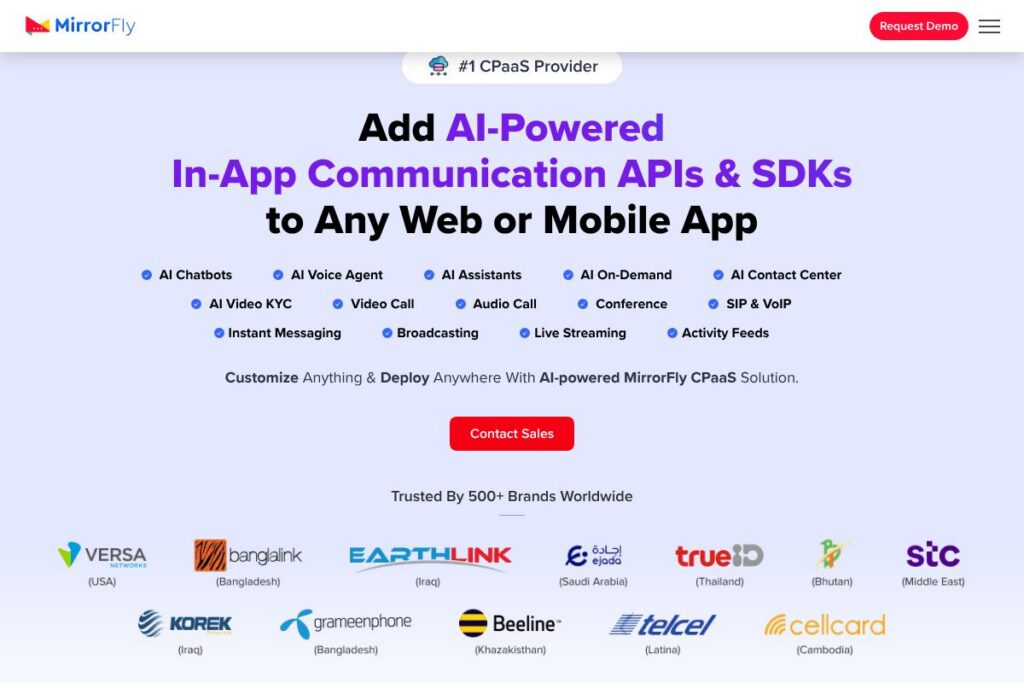
MirrorFly is a self-hosted communications platform-as-a-service built to embed real-time chat, video, voice, SIP/VoIP, AI agents, and chatbot capabilities into web and mobile apps. The platform emphasizes full source code access, multi-tenant deployment, and complete customer data ownership so organizations can run communications on their infrastructure or isolated cloud instances.
Compared with public CPaaS vendors like Twilio and MessageBird, MirrorFly focuses on self-hosting, deep customization, and enterprise privacy controls rather than a pure pay-as-you-go usage model. Compared with SDK-first providers such as Agora, MirrorFly markets full source code access and end-to-end customizability as core differentiators.
All of this makes MirrorFly a fit for teams that require strict data control, custom workflows, and deep integration of AI chat and voice agents into their apps. It is aimed at enterprises and platforms that prefer to own their communication stack and customize every layer of the user experience.
How MirrorFly Works
MirrorFly provides platform components as SDKs for Android, iOS, and web, plus server components that can be deployed on-premises or in private cloud environments. Developers integrate client SDKs into apps, connect to the MirrorFly multi-tenant CPaaS server, and enable features such as messaging, voice, video, SIP, and AI-driven agents via straightforward API calls.
Typical implementations start with the SDK integration for real-time messaging and presence, then add voice/video and SIP for calling, and finally layer AI chatbots or voice agents for automation. MirrorFly supports data segregation and custom security controls, so teams retain direct control of user data and compliance settings while the in-house or MirrorFly-managed teams handle deployment and monitoring.
MirrorFly features
MirrorFly’s feature set centers on real-time communication, AI-assisted interactions, and deep customization. Core capabilities include one-to-one and group chat, video conferencing, SIP/VoIP calling, AI chatbot and voice agent support, recording and moderation, and a wide set of developer APIs and SDKs. The platform highlights full source code access and multi-tenant server deployments to support enterprise deployments and strict compliance requirements.
Let’s talk MirrorFly’s Features
Real-time Chat and Messaging
MirrorFly’s messaging supports private and group chats, message history, large file transfers, read receipts, delivery status, and presence indicators. These features help teams build chat experiences for customer support, social apps, and internal collaboration with predictable behavior across devices.
Live Video Call and Conferencing
The video SDK supports one-to-one calls and large-scale conferencing with screen sharing and recording options. This benefits telehealth, remote learning, and enterprise collaboration by providing low-latency, in-app video without requiring external services.
Voice Calling and SIP/VoIP
SIP and VoIP integrations enable inbound and outbound calling inside apps, with features such as call queuing, waiting, and click-to-call. Organizations can connect to PSTN or softphone infrastructure and embed voice workflows directly into their products.
AI Chatbots and AI Voice Agents
MirrorFly offers AI-driven conversational agents that can handle intents, sentiment analysis, speech-to-text, and automated responses. These agents reduce repetitive customer support tasks and provide an automated first line of engagement before escalation to human agents.
Contact Center and AI Analytics
The platform supports AI-enabled contact center features including routing to human or AI agents, call recording, transcription, moderation, and analytics dashboards. Teams can monitor customer interactions and apply AI insights to improve agent performance and customer satisfaction.
Security and Compliance
MirrorFly provides end-to-end encryption, TLS/SSL, AES options, multi-factor authentication, LDAP/SSO integration, and frameworks to satisfy HIPAA, GDPR, and OWASP guidelines. These controls are designed to meet enterprise and regulated-industry security requirements.
Developer Tools and Source Access
Developers get SDKs, REST APIs, webhook hooks, and access to source code to customize UI, messaging flows, and server logic. This enables deep integrations with CRM systems, identity providers, and custom backend services according to organization needs.
MirrorFly’s biggest benefit is the combination of full-source access with a broad set of CPaaS features, which makes it possible to build fully bespoke communication products while retaining control over user data and deployment architecture. For more details on capabilities, see the MirrorFly features overview.
MirrorFly pricing
MirrorFly uses a custom enterprise pricing model rather than a fixed, public tiered price list. Pricing and licensing depend on deployment choice, scale, feature set, and whether you opt for managed services or in-house deployments.
For exact pricing, deployment options, and licensing that match your organization, contact MirrorFly sales via their contact page or request a personalized demo through the demo request form.
What is MirrorFly Used For?
MirrorFly is used to add native communication features into consumer and enterprise applications, including in-app messaging, voice and video calling, AI chatbots, and contact center workflows. Typical use cases include telehealth consultations, financial service secure messaging, marketplaces with buyer-seller chat, social and community apps, and internal enterprise collaboration tools.
Companies with regulatory or data residency requirements use MirrorFly when they need to host communication servers in private clouds or on-premises and retain full ownership of conversation and call data. It is also used by products that require heavy customization of UI, workflow, or AI agent behavior.
Pros and Cons of MirrorFly
Pros
- Full source code access: Provides the ability to modify SDKs and server code so development teams can fully tailor behavior, UI, and integrations.
- Complete data ownership: Organizations retain control of user data and deployment environments, which helps with compliance and privacy obligations.
- Comprehensive feature set: Includes chat, video, voice, SIP/VoIP, AI chatbots, contact center features, and analytics in a single platform.
- Enterprise security controls: Offers encryption, MFA, LDAP/SSO, and compatibility with HIPAA and GDPR standards to support regulated industries.
- Managed services and engineering support: MirrorFly can provide development teams or a managed engagement to accelerate integration and deployment.
Cons
- Custom pricing model: Enterprise and custom pricing require vendor engagement for quotes, which may be slower than selecting a published plan from pay-as-you-go providers.
- Self-hosting complexity: Running a self-hosted CPaaS requires more operational resources and DevOps expertise compared to fully managed cloud-only services.
- Integration scope: While highly customizable, some organizations may need to build custom connectors to third-party CRMs or analytics platforms that are not available as out-of-the-box integrations.
Does MirrorFly Offer a Free Trial?
MirrorFly offers demos and trial engagements rather than a public free plan. Prospective customers can request a demo, pilot deployment, or proof-of-concept to evaluate capabilities, and MirrorFly can assist with migration and trial setups that include real-time features and integrations.
MirrorFly API and Integrations
MirrorFly provides REST APIs, WebSocket-based real-time protocols, and SDKs for Android, iOS, and web; developer resources and API documentation are available in the MirrorFly developer documentation. The platform supports identity federation and enterprise SSO, LDAP integration, and can be connected to CRM and backend systems via custom integrations.
If you need prebuilt connectors or a managed integration, MirrorFly also offers professional services to implement integrations with popular business systems and telephony networks.
10 MirrorFly alternatives
Paid alternatives to MirrorFly
- Twilio — Cloud communications platform with pay-as-you-go APIs for messaging, voice, video, and serverless logic; strong global telephony reach and broad ecosystem. See Twilio’s site.
- Agora — Real-time voice and video SDKs focused on low-latency live engagement and interactive streaming, with global RTC infrastructure. See Agora’s product pages.
- Vonage — Communication APIs for voice, messaging, and verification plus contact center solutions targeted at enterprises. See Vonage’s platform.
- MessageBird — Omnichannel messaging and voice APIs with programmable workflows and global reach suited for customer engagement. See MessageBird offerings.
- Sinch — Cloud-based communications APIs for messaging, voice, and verification, with emphasis on mobile and customer engagement use cases. See Sinch’s platform.
- Bandwidth — CPaaS provider with voice, messaging, and emergency services, often used by companies that need direct carrier-level control. See Bandwidth’s services.
Open source alternatives to MirrorFly
- Matrix (Element) — Decentralized open standard for secure real-time communication; Element is a popular client with bridges to other networks. See Matrix project.
- Jitsi — An open source video conferencing solution suitable for self-hosted video meetings and webinars. See Jitsi.org.
- Asterisk — Open source PBX and telephony engine for building SIP/VoIP systems and call center backends. See Asterisk.org.
- Rocket.Chat — Open source team chat platform that can be self-hosted and extended via apps and integrations. See Rocket.Chat.
- OpenSIPS — Open source SIP server for carrier-grade VoIP routing and telephony infrastructure. See OpenSIPS.org.
Frequently asked questions about MirrorFly
Does MirrorFly support AI agents?
Yes, MirrorFly supports AI agents for chat and voice. The platform includes AI chatbot and AI voice agent capabilities for intent recognition, sentiment analysis, automated responses, and speech-to-text.
How can MirrorFly help build an AI-powered voice agent?
MirrorFly provides SDKs and APIs plus integration paths for AI models and speech services. Developers can combine the voice SDK with speech-to-text, intent engines, and response logic to create conversational voice agents hosted within their own infrastructure.
Is MirrorFly’s CPaaS solution secure?
MirrorFly emphasizes enterprise security and data ownership. It supports end-to-end encryption, TLS/SSL, MFA, LDAP/SSO, and features to meet HIPAA and GDPR compliance requirements.
Can I use MirrorFly’s CPaaS for both web and mobile applications?
Yes, MirrorFly offers SDKs for Android, iOS, and web. The SDKs and APIs are designed to provide consistent real-time chat, voice, and video experiences across device platforms.
How much does MirrorFly CPaaS cost?
MirrorFly uses custom enterprise pricing based on deployment, scale, and services required. For tailored pricing and a demo, contact their sales team via the MirrorFly contact page.
Final verdict: MirrorFly
MirrorFly stands out by offering a self-hosted CPaaS with full source code access and a broad set of communication primitives, including AI chatbots, AI voice agents, SIP/VoIP, and contact center features. It is particularly strong for organizations that must control data residency, comply with strict regulations, or need aggressive UI and workflow customization.
Compared with Twilio, which uses transparent pay-as-you-go pricing and a fully managed cloud approach, MirrorFly focuses on enterprise engagements and custom pricing while offering deeper control and the option to self-host. If your priority is operational simplicity and published usage rates, Twilio may be easier to start with; if your priority is full ownership, customization, and on-premises deployment, MirrorFly is likely the better match.
Overall, MirrorFly is well suited for enterprises, regulated industries, and product teams that require an extensible, privacy-first communications platform with professional services available to assist integration and migration. To evaluate fit for your project, request a demo or pilot through the MirrorFly demo request.