What is MyAlice
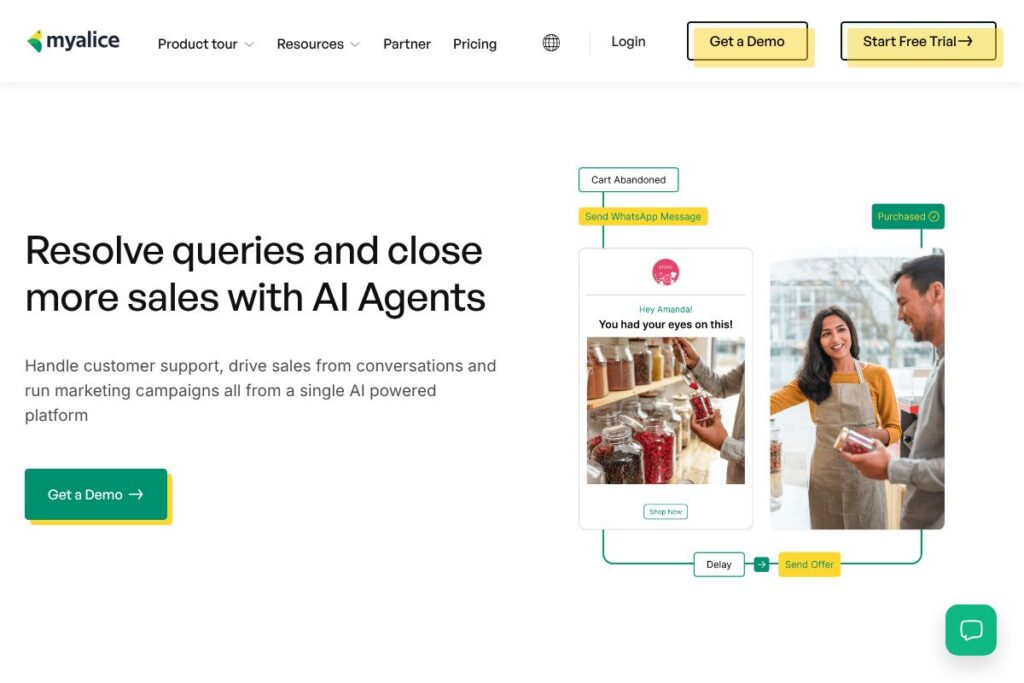
MyAlice is a support and sales automation platform built for growing eCommerce and direct-to-consumer brands. It centralizes customer conversations from storefronts, social messaging, and email into a unified workflow, while adding automation to send personalized messages at key moments in the customer journey to increase conversions and retention.
Compared with competitors like Zendesk, Gorgias, and Freshdesk, MyAlice emphasizes eCommerce-specific workflows and tighter commerce integrations; Zendesk is broader enterprise helpdesk software, Gorgias focuses heavily on agent efficiency for online stores, and Freshdesk targets general support teams with robust ticketing. MyAlice’s strengths are in combining conversational commerce, order context, and automated messaging tailored for DTC brands.
All of this makes MyAlice especially useful for merchants who need to discover customers, hold higher-quality conversations, and service orders after purchase at scale. It is best suited to eCommerce teams that want a single tool to handle sales messaging, customer service, and order-related automation without stitching together multiple point products.
How MyAlice Works
MyAlice ingests customer interactions from storefront chat, social channels, and messaging apps into a single inbox where agents and automation rules operate. The platform surfaces order and customer context alongside each conversation so replies and automated messages can reference products, order status, and previous interactions.
Automation rules route conversations, send follow-up messages, and trigger personalized outbound campaigns at key moments such as cart abandonment, post-purchase follow-up, and subscription renewals. Teams can mix automated flows with live agent handoffs, using templates and Canned Responses for consistency while retaining the option for one-to-one personalization.
Implementation typically involves connecting your storefront and messaging channels, mapping common workflows, and creating automation rules for the moments that matter to your business. Teams often start with a unified inbox and order sync, then add targeted automations for conversion and post-sale support as they scale.
MyAlice features
MyAlice’s core features center on unified messaging, automation for sales and support, and order-aware conversation context. The platform brings together multichannel message routing, templates and macros, analytics, and prebuilt eCommerce integrations to help merchants convert more visitors and resolve issues faster.
The platform includes several powerful capabilities worth highlighting:
Unified inbox
All customer messages from storefront chat, social inboxes, and email appear in one place with order and customer context attached. This reduces context switching for agents and shortens response times because order details and recent interactions are visible alongside the conversation.
Automation & routing
Automation rules let you route messages to the right agent or team, send scheduled follow-ups, and escalate tickets automatically when certain conditions are met. These rules reduce manual triage and ensure high-value signals such as high-cart-value customers are handled promptly.
Personalized outbound messaging
Create automated outbound sequences that deliver tailored messages at specific journey moments like cart abandonment, shipping updates, and post-purchase cross-sell. Personalization uses order metadata and customer history to keep messages relevant and increase conversion rates.
Order and CRM synchronization
Order data from your store syncs into conversation threads so agents can view purchases, shipment status, and returns from inside the inbox. The built-in CRM functionality stores customer profiles and conversation history to support ongoing relationship management.
Multichannel support
Support for channels commonly used by shoppers, including storefront chat, social messaging apps, and email, lets teams meet customers where they shop. Centralized channel handling prevents missed messages and provides consistent responses across platforms.
Reporting and analytics
Dashboards and reports track response times, conversion lift from campaigns, and agent performance so teams can measure the impact of automation and optimize workflows. Reporting helps identify common support issues and campaign opportunities.
With these capabilities combined, MyAlice helps merchants both reduce support overhead and improve sales outcomes by automating routine tasks while preserving the ability to hold quality one-to-one conversations.
MyAlice pricing
MyAlice offers flexible pricing tailored to eCommerce and DTC brands rather than a one-size-fits-all public price list. Plans and billing models are typically structured around business size, channel volume, and feature needs, with options for teams and enterprise deployments.
For the most accurate and current details on available plans, billing cycles, and any usage-based fees, check the official MyAlice homepage or contact their sales team for a tailored quote.
What is MyAlice Used For?
MyAlice is used to convert website visitors into buyers through timely, personalized messaging and to provide faster, context-rich post-sale support. Common workflows include cart abandonment recovery, order status notifications, returns handling, and targeted cross-sell messaging after purchase.
Teams that benefit most are small to mid-market eCommerce brands and DTC merchants that need to consolidate channels, reduce manual work with automation, and keep customer conversations tied to orders. Customer success, operations, and marketing teams often collaborate within MyAlice to align support and sales touchpoints.
Pros
- Ecommerce-focused workflows: Automation and inbox features are built around order data and typical merchant needs, which reduces custom configuration for stores.
- Multichannel consolidation: The platform centralizes messages from chat, social, and email so agents work from a single view with full customer context.
- Personalization at scale: Automated outbound sequences use order metadata and customer history to increase conversion and post-sale engagement.
- Scalable routing and automation: Rules and templates let growing teams automate common scenarios while preserving agent handoffs for complex cases.
Cons
- Pricing clarity for buyers: Because pricing is tailored, prospective buyers need to request a quote to see exact costs, which can slow initial evaluation cycles.
- Learning curve for complex automations: Setting up advanced automation flows may require planning and iteration, especially for merchants with multiple channels and order flows.
Does MyAlice Offer a Free Trial?
MyAlice offers a free trial and demo options for new users. Trial availability and feature access vary by plan, so prospective customers should use the trial or a guided demo to validate core automations, channel connections, and order sync before committing to a plan.
MyAlice API and Integrations
MyAlice provides integrations for common eCommerce platforms and messaging channels so order and customer data flow into the inbox automatically. Integrations typically include storefront platforms, social messaging apps, and email channels to enable order-aware conversations and automated triggers.
For development teams, MyAlice also exposes APIs and webhooks to extend workflows, connect third-party systems, and automate data synchronization. Check the MyAlice developer resources or contact support for access to API documentation and integration guides.
10 MyAlice alternatives
Paid alternatives to MyAlice
- Gorgias – A support platform built for eCommerce merchants that emphasizes shortcuts and macros to speed up agent replies and integrates closely with Shopify and other stores.
- Zendesk – A broad customer service platform with advanced ticketing, workflows, and reporting suited to companies needing enterprise features and scale.
- Freshdesk – Ticketing-centric support software with automation, knowledge base, and multi-channel support geared to teams of varied sizes.
- Intercom – Conversational messaging and customer engagement platform that blends live chat, bots, and product messaging for marketing and support use cases.
- Help Scout – Email-first support tool with shared inboxes, knowledge base, and simple workflows focused on small to medium-sized teams.
- Kustomer – A customer service CRM with a timeline-based view and automation tools targeted at higher-touch support organizations.
- Re:amaze – Messaging and helpdesk platform that combines live chat, automation, and eCommerce integrations for online stores.
Open source alternatives to MyAlice
- Zammad – Open source helpdesk with ticketing, multi-channel support, and role-based permissions that can be self-hosted and customized.
- osTicket – Lightweight, open source ticketing system for basic support workflows and straightforward email-based ticket routing.
- Helpy – Open source customer support platform focused on help center and community-driven support with options for self-hosting.
- Faveo Helpdesk (open source edition) – Ticketing system that offers a modular architecture for self-hosted helpdesk deployments.
Frequently asked questions about MyAlice
What is MyAlice used for?
MyAlice is used to automate support and sales messaging for eCommerce and DTC brands. Merchants use it to centralize conversations, send timely personalized messages, and tie support to order data.
Does MyAlice integrate with Shopify?
Yes, MyAlice integrates with popular eCommerce platforms including Shopify. Integrations sync order and customer data into conversations so agents can act with full context.
How does MyAlice improve sales conversion?
MyAlice uses automation and personalized outbound sequences to increase conversion at key moments. Targeted messages for cart abandonment, shipping updates, and post-purchase offers help lift conversion and average order value.
Can MyAlice handle multiple messaging channels?
Yes, MyAlice consolidates messages from storefront chat, social inboxes, and email. The unified inbox lets teams respond consistently across channels without losing order context.
Is there an API for MyAlice?
MyAlice provides APIs and webhooks for customization and integrations. Developers can use them to sync data, extend automations, and connect third-party systems to the platform.
Final verdict: MyAlice
MyAlice is a practical choice for growing eCommerce and DTC brands that need a single platform for support and sales automation tied to order data. It does well at consolidating channels, personalizing outreach based on purchase context, and reducing manual triage with routing and automation rules.
Compared with a direct competitor like Gorgias, MyAlice leans into flexible automations and multichannel consolidation tailored for merchant workflows, while Gorgias focuses tightly on agent efficiency and deep Shopify-native experiences. For teams evaluating options, MyAlice is a strong fit when the priority is automated, order-aware messaging across many channels and a unified place to run both support and conversion campaigns.