Planview: An Overview
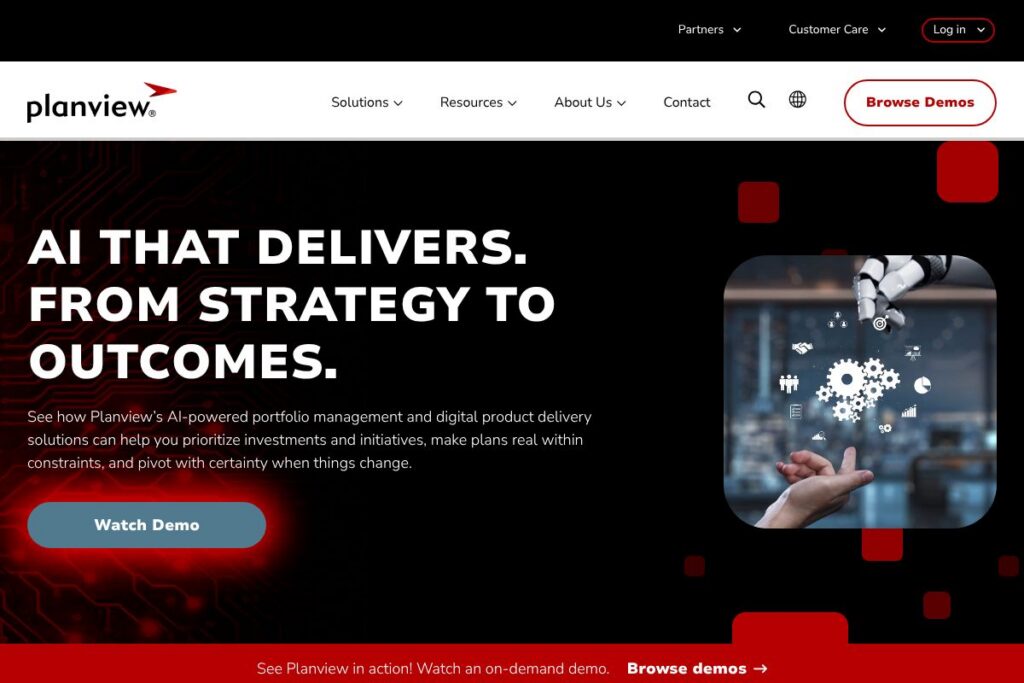
Planview is an enterprise platform for strategic portfolio management and end-to-end software delivery. It helps organizations prioritize projects, products, and services across portfolios, balance resources and risk, and convert strategy into executable plans that account for constraints and dependencies.
Compared with ServiceNow, which is strong at IT service management and workflows, Planview focuses more on portfolio prioritization and investment governance across mixed delivery modes. Against Atlassian Jira Align, Planview places heavier emphasis on financial governance, scenario modeling, and enterprise resource capacity; Jira Align is tightly integrated with development-level agile planning. Compared with Microsoft Project and Project Online, Planview provides broader portfolio-level decision support, value stream mapping, and AI-assisted what-if analysis rather than classic scheduling alone.
Planview does portfolio-to-delivery coordination well; it is suited for large organizations and transformation programs that require cross-functional visibility, centralized investment governance, and the ability to pivot plans with confidence when constraints or priorities change. The platform is commonly used by EPMO, IT PMO, product portfolio managers, and services organizations that need portfolio-level decisioning backed by delivery telemetry.
How Planview Works
Planview collects portfolio, project, resource, and product data into a connected data model so stakeholders can see investments side-by-side and evaluate trade-offs. Users create and rank initiatives, attach cost and capacity estimates, and then run scenario models to compare outcomes under different funding or resource assumptions.
On the delivery side, Planview links to engineering and work management tools to surface progress and bottlenecks, enabling end-to-end visibility into value streams. Practical workflows include using Planview to prioritize a set of programs, convert approved initiatives into delivery roadmaps, allocate team capacity, and track delivery health with executive dashboards and risk indicators.
Planview features
Planview’s platform combines portfolio management, resource capacity planning, value stream visibility, and AI-driven scenario modeling. Recent enhancements emphasize intelligent agents that produce actionable portfolio recommendations and automated risk detection across complex delivery pipelines. The platform integrates with common tooling to bring delivery metrics into portfolio decisioning and supports both Agile at scale and hybrid delivery approaches.
Portfolio prioritization and funding allocation
Prioritize initiatives using configurable scoring models that weigh strategic objectives, ROI, risk, and dependencies. This feature helps leaders compare initiatives objectively and align funding to the highest-impact work while preserving traceability from strategy to delivery.
Scenario modeling and AI analysis
Run what-if scenarios to test the impact of changing budgets, resource levels, or timelines; AI assists by highlighting high-leverage options and potential conflicts. Scenario outputs make trade-offs visible to stakeholders so decision-makers can select plans that fit constraints and business goals.
Resource and capacity management
Balance team capacity and skills across portfolios, plan future hiring or contractor needs, and simulate load under different demand scenarios. Capacity planning ties directly to prioritized work so resource allocation matches strategic intent rather than local optimization.
Enterprise Agile planning at scale
Support Agile at scale with tools for program planning, PI planning inputs, and backlog-to-portfolio traceability. This enables product and engineering leaders to maintain cadence while preserving portfolio-level governance and funding alignment.
Value stream and flow visibility
Map value streams and measure flow metrics to identify bottlenecks and optimize time-to-value. Value stream visibility connects operational delivery metrics to portfolio outcomes so investments can be judged by realized customer impact.
Integrations and toolchain connectivity
Integrate with development, test, and collaboration tools to ingest delivery telemetry and synchronize work items; this reduces manual reconciliation and preserves a single source of truth. Integrations allow portfolio leaders to see real-time delivery progress without forcing teams onto a single work tracker.
Reporting, analytics, and executive dashboards
Create role-based dashboards and reports that surface KPIs, risks, and financials for executive reviews. Built-in analytics supports recurring governance cycles, ad hoc queries, and multi-dimensional portfolio views for stakeholders.
With these capabilities, Planview provides portfolio decision support that ties strategy to delivery and gives leaders the tools to make constrained plans real while adapting when assumptions change.
Planview pricing
Planview uses an enterprise licensing model with flexible pricing based on deployment scope, modules selected, user roles, and support requirements. Pricing is typically custom for organizations because package composition varies by whether you adopt portfolio management, value stream management, resource capacity planning, or the full delivery suite.
For detailed options and to request a quote, view the Planview homepage and use the vendor’s contact channels to discuss licensing tiers, seat types, and implementation services.
What is Planview Used For?
Planview is used to prioritize and govern enterprise investments so decision-makers can allocate funding to initiatives that best support strategic goals. It is commonly used for portfolio rationalization, investment funding cycles, and maintaining alignment between strategy and delivery while tracking outcomes.
The platform is also used to accelerate software delivery and product development by providing value stream visibility and integrating delivery telemetry into portfolio decisions. Typical users include EPMO leaders, IT PMO and delivery managers, product portfolio owners, R&D leaders, and professional services organizations that need to coordinate capacity and billing against prioritized work.
Pros and Cons of Planview
Pros
- Comprehensive portfolio visibility: Planview aggregates financials, capacity, risks, and delivery status so leaders can assess investments end-to-end and make funding decisions with context.
- Advanced scenario modeling: The platform’s scenario tools and AI-assisted analysis let organizations simulate trade-offs and choose plans that fit resource and budget constraints.
- Value stream alignment: Built-in value stream mapping and flow metrics connect operational performance to portfolio outcomes, helping organizations prioritize customer-impacting work.
- Flexibility across delivery modes: Supports Agile at scale, hybrid projects, and traditional programs, making it suitable for organizations with mixed delivery practices.
Cons
- Enterprise focus and complexity: The breadth of capabilities means implementation can be complex and may require organizational change management and professional services.
- Custom pricing and procurement: Pricing is tailored to each customer; smaller teams or simple use cases may find it harder to justify without a clear scale of benefit.
- Integration effort: While the platform supports many integrations, connecting diverse toolchains and normalizing data can take time and technical coordination.
Does Planview Offer a Free Trial?
Planview offers on-demand demos and evaluation engagements rather than a standard public free plan. Prospective customers can request demos, watch product videos, or arrange trial evaluations coordinated with Planview’s sales and services teams to assess fit for their portfolios.
Planview API and Integrations
Planview provides APIs and prebuilt connectors to ingest delivery telemetry and synchronize work items across toolchains. The Planview homepage links to resources and contact options for API documentation and integration support.
Common integrations include development and issue trackers, CI/CD tools, reporting systems, and collaboration platforms so delivery data flows into portfolio views for accurate decisioning.
10 Planview alternatives
Paid alternatives to Planview
- ServiceNow — Portfolio and IT workflow automation that integrates tightly with IT service management and operations.
- Atlassian Jira Align — Agile-at-scale planning tool built to align engineering teams with strategic objectives using Jira as the execution layer.
- Microsoft Project Online — Traditional project and portfolio scheduling with strong integration into Microsoft 365 and Azure ecosystems.
- Planisware — Portfolio management software focused on R&D and product development investment planning and governance.
- Workfront (Adobe Workfront) — Work and project management with portfolio visibility and resource planning for marketing and creative teams.
- Clarity PPM (Broadcom) — Enterprise project and portfolio management with financial planning and resource forecasting.
- SAP Portfolio and Project Management — Integrated portfolio management for organizations using SAP for finance and operations.
- Smartsheet — Flexible work management with portfolio roll-up capabilities and configurable templates for governance.
- Monday.com — Work operating system that can be extended for portfolio visibility and lightweight resource tracking.
- Wrike — Project and portfolio management with customizable workflows and real-time collaboration features.
Open source alternatives to Planview
- OpenProject — Web-based project management with roadmaps and portfolio views suitable for self-hosted deployments.
- Taiga — Agile project management platform geared toward small teams that can be combined with other tools for broader portfolio views.
- Redmine — Flexible issue and project tracker with plugins that can approximate portfolio reporting for technical teams.
- Kanboard — Lightweight kanban system for visualizing work; suits teams that want a simple, self-hosted solution and integrate with external reporting.
Frequently asked questions about Planview
What is Planview used for?
Planview is used for enterprise portfolio management and connecting strategy to delivery. Organizations use it to prioritize investments, plan capacity, and monitor delivery outcomes across projects, products, and services.
Does Planview offer AI capabilities?
Yes, Planview includes AI-assisted scenario modeling and intelligent agents. These features help surface risks, recommend portfolio trade-offs, and speed decision-making by analyzing portfolio and delivery data.
Can Planview integrate with Jira and other development tools?
Yes, Planview integrates with development tools like Jira and common CI/CD systems. Integrations bring delivery telemetry into portfolio views so leaders can assess progress without manual consolidation.
How much does Planview cost?
Planview uses custom enterprise pricing tailored to customer needs. For specific licensing options and a quote, consult the Planview homepage to contact sales and request pricing details.
Is Planview suitable for Agile at scale?
Yes, Planview supports Agile at scale alongside hybrid and traditional delivery modes. It provides program and portfolio planning features that align Agile delivery with investment and funding decisions.
Final Verdict: Planview
Planview is a full-featured enterprise platform that links strategy, portfolio decisioning, and delivery telemetry so organizations can prioritize investments and make constrained plans actionable. Its strengths are portfolio prioritization, scenario modeling, resource capacity planning, and value stream visibility backed by AI analysis.
Compared with Atlassian Jira Align, Planview offers broader financial governance and enterprise scenario analytics; Jira Align is more tightly coupled to engineering execution on Jira. Pricing for Planview is custom and enterprise-focused, whereas Jira Align and other competitors publish more modular, role-based pricing; choose Planview if you need comprehensive portfolio governance and cross-functional investment planning across large organizations.
Planview is best for organizations that require centralized investment decisioning, traceability from strategy to delivery, and the ability to model and adapt plans under real-world constraints. For teams seeking lightweight tracking or lower-cost hosted options, consider scaled-down alternatives, but for enterprise portfolio governance Planview provides a mature, capable solution with integrated AI-assisted decision support and delivery visibility.