Powerdrill Bloom: An Overview
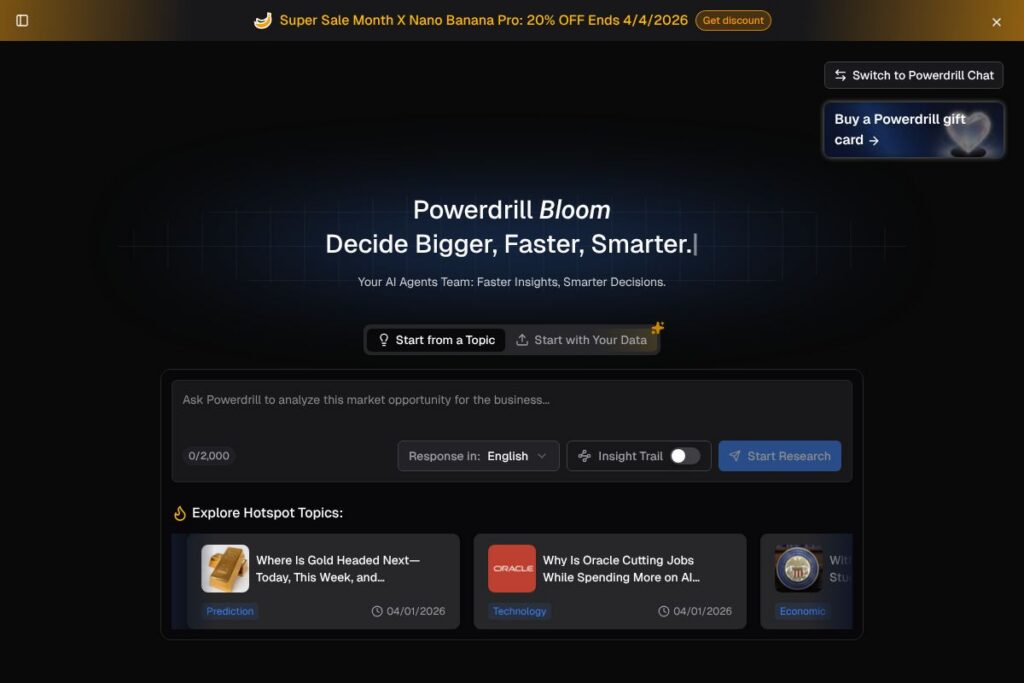
Powerdrill Bloom organizes multiple AI agents into configurable workflows that research topics, extract evidence, and create concise insight reports. It lets teams spin up parallel agents for sourcing, summarization, and evaluation, then stitches outputs into an “Insight Trail” so users can see sources and reasoning behind each conclusion. The product integrates its agents with conversational interfaces such as Powerdrill Chat to let users refine queries and follow up on findings.
In the broader market, Powerdrill Bloom sits between single-query AI assistants like Perplexity and developer-focused agent frameworks such as LangChain. Compared with workspace search and knowledge platforms like Glean, Bloom places more emphasis on autonomous multi-step research agents and an audit-friendly trail of evidence rather than only indexing internal documents. All of this makes Bloom especially suited for teams that need repeatable research workflows and traceable outputs for decisions.
Powerdrill Bloom does well at coordinating agent work, surfacing source-backed insights, and maintaining a visible audit trail that helps teams validate conclusions. It is a practical choice for product managers, researchers, and analysts who need faster synthesis of diverse sources and a way to iterate on agent workflows without building orchestration from scratch.
How Powerdrill Bloom Works
Users begin by defining a research objective or question and choosing a workflow template or custom agent chain. Bloom spawns specialized agents for tasks such as web search, document ingestion, fact extraction, and summarization, running them in parallel or sequence depending on the workflow design.
As agents run, Bloom collects intermediate results into an Insight Trail that records sources, agent actions, and confidence signals; teams can inspect, comment, or re-run parts of the trail. Results can be refined via conversational follow-ups using Powerdrill Chat, routed into team workspaces, or exported for reporting and handoffs.
Powerdrill Bloom features
Powerdrill Bloom centers on agent orchestration, insight traceability, and conversational refinement. Core capabilities include multi-agent workflows, the Insight Trail for evidence-backed outputs, hotspot and trending topic detection, and integrations that let teams move findings into their existing tools. Recent additions focus on tighter collaboration between the chat interface and agent workflows to shorten the loop from question to validated insight.
Agent orchestration
Agents are modular and task-focused, allowing teams to chain search, extract, validate, and summarize steps without writing orchestration code. This reduces manual coordination work and lets teams reuse tested workflows across projects.
Insight Trail
The Insight Trail captures the sources, agent decisions, and intermediate summaries that led to each conclusion, providing an audit-ready path from raw data to final insight. That makes it easier to validate findings, respond to follow-up questions, and track provenance for compliance or review.
Hotspot and trending detection
Bloom surfaces hotspot topics and trending themes across ingested content and conversations to help teams prioritize investigation areas. These signals speed up scoping by highlighting which topics are gaining attention or accumulating supporting evidence.
Conversational refinement with Powerdrill Chat
The integrated chat interface enables iterative questioning of agent outputs, letting users request deeper dives, clarifications, or alternative perspectives without leaving the workflow. This improves turnaround time for follow-up analysis and keeps context attached to the Insight Trail.
Collaboration and reporting
Shared workspaces, annotation tools, and export options let teams hand off insights to stakeholders or embed findings into reports and presentations. Role-based access and comment threads support collaborative review and decision-making.
Integrations and data connectors
Bloom connects to common content sources and collaboration platforms so agents can access documents, conversations, and web content as input. That reduces the friction of gathering evidence and lets agents operate on the same data used by the team.
With these capabilities, the biggest benefit of Powerdrill Bloom is reducing the time from question to validated insight while keeping a usable record of how conclusions were reached. Teams get a practical research engine that ties agent work to collaboration and reporting workflows.
Powerdrill Bloom pricing
Powerdrill Bloom uses a subscription and enterprise model that is tailored to team size and usage, with custom options for larger organizations and integrations. Because there is no dedicated public pricing page, organizations typically request a demo or contact sales to get a plan that matches their agent volume, data connectors, and support needs; view the Powerdrill Bloom overview on the Powerdrill site for contact and licensing options.
For enterprise requirements such as SSO, on-premises connectors, or data residency, vendors commonly offer custom contracts and volume-based tiers. To get exact plan definitions and any available trial or pilot pricing, consult the Powerdrill Bloom product pages and contact their sales team through the Powerdrill Bloom homepage.
What is Powerdrill Bloom Used For?
Powerdrill Bloom is primarily used for research automation, competitive intelligence, product discovery, and strategic decision support. Teams use it to run repeatable investigation workflows that ingest documents, extract evidence, and produce summarized insights with clear provenance.
It is also used for post-meeting analysis and synthesis, where agents process transcripts and surface themes and action items, and for market and trend monitoring where hotspot detection helps prioritize deeper analysis. The platform suits teams that need reliable, auditable outputs rather than ad-hoc answers.
Pros and Cons of Powerdrill Bloom
Pros
- Transparent insight provenance: The Insight Trail provides a clear record of sources and agent actions, which helps with validation and auditability. This is particularly useful for regulated industries or teams that need to justify decisions.
- Reusable agent workflows: Templates and modular agents let teams formalize common research patterns and scale investigative work without rebuilding orchestration. This shortens ramp time for repeated tasks.
- Integrated conversational refinement: Tight coupling with Powerdrill Chat allows quick follow-ups and refinements, keeping context and reducing back-and-forth between tools.
Cons
- Custom pricing for enterprise use: Organizations with complex needs will engage sales for tailored contracts, which can slow procurement for smaller teams looking for transparent list pricing. This is common for tools that offer enterprise-grade connectors and SLAs.
- Learning curve for complex workflows: Designing multi-agent workflows and interpreting Insight Trails requires some initial investment in training and process design to get consistent, high-quality outputs.
Can You Test Powerdrill Bloom Before Buying?
Powerdrill Bloom offers trials or pilot evaluations on request and typically provides demos for teams. Interested teams can schedule a demo or request a pilot through the Powerdrill Bloom homepage to evaluate agent workflows, the Insight Trail, and integrations before committing to a contract.
Powerdrill Bloom API and Integrations
Powerdrill Bloom provides API access and connectors so teams can programmatically trigger workflows, ingest content, and export insight artifacts; consult the Powerdrill Bloom API documentation for endpoint details and authentication guidance. The platform also integrates with common workplace apps to pull source documents and push summaries into collaboration tools for handoff.
Key integrations commonly include workspace and communication platforms, cloud storage connectors, and analytics systems so agents can operate on the same data sets teams already use. For specifics on supported connectors and developer guides, review the Powerdrill Bloom developer resources on the official site.
10 Powerdrill Bloom alternatives
Paid alternatives to Powerdrill Bloom
- Perplexity — An AI answer engine that focuses on direct, source-cited answers and a consumer-to-pro user model for fast Q&A and research.
- Glean — A knowledge discovery platform that indexes company data and provides search-driven insights for teams.
- Notion AI — Adds AI writing and summarization inside a knowledge workspace, suited for notes and lightweight research.
- Gong — Meeting intelligence and conversation analytics focused on sales and customer-facing teams, with automated insights from calls.
- Chorus.ai — Conversation intelligence with emphasis on coaching and deal insights from sales calls.
- Claude (Anthropic) — A conversational assistant platform that can be embedded into workflows for summarization and analysis.
- Jasper — AI content platform with assistive workflows for marketing and creative teams, useful for synthesizing narratives from source materials.
Open source alternatives to Powerdrill Bloom
- Auto-GPT — An experimental open source agent framework that chains LLM calls to perform multi-step tasks autonomously.
- LangChain — A developer framework for building applications with chains of LLM calls and agent-like behavior, used to assemble custom orchestration.
- Haystack — An open source framework for building search and QA systems over documents with retrievers and readers.
- BabyAGI — A research project that sequences tasks and agents for autonomous goal completion, useful as a prototype for agent orchestration.
Frequently asked questions about Powerdrill Bloom
What is Powerdrill Bloom best used for?
Powerdrill Bloom is best used for automated research and insight synthesis across documents and conversations. Teams use it to create traceable research outputs and repeatable investigation workflows.
Does Powerdrill Bloom offer an API for automation?
Yes, Powerdrill Bloom provides API access for programmatic workflow control and data ingestion. API documentation and developer guides are available on the product’s developer pages to help integrate with your systems.
How does Powerdrill Bloom handle source attribution?
Powerdrill Bloom records sources and intermediate agent steps in an Insight Trail for clear attribution. That makes it easier to verify claims and understand how each conclusion was produced.
Can Powerdrill Bloom integrate with Slack and collaboration tools?
Yes, Powerdrill Bloom supports integrations that let teams push findings into collaboration and storage platforms. Connectors typically include communication apps, cloud storage, and document sources used by teams.
Is Powerdrill Bloom suitable for regulated industries?
Powerdrill Bloom can be adapted for regulated environments through enterprise controls and audit trails. Enterprise contracts often include access controls, data governance options, and deployment choices to meet compliance needs.
Final verdict: Powerdrill Bloom
Powerdrill Bloom stands out where teams need coordinated, repeatable research work that leaves a clear audit trail. Its combination of multi-agent orchestration, the Insight Trail, and conversational refinement with Powerdrill Chat makes it a strong option for product, research, and strategy teams that require evidence-backed findings rather than quick, single-answer results.
Compared with tools like Perplexity, which emphasizes fast, citation-backed answers and offers consumer-friendly tiers, Powerdrill Bloom focuses on team workflows and traceability and typically follows a subscription or enterprise engagement model. If your priority is scalable, auditable research workflows and integration into team processes, Powerdrill Bloom is a practical choice to evaluate through a pilot or demo.