What is Opcenter APS
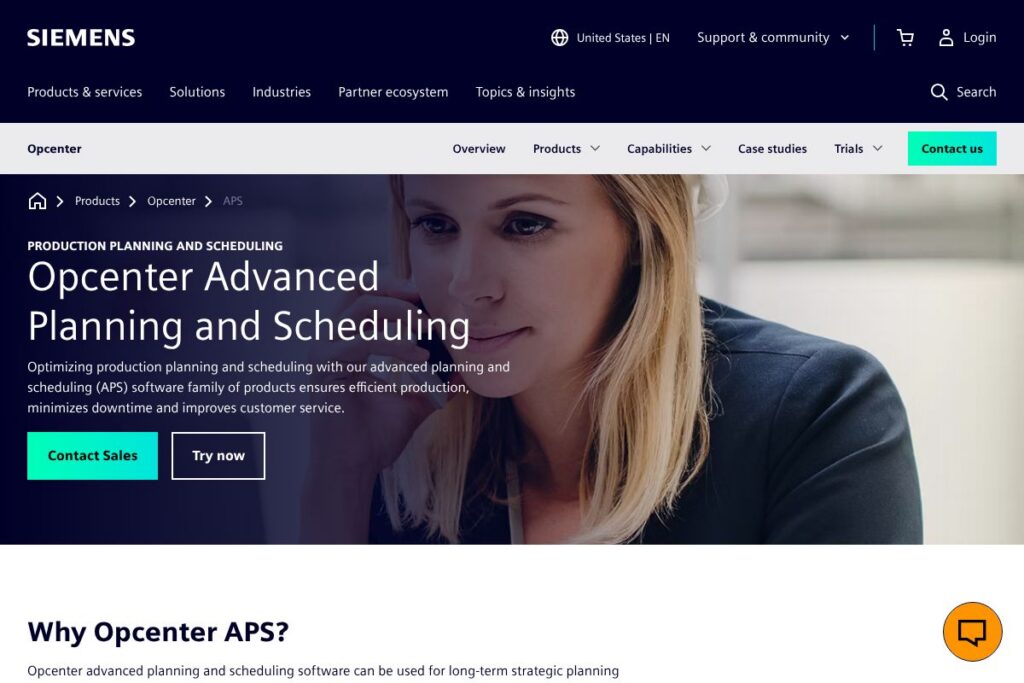
Opcenter APS is a set of production planning and scheduling solutions from Siemens that focuses on finite capacity scheduling, constraint-based sequencing, and material synchronization across manufacturing operations. The suite supports long-term strategic planning, medium-term tactical plans, and short-term detailed sequencing so planners can align resources, materials, and customer demand across horizons.
Compared with competitors, Opcenter APS emphasizes tight integration with Siemens’ broader manufacturing and digitalization portfolio. DELMIA Quintiq competes on large-scale supply chain and workforce planning, often for logistics-heavy enterprises, while AspenTech provides strong process-industry optimization and model-based scheduling. Opcenter APS stands out for its shop-floor execution connectivity and for being offered as part of Siemens’ Opcenter and Teamcenter ecosystems.
Opcenter APS is well suited for medium to large manufacturers that need a single planning backbone to balance capacity, materials, and customer commitments. It is particularly useful where detailed sequencing, multi-resource setups, and integration with MES and ERP systems are required to translate plans into reliable execution.
How Opcenter APS Works
Opcenter APS consumes master data from ERP, MES, and CAD systems and builds a planning model that includes resources, routings, bills of material, and constraints. The system runs finite-capacity scheduling algorithms and heuristics to generate feasible plans that respect resource calendars, setup matrices, and material availability.
Planners can run what-if scenarios to compare alternatives, simulate changes in demand, and evaluate the impact of new assets or maintenance windows. Once a schedule is accepted, Opcenter APS publishes dispatch lists and sequencing instructions to MES and execution systems, and monitors actual progress to support re-scheduling when deviations occur.
Opcenter APS features
Opcenter APS focuses on aligning capacity, materials, and customer demand through finite planning, scenario simulation, and shop-floor integration. Recent product directions emphasize deeper MES/ERP connectivity, visualization for planners, and faster scenario evaluation to shorten planning cycles.
Finite capacity scheduling
Schedules respect actual machine, labor, and tooling capacities, preventing infeasible plans and enabling realistic lead time estimates. This reduces rework and improves on-time delivery by avoiding over-commitment of constrained resources.
Constraint-based sequencing
The engine sequences work to minimize setups, respect precedence rules, and enforce resource-specific constraints such as tooling compatibility and operator skill levels. Sequencing reduces downtime and improves throughput on mixed-model production lines.
Multi-horizon planning
Support for strategic, tactical, and operational horizons lets organizations plan months ahead while retaining the ability to create day-level sequences for execution. This reduces conflicts between long-term forecasts and short-term reality, helping keep inventory low and service levels high.
Material and BOM-aware planning
The planner accounts for bills of material and material lead times so production schedules align with component availability. This improves material flow, reduces shortages, and decreases work in progress.
Scenario modeling and what-if analysis
Planners can simulate alternate production strategies, capacity changes, or demand shifts to compare outcomes before committing changes. Scenario modeling helps quantify trade-offs between lead time, inventory, and resource utilization.
Integration with MES and ERP
Opcenter APS exchanges schedules, production orders, and status updates with MES and ERP systems so plans translate to execution and feedback refines future schedules. This closed-loop approach reduces manual handoffs and synchronization delays.
Advanced optimization and heuristics
The product combines optimization techniques with practical heuristics to generate high-quality schedules within usable runtimes for large, constrained environments. This balance helps production planners get actionable results quickly without excessive computing time.
KPIs, reporting, and visualization
Built-in dashboards and reports track productivity, inventory levels, lead times, and on-time delivery, enabling planners and managers to measure the impact of schedule changes. Visual Gantt and resource views help identify bottlenecks and idle capacity at a glance.
Opcenter APS’ core benefit is providing a single, constraint-aware planning engine that links strategic plans to executable shop-floor schedules. That linkage reduces lead times, cuts inventory, and increases on-time delivery by ensuring plans are feasible and tightly synchronized with execution systems.
Opcenter APS pricing
Opcenter APS is positioned as enterprise manufacturing software and uses custom licensing and deployment models rather than published flat-rate plans. Pricing is typically negotiated based on modules, number of users, integration scope, deployment model, and support requirements, so organizations receive quotes tailored to their footprint.
For detailed licensing options, module descriptions, and to request a custom quote, see the Siemens Opcenter APS product page, or contact Siemens sales for enterprise pricing and deployment guidance.
What is Opcenter APS Used For?
Opcenter APS is used for production planning and scheduling across discrete and process manufacturing industries where capacity constraints, setup complexity, and material dependencies drive the need for finite, sequenced schedules. Typical uses include make-to-order production, multi-stage assembly lines, and environments with significant tooling or changeover overhead.
Operations managers use Opcenter APS to detect bottlenecks and improve utilization, sales teams rely on it to provide reliable delivery dates, and finance teams use the output to assess inventory and cost implications of planning choices. The product also supports planner workflows for re-sequencing and handling last-minute order changes while keeping execution aligned with the revised plan.
Pros and cons of Opcenter APS
Pros
- Finite, constraint-aware scheduling: The engine enforces real-world constraints so generated schedules are executable and reduce downstream firefighting. This leads to higher on-time delivery and more predictable production performance.
- Deep shop-floor integration: Native connectivity with MES, ERP, and Siemens’ digital manufacturing tools translates plans into execution and captures feedback for re-scheduling. That closed-loop approach shortens the planning-to-execution cycle.
- Scenario-driven decision making: What-if analysis and scenario modeling make it easier to quantify the impact of capacity changes, new assets, or demand shifts. This supports informed trade-offs between lead time, inventory, and utilization.
- Support for multiple planning horizons: The suite handles strategic, tactical, and operational planning in one environment, reducing fragmentation between long-term forecasts and short-term execution sequences.
Cons
- Enterprise deployment complexity: Implementing Opcenter APS requires integration with existing ERP and MES systems and careful data preparation, which can extend time to value for organizations without mature digital infrastructures. Planning model design and data cleansing are common initial activities.
- Custom licensing and pricing: Because pricing is negotiated per deployment, organizations must engage with Siemens sales to receive an estimate, which can slow procurement for smaller manufacturers. There are no standardized, self-serve price tiers.
- Specialized skill requirements: Extracting full value often requires trained planners or consultants familiar with constraint-based scheduling and the product’s modeling capabilities. Internal training and governance help maintain schedule quality.
Does Opcenter APS Offer a Free Trial?
Opcenter APS is paid-only with enterprise licensing; Siemens typically offers product demonstrations and pilot projects. Prospective customers can arrange demonstrations, pilot implementations, or proof-of-concept projects through Siemens to validate fit before committing to a licensed deployment, see the Opcenter APS product page for contact options.
Opcenter APS API and Integrations
Opcenter APS provides connectors and integration options for common ERP and MES systems, and supports industry interfaces such as OPC UA and standard exchange formats, enabling tight data flow between planning and execution layers. For developers, Siemens documents integration routes and recommended connectivity patterns on its Opcenter integration pages, see the Opcenter integration capabilities for technical details.
Typical integrations include SAP and Oracle ERPs, Siemens Teamcenter PLM, MES solutions including Opcenter Execution, PLC systems, and third-party logistics or WMS platforms. These integrations allow schedules to be published to execution systems and actual production data to be returned for re-planning and variance analysis.
10 Opcenter APS alternatives
Paid alternatives to Opcenter APS
- DELMIA Quintiq: A comprehensive supply chain and production planning platform from Dassault Systèmes that handles workforce, logistics, and production sequencing for complex, large-scale operations.
- AspenTech aspenONE APS: Optimization and scheduling solutions focused on process industries, with model-based scheduling and strong process optimization capabilities.
- Kinaxis RapidResponse: Cloud-native concurrent planning for supply chain and S&OP, with rapid scenario analysis and integrated demand-supply balancing.
- Infor Advanced Scheduling: Production scheduling that integrates with Infor ERP systems, providing finite scheduling, sequencing, and shop-floor dispatching.
- Oracle Manufacturing Scheduling: Part of Oracle’s supply chain suite, offering scheduling and capacity planning tightly integrated with Oracle ERP Cloud.
- Preactor (Siemens Preactor): A scheduling product often used for shop-floor sequencing and detailed line scheduling in smaller footprints and fast deployments.
- E2 Shop System: Production and job shop scheduling combined with shop-floor control, reporting, and job costing for discrete manufacturers.
Open source alternatives to Opcenter APS
- OptaPlanner: A Java-based constraint solver from Red Hat for vehicle routing and employee rostering that can be adapted to production scheduling through custom problem modeling. It requires development effort to build a full APS solution.
- ERPNext: An open source ERP with manufacturing and basic production planning features, suitable for smaller manufacturers needing an integrated ERP and simple scheduling capabilities.
- Odoo (Manufacturing module): Odoo’s open source ERP includes manufacturing and MRP features with basic scheduling tools and a modular architecture for customization.
Frequently asked questions about Opcenter APS
What is Opcenter APS used for?
Opcenter APS is used for finite production planning and sequencing across strategic, tactical, and operational horizons. It helps manufacturers create executable schedules that respect capacity, material, and setup constraints to improve delivery performance and reduce inventory.
Does Opcenter APS integrate with SAP and other ERPs?
Yes, Opcenter APS integrates with major ERP systems, including SAP and Oracle. Integration is typically implemented via connectors, data exchange formats, or middleware to synchronize master data, orders, and production status.
Can Opcenter APS handle mixed-model and high-mix production?
Yes, Opcenter APS supports mixed-model lines and complex setup matrices. The constraint-based sequencing and setup optimization features help minimize changeover time and improve throughput in high-mix environments.
Is Opcenter APS available on-premises and in the cloud?
Opcenter APS can be deployed in enterprise on-premises or cloud environments depending on customer requirements. Deployment choice typically influences integration patterns, licensing, and support arrangements.
How does Opcenter APS improve on-time delivery?
Opcenter APS improves on-time delivery by generating realistic, constraint-aware schedules and enabling scenario-driven adjustments. Tight integration with MES and real-time feedback reduces deviations between plan and actual execution.
Final verdict: Opcenter APS
Opcenter APS is a mature APS solution focused on producing executable, finite schedules that bridge strategic plans and shop-floor execution. Its strengths lie in constraint-based sequencing, scenario modeling, and integration with Siemens’ manufacturing and PLM ecosystem, which make it a strong choice for manufacturers that require detailed sequencing and close MES/ERP connectivity.
Compared with DELMIA Quintiq, Opcenter APS is typically chosen for tighter shop-floor integration within Siemens environments, while Quintiq is often selected for very large, multi-domain supply chain problems. Both solutions use enterprise, custom pricing models, so decisions usually come down to required integrations, preferred implementation partner, and product fit rather than list price differences. For procurement, contact Siemens through the Opcenter APS product page to discuss licensing, pilots, and deployment options.