What is PubNub
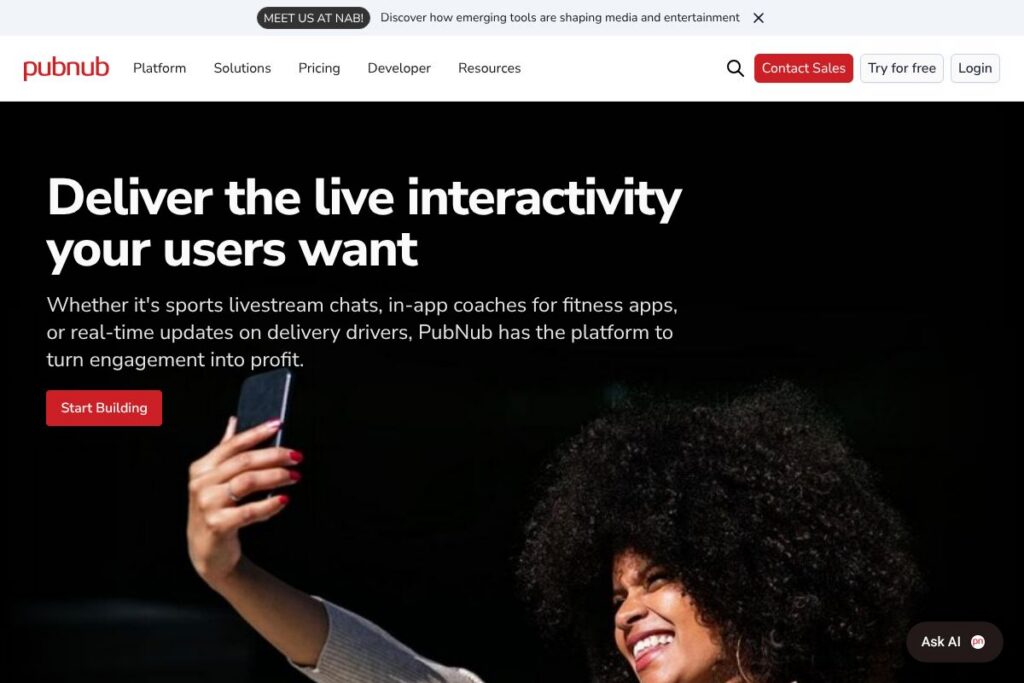
PubNub is a real-time data stream network and API platform that provides publish/subscribe messaging, presence, storage, and edge compute capabilities for mobile, web, and IoT applications. It focuses on delivering low-latency global messaging with a distributed edge network to minimize delivery times and handle very large event volumes.
Compared with Pusher and Ably, PubNub positions itself for enterprise-grade scale with guarded SLAs and a wider portfolio of built-in services such as on-edge serverless functions, message storage and playback, and fine-grained access controls. Against backend alternatives like Firebase Realtime Database, PubNub is designed around event-driven pub/sub at the network layer rather than as a database with realtime listeners, which can simplify architectures that need predictable message delivery and presence at global scale.
PubNub excels at delivering consistent low-latency messaging across many regions and devices, while providing tools for security, auditability, and edge processing. This makes it suitable for teams building chat, live dashboards, multiplayer game state, auctions, telematics, and other interactive experiences that must operate reliably at large scale.
How PubNub Works
Applications publish events to named channels via PubNub SDKs or REST APIs; the PubNub global network routes those events to subscribed clients with sub-30 millisecond delivery in most paths. Channels are lightweight logical streams that group related events such as chat rooms, device telemetry feeds, or game lobbies.
Presence and state APIs let apps track who is online and hold small amounts of per-user or per-channel state; Storage & Playback preserves recent events for late-joining clients. PubNub Functions run custom logic at the edge to transform messages, validate events, or connect to external services without running separate servers, which shortens development cycles and reduces backend complexity.
A typical workflow for a chat feature involves initializing the PubNub SDK in client apps, subscribing to a channel, publishing user messages to that channel, and optionally invoking Functions for moderation or translation before forwarding messages to subscribers. For location tracking, devices publish periodic position updates to a channel while presence and state APIs are used to indicate availability and metadata.
PubNub features
The platform centers on real-time pub/sub messaging, presence, message persistence, and serverless edge functions, plus a broad set of SDKs for mobile, web, and embedded devices. Core capabilities include global delivery via an edge network, fine-grained access control, message history and replay, real-time analytics hooks, and runtime extensibility through on-edge Functions.
Let’s talk PubNub’s Features
Pub/Sub Messaging
A high-throughput publish/subscribe model handles event distribution across channels with built-in retry and connection management. This supports one-to-many, many-to-many, and point-to-point patterns useful for chat, live notifications, and telemetry streams, and benefits teams by decoupling message producers from consumers.
Global Data Stream Network
A geographically distributed edge network routes messages to the nearest point of presence to reduce latency and improve reliability for globally distributed users. Developers get predictable delivery characteristics without having to design and operate their own multi-region infrastructure.
Presence and State APIs
Presence APIs report who is currently connected to a channel and emit join/leave events, while state APIs let applications store and retrieve small pieces of user or channel metadata. This is helpful for features like online user lists, typing indicators, and presence-aware routing logic.
Storage & Playback (History)
Message history stores recent events so clients that reconnect or join late can retrieve missed messages and catch up. Playback simplifies onboarding and recovery workflows by providing a straightforward way to fetch and replay earlier events.
PubNub Functions (Edge Compute)
On-edge serverless functions let teams run small pieces of custom logic close to where messages flow through the network. Use cases include message enrichment, validation, moderation, transformation, and forwarding to external APIs without adding backend servers.
Access Manager and Security Controls
Role-based access and token-based permissions control which clients can publish, subscribe, or manage channels and resources. Audit and encryption options help meet compliance and security requirements for regulated industries.
SDKs and Platform Integrations
A wide range of client SDKs covers JavaScript, Android, iOS, Unity, and several IoT protocols, plus server SDKs and REST APIs for custom integrations. This reduces the amount of client-side plumbing developers must write and speeds multi-platform rollouts.
With these features, PubNub provides a complete stack for adding live interactivity to apps while removing much of the operational burden of running global real-time infrastructure.
PubNub pricing
PubNub uses a usage-based SaaS pricing model with tiered and enterprise options that scale by traffic, connections, and feature needs; organizations typically engage sales for high-volume or custom SLAs. For current plan details, free tier availability, and enterprise offers, review PubNub’s pricing and plans on their homepage or contact sales for a custom quote.
What is PubNub Used For?
PubNub is used to add live chat, presence indicators, live updates, multiplayer state synchronization, and device telemetry to customer-facing and internal applications. Teams commonly deploy it for gaming, media and live broadcasting features, real-time dashboards for logistics, and in-app communication for marketplaces.
Enterprise use cases include high-volume transaction feeds for fintech, live bidding for auction platforms, patient monitoring notifications in healthcare, and live location updates for delivery and fleet tracking. Developers also use PubNub to prototype interactive features quickly and then scale those features to millions of users without rearchitecting the messaging layer.
Pros and cons of PubNub
Pros
- Global low-latency delivery: PubNub’s edge network reduces round-trip time and provides consistent delivery across regions, which improves user experience for interactive features.
- Built-in operational features: Presence, history, access control, and Functions reduce the amount of custom infrastructure teams must build and maintain for realtime use cases.
- Wide SDK coverage: Official SDKs for web, mobile, game engines, and IoT devices speed cross-platform development and reduce integration work.
- Enterprise readiness: Compliance options, SLAs, and professional support match the needs of regulated industries and mission-critical use cases.
Cons
- Usage-based cost model: For very high event volumes, costs can rise and require careful traffic planning and optimizations to control spend. Monitoring and architecture choices matter for cost predictability.
- Feature overlap with other platforms: Teams that already use a backend-as-a-service or event streaming platform may need to evaluate overlap and integration complexity before adding PubNub as an additional layer.
- Dependency on external network: Relying on an external real-time network requires assessing data residency, compliance, and outage tolerances relative to an in-house solution.
Does PubNub Offer a Free Trial?
PubNub offers a free tier and trial options for evaluation. The free tier provides limited usage suitable for prototyping and testing, and higher-volume or enterprise evaluations are available through sales; sign up for an account or contact PubNub through their homepage to begin a trial.
PubNub API and Integrations
PubNub provides developer APIs and a comprehensive set of SDKs; the PubNub API documentation details endpoints for publish/subscribe, presence, storage, and Functions. The documentation includes code samples for JavaScript, iOS, Android, Unity, and server-side languages to accelerate integration.
Integrations include connectors and recommended patterns for cloud platforms such as AWS, Azure, and Google Cloud, plus support for common IoT protocols and third-party services via Functions or webhook forwarding. Use the SDKs and Functions to integrate PubNub with analytics, database, and backend systems without building a custom messaging bridge.
10 PubNub alternatives
Paid alternatives to PubNub
- Pusher — A hosted realtime messaging service focused on WebSockets and channel-based event delivery for web and mobile applications, with simple SDKs and developer tools.
- Ably — A realtime messaging platform with global routing, rich client libraries, and durable message guarantees, often chosen for event stream reliability and feature parity with PubNub.
- Firebase — Google’s realtime features including Realtime Database and Cloud Messaging are tightly integrated with Firebase’s backend services and analytics for mobile-first apps.
- AWS AppSync — Managed GraphQL with realtime subscriptions, suited for teams that prefer GraphQL-driven realtime updates integrated with AWS services.
- Azure SignalR Service — A managed SignalR offering for .NET and web apps that require realtime server-to-client push capabilities within the Azure ecosystem.
- Twilio Programmable Chat — A communications-focused platform geared toward chat features with built-in moderation, session routing, and messaging APIs.
- Stream — Focused on activity feeds and scalable messaging patterns, Stream is used for social feeds and timeline-style realtime updates.
Open source alternatives to PubNub
- Socket.IO — A JavaScript library for realtime web applications that supplies fallbacks and a simple pub/sub-style API, commonly self-hosted with Node.js.
- NATS — A high-performance messaging system aimed at cloud native and microservices architectures, offering pub/sub, request/reply, and streaming features.
- Eclipse Mosquitto — A lightweight MQTT broker suitable for constrained IoT devices and telemetry scenarios, with wide protocol support.
- RabbitMQ — A mature message broker with flexible routing and plugin architecture, often used for reliable message queuing and pub/sub patterns.
- Apache Kafka — A distributed streaming platform used for high-throughput event streaming and log aggregation where persistence and long retention are primary needs.
Frequently asked questions about PubNub
What is PubNub used for?
PubNub is used for building low-latency, real-time features such as chat, presence, live updates, and device telemetry. Teams use it when they need predictable global message delivery and built-in primitives like history, presence, and edge functions.
Does PubNub provide an API for developers?
Yes, PubNub provides a full set of APIs and SDKs for web, mobile, and server platforms. The PubNub API documentation includes code samples, endpoint details, and SDK guides to get started.
Can PubNub handle global scale and high message volume?
Yes, PubNub is designed for high-volume global workloads and operates a distributed edge network for low-latency delivery. Organisations use it for use cases that require millions of concurrent connections and high message throughput.
Is PubNub secure for regulated industries?
PubNub offers security controls like token-based access, role-based permissions, and encryption to support compliance needs. Enterprise customers can discuss SLAs, compliance, and audit options directly with PubNub’s sales and support teams.
How do I get started with PubNub?
You can sign up for a free tier and review documentation to prototype features quickly. Begin by creating an account from PubNub’s homepage and follow the SDK guides in the developer documentation to integrate publish/subscribe and presence into your app.
Final verdict: PubNub
PubNub is a mature realtime platform that combines a global edge network with built-in services such as presence, message history, access controls, and on-edge Functions. It is best suited for teams that need reliable, low-latency message delivery at large scale and want to minimize the operational burden of running global realtime infrastructure.
Compared with Pusher, PubNub targets larger-scale and enterprise use cases by offering a broader set of built-in operational features and stronger SLA focus, while Pusher may be a simpler, lower-cost option for smaller projects or teams favoring minimal setup. For organizations that require fine-grained security, edge processing, and predictable global delivery, PubNub is a capable choice; evaluate integration patterns and expected usage to align cost and architecture with your requirements.