Quickchat AI: An Overview
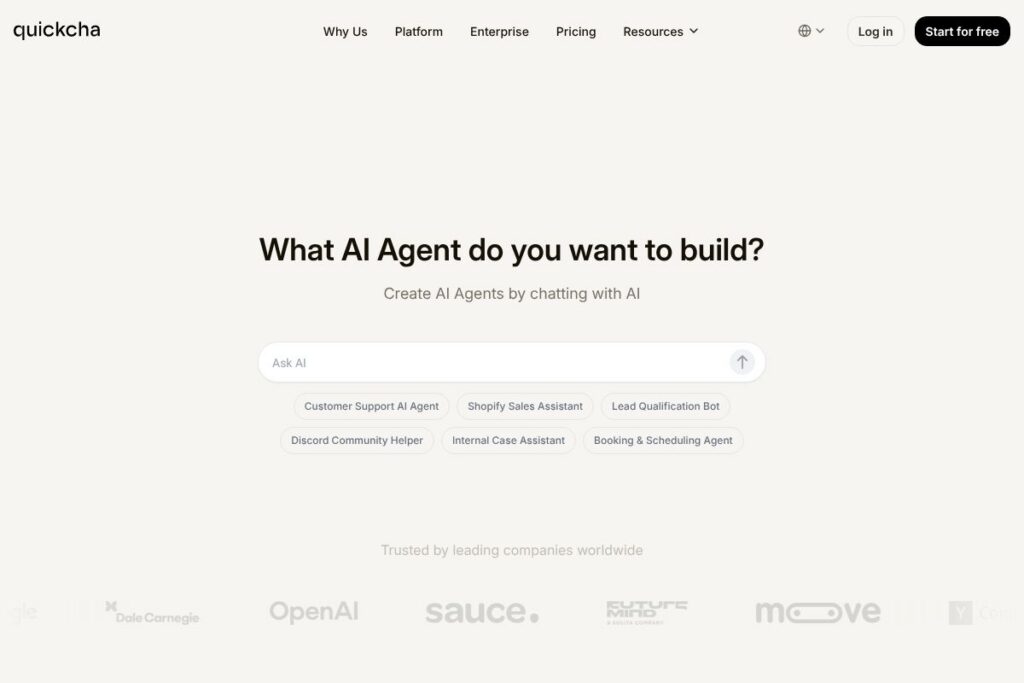
Quickchat AI is a no-code platform for creating conversational AI Agents that handle customer inquiries, support flows, and knowledge base lookups. The platform emphasizes creating agents by chatting with the system, then deploying them via an API or prebuilt connectors to existing customer service channels.
Quickchat AI positions itself as an alternative to Agentforce, Fin, and Sierra, highlighting higher conversation quality and faster resolution rates alongside scalable pricing. Compared with traditional chatbot vendors like Zendesk or live-chat-first tools such as Intercom, Quickchat AI focuses on AI-first automation and rapid migration paths so teams can switch within days rather than months.
All of this makes Quickchat AI well suited for customer service teams, product support groups, and any company that needs multilingual, high-resolution conversational flows without a heavy engineering lift. The platform is particularly useful for organizations that want to plug an AI layer into existing support infrastructure and reduce manual handling of repetitive queries.
How Quickchat AI Works
Quickchat AI lets you design an AI Agent through an interactive, conversational builder. You train the agent by chatting with it, adding FAQs, and importing documents or knowledge bases so the agent learns the correct responses and escalation paths.
Once an agent is trained, you can deploy it across channels using the Quickchat AI API and integrations. Typical workflows include routing unresolved queries to human agents, syncing conversation logs with CRMs, and using analytics to refine agent behavior over time.
Quickchat AI features
Quickchat AI combines agent creation, knowledge ingestion, multichannel deployment, and analytics into a single platform to simplify conversational automation. Recent improvements emphasize higher-resolution conversations, faster migration from legacy systems, and API-first deployment for integration with existing tools.
No-code Agent Builder
The builder uses a conversational interface so non-technical teams can create and refine AI Agents by chatting with the system. This reduces setup time and makes iterative updates fast, enabling product and support teams to own the agent without heavy engineering resources.
Knowledge Base Ingestion
Agents can ingest FAQs, help center articles, and structured documents to answer queries from an up-to-date knowledge base. That capability shortens time to value by allowing agents to respond from existing content rather than requiring manual rule creation.
Multichannel Deployment
Deploy agents to web chat, messaging platforms, and custom apps through the API and prebuilt connectors. This ensures consistent responses across channels and reduces the need to manage separate bots for each platform.
Human Handover and Routing
Quickchat AI supports configurable escalation rules that route conversations to live agents or external systems when the AI cannot confidently resolve an issue. Integrations with ticketing systems keep handoffs seamless and preserve context for human agents.
Conversation Analytics
Built-in analytics track resolution rates, conversation flows, and top intents so teams can measure agent performance and prioritize improvements. The insights help reduce repeat questions and surface knowledge gaps in documentation.
Multilingual Support
The platform supports multiple languages so organizations can serve global customers without building separate agents for each language. That capability helps maintain consistent service quality across regions.
Security and Compliance
Quickchat AI provides enterprise-grade security controls, role-based access, and data management features suitable for regulated environments. These controls help teams manage sensitive conversations and comply with internal policies.
With these capabilities, Quickchat AI reduces the time between concept and production, delivering conversational agents that handle a large share of routine support work while allowing smooth escalation to humans when needed.
Quickchat AI pricing
Quickchat AI offers flexible, scalable pricing tailored to business needs rather than a single one-size-fits-all plan. While specific public rates are not listed on a dedicated pricing page, the company positions itself as an attractive alternative to higher-cost agent providers and offers options for teams of different sizes.
For up-to-date plan details and to discuss volume, enterprise security, and SLAs, consult the Quickchat AI pricing information on the Quickchat AI homepage. Visit the Quickchat AI homepage to view current pricing options and contact sales for custom quotes.
What is Quickchat AI Used For?
Quickchat AI is primarily used for customer service automation, handling common support queries, self-service workflows, and knowledge retrieval. Organizations deploy agents to deflect repetitive requests, shorten response times, and provide 24/7 support coverage.
Beyond support, teams use Quickchat AI for lead qualification, onboarding assistance, internal knowledge access for employees, and multilingual customer engagement. Its integrations with existing CRMs and help desks make it usable across marketing, sales, and product support workflows.
Pros and Cons of Quickchat AI
Pros
- No-code agent creation: The conversational builder lets non-technical teams create and iterate on agents quickly without engineering overhead.
- High-resolution conversations: The platform emphasizes conversational quality and higher first-contact resolution rates compared with several alternatives.
- Fast migration path: Tools and connectors reduce migration time from legacy chat systems to days instead of months, which speeds rollout and reduces disruption.
- API-first deployment: Robust API and integration options let engineering teams embed agents into custom channels and workflows.
Cons
- Enterprise pricing details: Pricing is tailored and not published on a dedicated page, which requires contacting sales for exact costs.
- Platform dependency for advanced customization: Teams needing deeply custom or experimental models may require engineering investment outside of the no-code builder.
- Limited publicly documented pricing transparency: The lack of a public pricing table makes quick comparisons with other vendors less straightforward.
Does Quickchat AI Offer a Free Trial?
Quickchat AI offers a free trial for new users, providing time-limited access to core agent-building and deployment tools so teams can validate performance and integration workflows; check the exact trial terms and sign-up process on the Quickchat AI homepage.
Quickchat AI API and Integrations
Quickchat AI provides an API for programmatic access to agents, conversation logs, and deployment endpoints; the Quickchat AI API documentation explains available endpoints, authentication, and webhook options. Explore the Quickchat AI API documentation for technical details and sample integrations.
The platform also offers connectors for common tools so you can integrate with ticketing, CRM, and messaging systems. Typical integration targets include help desks and messaging channels so agents work alongside human teams in established workflows.
10 Quickchat AI alternatives
Paid alternatives to Quickchat AI
- Agentforce — A conversational AI provider focused on enterprise agent automation and SLA-backed deployments for support teams.
- Fin — AI assistants tailored for internal knowledge and task automation with a focus on enterprise workflows.
- Sierra — A customer-facing AI agent platform that emphasizes high-resolution automation for support teams.
- Intercom — Conversational customer engagement platform that pairs chat, bots, and live support for sales and support use cases.
- Zendesk — Support platform with native chat and bot capabilities tied to a full ticketing and customer support suite.
- Drift — Conversational marketing and sales automation focused on lead qualification and routing to sales reps.
- Ada — Customer service automation platform with a no-code bot builder designed for enterprise-scale deployments.
Open source alternatives to Quickchat AI
- Rasa — Open source conversational AI framework for building custom, on-premises chatbots with full developer control.
- Botpress — Modular, open source bot-building platform with visual flow editors and extensible connectors.
- Microsoft Bot Framework — Developer platform for building bots that integrate with Microsoft services and multiple channels.
- Chatwoot — Open source customer engagement suite that supports live chat and automation for customer support teams.
Frequently asked questions about Quickchat AI
What is Quickchat AI used for?
Quickchat AI is used to build and deploy conversational agents for customer support and knowledge automation. Teams rely on it to automate repetitive queries, surface documentation, and route complex issues to humans.
Does Quickchat AI support multiple languages?
Yes, Quickchat AI supports multilingual agents. That enables support teams to handle global customer inquiries without creating separate agents per language.
How does Quickchat AI integrate with CRMs and help desks?
Quickchat AI integrates via API and prebuilt connectors to forward conversations and tickets to CRMs and help desks. Integrations preserve context so human agents see the full conversation history when they take over.
Does Quickchat AI provide an API for developers?
Yes, Quickchat AI offers an API for agent management, conversation streaming, and webhooks. Refer to the Quickchat AI API documentation for endpoint details and authentication examples.
How much does Quickchat AI cost?
Quickchat AI uses scalable pricing tailored to business size and usage. For current plan structures, trial offers, and enterprise options, review the pricing information on the Quickchat AI homepage.
Final verdict: Quickchat AI
Quickchat AI delivers a practical no-code path to conversational automation, combining an interactive agent builder with API deployment and integrations that shorten migration timelines. It stands out for enabling non-technical teams to design and refine agents while offering the integration points engineers need to embed those agents into existing support stacks.
Compared to Agentforce, which targets large enterprises with more bespoke deployments, Quickchat AI aims to balance conversation quality and cost efficiency with faster time to production. For teams evaluating features and pricing, Quickchat AI is a strong choice when you need rapid rollout, multilingual support, and a platform that blends no-code usability with API-first flexibility; visit the Quickchat AI homepage to evaluate fit for your environment.