Rapidr: An Overview
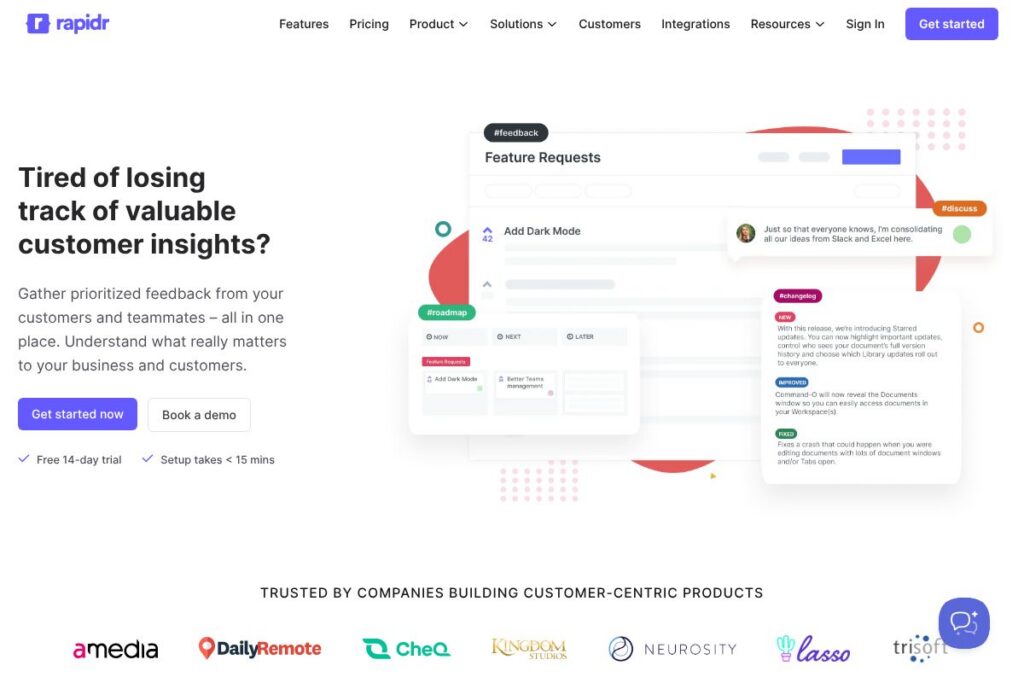
Rapidr is a feedback management platform designed for SaaS product teams that need a single place to collect, prioritize, and act on customer and internal feedback. The platform combines feedback boards, voting, analysis tools, public roadmaps, and changelogs so teams can see which ideas matter, communicate status to stakeholders, and track adoption after release.
Compared with Canny and Productboard, Rapidr focuses on an integrated workflow that ties public feedback boards directly to a roadmap and changelog, which reduces manual cross-referencing. Canny emphasizes simple voting and community boards with a strong UX for end users; Productboard emphasizes deep product discovery and integration with development workflows for larger product organizations. Rapidr sits between these options by offering public-facing feedback collection with straightforward prioritization and release communication.
Rapidr does product feedback collection, prioritization, and communication well, and it is best suited for small to mid-size SaaS teams that want to involve customers in prioritization while keeping communication transparent. Its combination of in-app feedback widgets, board organization, and a public roadmap makes it practical for teams that want to close the loop on requests without heavy process overhead.
How Rapidr Works
Rapidr captures ideas and requests through public or private feedback boards and embeddable widgets, so customers and teammates can add and vote on items from a product, web page, or dedicated portal. Each piece of feedback can be enriched with comments, attachments, and metadata to help product managers understand use cases and context.
Feedback is aggregated and analyzed to surface the most requested items, with voting and status updates to signal priority. Product teams can convert top requests into roadmap entries, set custom statuses to reflect development progress, and publish a public roadmap so stakeholders can see what is planned and why.
When a feature ships, Rapidr uses an integrated changelog and notification channels to announce releases to customers and teammates, which helps increase adoption and demonstrates that feedback led to real product changes. SSO and user identification options help teams link requests to specific customers, which is useful for prioritizing enterprise accounts and tracking impact.
Rapidr’s main Features
Rapidr groups the functionality needed to gather, prioritize, and act on product feedback into boards, widgets, analytics, roadmaps, and release announcements. Key capabilities include unlimited feedback boards, embeddable widgets, voting and comment threads, status workflows, a public roadmap, a changelog, SSO, and integrations that connect feedback to existing tools.
Feedback Boards
Create unlimited boards to collect feedback, feature requests, and ideas in a single place. Boards can be public or private, support threaded comments and attachments, and let teams segment feedback by product area or customer cohort.
Feedback Widgets
Embed lightweight feedback widgets in web and mobile apps to let users submit ideas without leaving the product. Widgets capture user context automatically and can be configured to appear on specific pages, improving submission quality and volume.
Voting and Prioritization
Support customers and teammates to vote on ideas so teams can quantify demand and spot high-impact requests. Voting combined with qualitative comments helps product managers validate use cases and reduce the risk of building the wrong thing.
Custom Statuses
Define custom statuses such as Planned, In Progress, and Resolved to reflect your development workflow. Status updates can be shown on the public roadmap and in the changelog to keep stakeholders informed at each stage.
Public Product Roadmap
Publish a public roadmap that links each entry back to the underlying feedback items and votes. The roadmap increases transparency, helps manage user expectations, and makes it easier to gather additional context from interested customers.
Product Changelog
Announce updates and feature releases with an integrated changelog that notifies users via in-app widgets, email, and other channels. The changelog helps close the feedback loop and encourages adoption by showing what changed and why.
Single Sign-On and User Identification
Use SSO to authenticate and identify customers so every request is tied to a specific account. This makes it possible to prioritize requests from high-value customers and to follow up directly when clarification is needed.
Collaborate & Invite
Invite unlimited product managers and teammates to contribute, triage, and prioritize feedback. Role-based access and collaboration threads keep discussions focused and visible to the right stakeholders.
Integrations and Webhooks
Connect Rapidr to your existing workflow with native integrations and webhooks so feedback events can be synced to support, analytics, and development tools. Integrations reduce manual work by keeping data synchronized across systems.
The biggest benefit of Rapidr is the end-to-end feedback workflow that links collection, prioritization, and release communication in one product. That single workflow helps teams move from idea to shipped feature while keeping customers informed and engaged.
Rapidr pricing
Rapidr uses a SaaS subscription model with tiered plans to fit individuals, teams, and enterprise customers, including options for custom enterprise plans. For up-to-date plan details, seat limits, and feature comparisons, view Rapidr’s homepage to see current pricing options and any available trials or discounts.
What is Rapidr Used For?
Rapidr is commonly used to centralize customer feedback and feature requests for product management teams. It helps teams collect suggestions from multiple channels, quantify demand with votes, and prioritize work based on customer impact and business value.
Teams also use Rapidr to communicate product direction with customers via a public roadmap and to announce releases through a changelog. This is useful for SaaS companies that want to build trust through transparency and increase feature adoption by informing users when items they requested are released.
Pros and Cons of Rapidr
Pros
- Centralized feedback hub: Rapidr consolidates feedback from customers and teammates into one organized system, which simplifies triage and reduces lost requests.
- Customer-facing roadmap and changelog: Publishing a roadmap and changelog helps teams manage expectations and show progress tied to real customer input.
- Flexible collection options: Public and private boards plus embeddable widgets let teams collect feedback directly in the product or via a portal.
- User identification and SSO: Identifying requesters makes it easier to prioritize enterprise customers and follow up for clarification.
Cons
- Custom reporting may be limited: Teams that need advanced, cross-system analytics might still require additional BI or analytics tools for deep analysis.
- Integration setup for complex workflows: Organizations with bespoke development or support tooling may need custom integration work to fully automate workflows.
- Feature parity with enterprise discovery tools: Larger product organizations that need heavy discovery and research workflows may find specialized platforms like Productboard more feature-rich for that use case.
Can You Test Rapidr Before Buying?
Rapidr offers a free trial and a freemium tier for evaluation. Trial and free-tier details vary by time and plan level, so check Rapidr’s homepage for the latest availability and sign-up instructions.
Rapidr API and Integrations
Rapidr provides integration options and webhook support so feedback events can be routed into support, development, and analytics systems. Explore the integration options to see connectors for platforms like Slack, Zapier, and common CRM or support tools.
For developer automation, Rapidr exposes API endpoints and webhooks to create, update, and query feedback items programmatically; refer to the API documentation for endpoint details and authentication patterns.
10 Rapidr alternatives
Paid alternatives to Rapidr
- Canny — Simple public boards, voting, and roadmaps that focus on community-driven feedback and ease of use. Check Canny’s pricing for tiers.
- Productboard — Deeper product discovery and prioritization for larger product teams that need integrated research and roadmapping workflows. See Productboard’s features for details.
- UserVoice — Traditional feedback and support integration with robust enterprise features for large organizations.
- Aha! — Roadmapping and product strategy tool that includes idea management as part of a broader product suite.
- Pendo — Product analytics with in-app feedback and guides, useful for teams that need behavior-based insights.
- Feature Upvote — Lightweight voting boards and ideas management for small teams.
- Nolt — Affordable boards and voting with simple moderation tools.
Open source alternatives to Rapidr
- Fider — An open source feedback board that supports voting, comments, and basic moderation, suitable for self-hosting.
- Planka — Kanban-style open source tool that can be adapted for feedback tracking when combined with custom forms.
- OpenFeedback — Community-driven feedback platforms or plugins that teams can self-host and extend.
- Errboard — Self-hosted issue and idea boards that can be customized for product feedback workflows.
Frequently asked questions about Rapidr
What is Rapidr used for?
Rapidr is used to capture, prioritize, and communicate product feedback and feature requests. Product teams use it to collect ideas, track votes and comments, and publish roadmaps and changelogs tied to customer input.
Does Rapidr integrate with Slack and other tools?
Yes, Rapidr supports integrations and webhooks for popular tools like Slack and Zapier. These integrations help notify teams of new feedback and sync items to support or development systems.
Does Rapidr have an API?
Yes, Rapidr provides an API and webhook endpoints for automation. The API documentation explains endpoints, authentication, and common use cases for programmatic access.
How does Rapidr pricing work?
Rapidr uses tiered SaaS subscription plans with options for individuals, teams, and enterprise customers. For the most current plan details and any free tier or trial options, visit Rapidr’s homepage to review offerings.
Can Rapidr publish a public roadmap?
Yes, Rapidr includes a public roadmap feature that links roadmap items to the underlying feedback. That linkage improves transparency and helps product teams collect further input from interested users.
Final verdict: Rapidr
Rapidr is well suited to SaaS teams that want an integrated feedback workflow that moves ideas from submission to roadmap and then to a public changelog. It combines the core needs of feedback collection, voting, prioritized analysis, and release communication in a single product which reduces the need to stitch multiple tools together.
Compared with Canny, Rapidr offers a similar community-facing experience but emphasizes built-in changelog and roadmap publishing tied directly to feedback items. On pricing, Rapidr follows a tiered SaaS model aimed at individuals through enterprise customers, while Canny also uses tiered plans; teams should compare each vendor’s feature set and limits to determine which fits their scale and integration needs.
Overall, Rapidr is a practical choice for small to mid-size product teams that want a straightforward way to involve customers in prioritization and to communicate outcomes without adding complex process overhead. For organizations needing extremely deep discovery workflows, pairing Rapidr with dedicated analytics or research tools may deliver the best results.