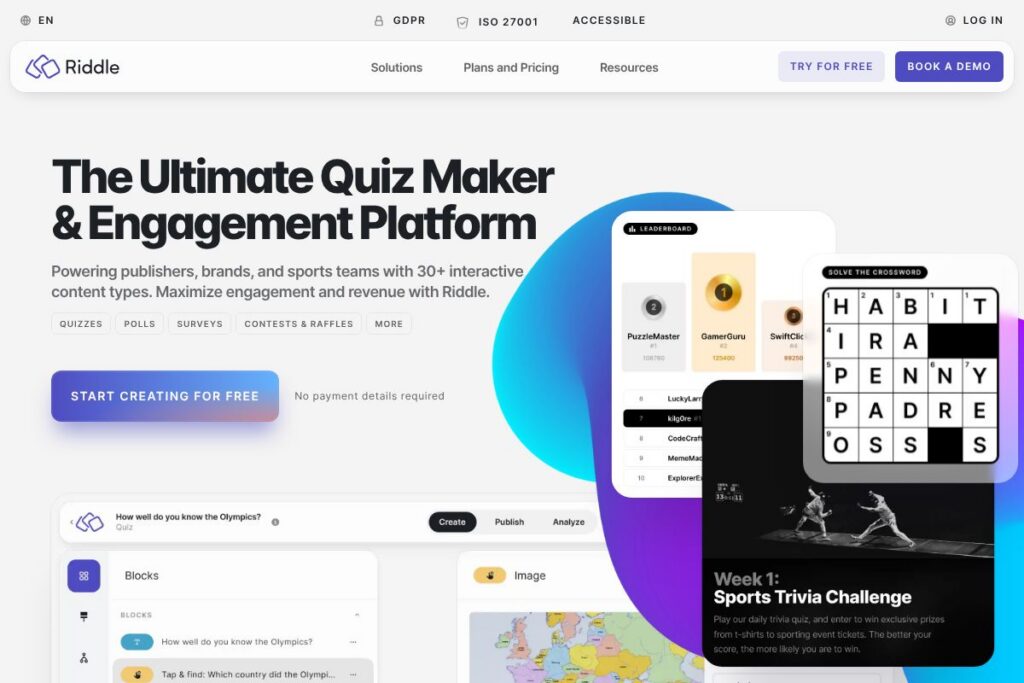
What is Riddle
Riddle is an interactive content platform designed to help publishers, brands, and sports teams build quizzes, polls, score predictors, calculators, and over 30 other content types. The platform combines content creation, embeddable player widgets, lead collection, and ad-serving features so teams can increase engagement, collect first-party data, and run sponsored content without depending on third-party trackers.
Compared with Typeform and SurveyMonkey, Riddle emphasizes interactive, media-rich experiences aimed at driving longer time-on-site and higher social share rates rather than pure form collection. Compared with Outgrow and Interact, Riddle adds deeper ad server integrations and a privacy-focused architecture that avoids cookies and trackers, which can be important for publishers and media brands.
All of this makes Riddle particularly well suited for editorial publishers, sports franchises, and marketing teams that want interactive content that looks good across devices, scales with high traffic, and supports direct revenue through ads and sponsored content.
How Riddle Works
Riddle provides a web-based editor where creators pick a template or a content type, add questions, media and logic, then publish an embeddable Riddle to a page. Embeds are responsive and mobile-first, so content adapts to desktop, tablet, and phone layouts automatically.
Creators can attach native lead forms inside quizzes to capture signups, enable leaderboards and competitions, or insert sponsored content and banners using the platform’s ad controls. Data and engagement metrics can be pulled via APIs or exported from the dashboard for segmentation and personalization workflows.
Riddle features
Riddle centers on interactive content, privacy controls, and monetization. Core capabilities include a visual quiz and interactive editor, native lead forms, ad server integrations for display and video, robust APIs for content and stats, WCAG 2.1 accessibility support, and full CSS customization for brand alignment. Recent product focus highlights privacy-first features and server-side ad options that reduce reliance on client-side trackers.
Here are some key features worth highlighting:
Interactive content types
The editor supports more than 30 formats including quizzes, polls, predictions, calculators, and interactive stories. This variety lets teams choose formats that suit editorial campaigns, sponsorships, or lead-gen funnels and reuse content templates across pages.
Ad monetization and sponsored content
Riddle includes ad server integrations that let publishers run display and video ads inside interactive pieces and attach sponsored content modules. That makes it possible to expand ad inventory on pages and manage demand directly from the Riddle dashboard.
Privacy-first design
Riddle is built to operate without cookies or client-side trackers and is positioned to be GDPR and CCPA compliant. This design helps publishers capture first-party data while offering users clear choices about data use and tracking.
Native lead forms and higher opt-in rates
Lead forms can be embedded directly into Riddles to collect email addresses and other details at high conversion rates. Many customers report significantly better opt-in performance compared with traditional static forms because the interactive experience primes engagement first.
API access and data export
APIs allow programmatic creation of content, embedding of Riddles, and retrieval of performance and response data. That makes it possible to automate content workflows or feed engagement data into analytics and marketing automation systems.
Branding and advanced styling
Templates are customizable and Riddle supports palettes and presets to maintain consistent brand styling. For Business and Enterprise plans, full CSS control allows teams to match complex design specifications and integrate with site styling.
Accessibility and mobile-first design
Riddle meets WCAG 2.1 accessibility standards and is designed to display well on every screen size. This ensures interactive content is usable for a broad audience and performs consistently on mobile devices where much audience attention lives.
Analytics and SEO impact
Riddle provides engagement metrics and exportable stats, and interactive embeds are shown to increase time-on-site metrics. Longer dwell times on pages with interactive content can support SEO efforts by improving a site’s engagement signals.
With these capabilities, Riddle is strongest as a platform for publishers and brands that want to blend engagement, audience data, and direct ad monetization into embeddable interactive experiences.
Riddle pricing
Riddle uses a subscription and enterprise pricing approach that is oriented toward publishers, brands, and teams with varying scale and support needs. Public, per-plan prices are not published in a single pricing table; instead Riddle offers free starting options and tailored Business and Enterprise arrangements for customers with higher traffic or advanced needs. For specifics on plans and any trial options, check Riddle’s pricing and plans on their homepage.
What is Riddle Used For?
Riddle is commonly used to increase reader interaction and time on site by embedding quizzes, polls, and interactive stories into editorial pages, landing pages, and campaign sites. Publishers use Riddle to boost session length and social shares, while sports teams deploy score predictors and leaderboards to engage fans around matches.
Marketing teams use Riddle to collect first-party data and create more personalized follow-up experiences by segmenting users based on responses. The platform is also used to host sponsored experiences and run competitions that convert engagement into revenue.
Pros and cons of Riddle
Pros
- High engagement formats: Interactive content types like quizzes and predictions tend to drive longer time-on-site and higher share rates compared with static articles or forms.
- Privacy-first architecture: No client-side trackers or cookies by default, making compliance with GDPR and CCPA easier and reducing dependence on third-party tracking.
- Ad monetization built-in: Publishers can run display and video ads or sponsored modules inside embeds to expand ad inventory and revenue options.
- Strong accessibility and mobile support: Riddles meet WCAG 2.1 standards and are responsive, ensuring consistent behavior across devices.
Cons
- Enterprise focus for advanced customization: Full CSS control and deep customization are gated behind Business and Enterprise plans, so small teams may find advanced styling restricted on lower tiers.
- Pricing not fully transparent: Public pricing is not presented as a single public pricing table, which means teams often need to contact sales for tailored quotes.
- Feature overlap with survey tools: For simple data collection use cases, Riddle may be heavier than necessary compared with lightweight form tools like Google Forms or basic survey platforms.
Does Riddle Offer a Free Trial?
Riddle offers a free plan that lets you create your first interactive content and test basic features. The platform also provides demo options and sales-assisted trials for Business and Enterprise customers; for hands-on testing or an organised demo, use Riddle’s signup and demo request flows on their site.
Riddle API and Integrations
Riddle provides developer APIs for content creation, embedding, and retrieving statistics so teams can automate content workflows and integrate response data with analytics or CRM systems. Refer to Riddle’s API documentation to explore available endpoints and authentication methods.
Riddle also supports common integrations for analytics and ad delivery, and it connects with ad servers and marketing platforms to enable video and display ad campaigns inside interactive content. For integration details, consult Riddle’s integrations and developer resources on their site.
10 Riddle alternatives
Paid alternatives to Riddle
- Typeform — A form and survey platform focused on conversational, visually polished forms and quizzes with broad integrations for marketing stacks.
- Outgrow — An interactive content builder with calculators, quizzes, and recommendations aimed at marketers who want conversion-focused experiences.
- Interact — A quiz maker optimized for lead generation with integrations to email providers and marketing automation tools.
- SurveyMonkey — A long-standing survey platform with robust analytics and enterprise features for feedback and market research.
- Playbuzz — A publisher-oriented interactive content platform for lists, quizzes, and other social-first formats.
- Opinion Stage — A tool for polls and quizzes with social sharing and lead capture features.
- Qzzr — A quiz platform designed for marketing and audience engagement with simple embedding and lead capture.
Open source alternatives to Riddle
- H5P — An open-source framework for creating, sharing, and reusing interactive HTML5 content types including quizzes, timelines, and interactive videos.
- LimeSurvey — An open-source survey system suitable for complex surveys and research-oriented data collection with self-hosting options.
- SurveyJS — A lightweight, open-source survey and form library that developers can embed and extend within web applications.
Frequently asked questions about Riddle
What types of content can I create with Riddle?
You can create quizzes, polls, calculators, score predictors, interactive stories, and more than 30 content types. The editor provides templates and logic options to tailor each format to editorial, marketing, or sponsored use cases.
Does Riddle support GDPR and CCPA compliance?
Yes, Riddle is built with a privacy-first approach and supports GDPR and CCPA compliance by operating without client-side trackers by default. The platform offers controls for data consent and user choices that help publishers meet regulatory requirements.
Can Riddle collect leads and integrate with CRMs?
Yes, Riddle includes native lead forms and provides APIs and integrations so response data can be exported or pushed to CRM and marketing automation systems. This enables follow-up campaigns driven by behavioral responses from interactive content.
Is Riddle accessible and mobile-friendly?
Yes, Riddle meets WCAG 2.1 accessibility guidelines and uses a mobile-first design so embeds render properly on phones and tablets. That makes interactive content usable across devices and for users with accessibility needs.
How does Riddle handle ad monetization?
Riddle supports ad server integrations for running display and video ads inside interactive content and for hosting sponsored modules. Publishers can manage ads and sponsorships through the platform to increase on-page inventory and direct revenue.
Final verdict: Riddle
Riddle is a purpose-built tool for teams that need interactive, embeddable experiences with first-party data capture and direct monetization options. It stands out for its broad selection of content types, privacy-first architecture, and ad-serving capabilities that publishers and sports brands can use to monetize engagement directly.
Compared with Typeform, Riddle focuses more on high-impact, media-rich experiences and publisher monetization. Typeform is strong for conversational forms and surveys with straightforward pricing tiers; Riddle is better suited when the goal includes expanding ad inventory and integrating sponsored content alongside audience data collection. For teams prioritizing engagement and publisher-style monetization, Riddle is a strong choice; for simple form workflows or light-weight surveys, a dedicated survey tool may be more cost-effective.