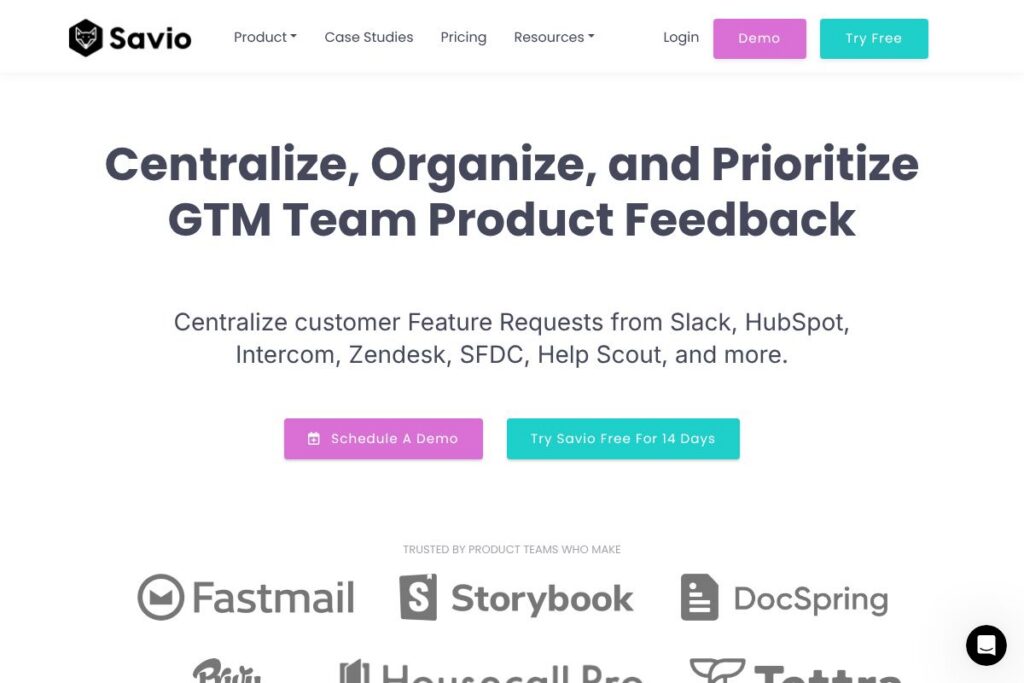
Savio: An Overview
Savio is a feedback management tool built for B2B SaaS product teams that need to aggregate requests from Sales, Success, and Support into a single, searchable system. It connects to CRMs and dev tools so product decisions can be prioritized using business metrics such as ARR, MRR, and opportunity value rather than anecdotes alone.
Compared to Productboard, which focuses on deep product discovery and user research workflows, Savio emphasizes revenue-aware prioritization and CRM alignment for GTM teams. Compared to Canny, which provides public feedback boards and community voting, Savio prioritizes closed-loop accountability and integrates richer CRM data. Against issue trackers like Jira, Savio is not a development ticketing system; it is a product feedback vault that syncs statuses from dev tools into CRM records.
Savio does particularly well at turning scattered requests into a single source of truth for roadmap conversations, and it is best suited for product teams that want prioritization tied to customer value and sales motion.
How Savio Works
Product teams connect Savio to internal sources and external tools so feedback arrives in a consistent, structured format. Submissions can come in via native integrations, a Chrome extension, Zapier, or the Savio API, and teams choose which metadata fields accompany each request for reliable filtering.
Once feedback is in Savio, requests are grouped, enriched with CRM attributes like Account MRR or Opportunity Value, and scored to show the highest-impact items. Product managers can sort and filter by number of requesters, total ARR, plan, or custom fields imported from HubSpot or Salesforce to create evidence-based roadmaps.
To close the loop, Savio syncs feature request status from dev tools such as Jira, Linear, or Shortcut back to CRM records so Sales and Success can see whether a request is planned, shipped, or declined. This status visibility helps reduce churn and gives GTM teams concrete reasons to reach back to customers.
What does Savio do?
Savio centralizes feedback intake, links requests to CRM and revenue data, and provides sorting and filtering tools that surface the highest-impact features for your ideal customer profile. It also supports status syncing with dev tools so GTM teams are kept up to date.
The platform includes structured capture from internal teams, prioritization workflows that use account-level metrics, and a way to communicate progress to stakeholders without switching between multiple spreadsheets and email threads.
Centralized Feedback Inbox
Savio collects product requests from Sales, Success, Support, and feedback collection tools so product teams have one consolidated list to review. This removes duplicate effort and keeps original context alongside each request for faster analysis.
Revenue-aware Prioritization
Requests can be sorted and scored using business metrics pulled from CRM records, including Account MRR, Opportunity Value, and plan tiers, allowing teams to prioritize by potential revenue impact rather than vote counts alone.
CRM and Dev Tool Integrations
Savio connects to HubSpot and Salesforce to import account attributes and to Jira, Linear, and Shortcut to reflect engineering status on feature requests, giving GTM teams visibility into development progress where they already work.
Structured Feedback Capture
Sales and Success teams can log requests using a Chrome extension, native integrations, Zapier, or the API, and admins choose which fields are required so incoming feedback is consistent and filterable for prioritization.
Roadmap and Stakeholder Communication
Product managers can build prioritized lists and share roadmap context with stakeholders, using evidence such as number of requesters and total ARR to back decisions and secure buy-in across GTM functions.
Filtering, Reporting, and Exports
Savio provides filters and views that let teams focus on features important to key customer segments, and export options for sharing lists with execs, engineering, or customer-facing teams for alignment and follow up.
With Savio you get a single place to collect requests, score them against business metrics, and keep Sales and Success in the loop with status updates from development tools.
Savio pricing
Savio uses a subscription-based SaaS model with plans and options tailored to different team sizes and needs; enterprise options are available for organizations that need SSO, advanced security, or custom integrations. For exact plan names, monthly and annual pricing, and any trial offers, visit Savio’s current pricing options.
What is Savio Used For?
Savio is commonly used to centralize customer feature requests from Sales, Success, and Support so product teams can prioritize work based on measurable business impact. It is especially useful for teams that rely on CRM data to identify which requests matter most to the companys biggest or most strategic customers.
Teams also use Savio to reduce churn and accelerate deals by surfacing development status to GTM teams so they can follow up with customers when features ship. Product managers use its sorting and filtering to create roadmaps backed by revenue and account context rather than intuition alone.
Pros and Cons of Savio
Pros
- Central source of truth: Collects feedback from multiple channels into one searchable system so product and GTM teams stop working from spreadsheets and scattered notes.
- Revenue-informed prioritization: Prioritization can use CRM metrics such as Account MRR and Opportunity Value, making roadmap decisions more evidence-based and aligned with business goals.
- Status sync with dev tools: Syncs feature request status from Jira, Linear, or Shortcut back to HubSpot or Salesforce so Sales and Success always see current progress.
- Flexible capture methods: Native integrations, a Chrome extension, Zapier, and an API let teams collect structured feedback without changing existing workflows.
Cons
- CRM dependence for full value: Teams that do not use HubSpot or Salesforce will miss some of the revenue-based prioritization benefits and may need workarounds to supply account metrics.
- Not a dev ticketing system: Savio is focused on feedback aggregation and prioritization, it is not a replacement for issue trackers or full engineering planning tools.
- Potential configuration overhead: Setting required fields, filters, and automation to match an organizations workflow can take initial setup and coordination across teams.
Does Savio Offer a Free Trial?
Savio offers a free trial so teams can test feedback capture, CRM integrations, and prioritization workflows before committing. The trial typically includes access to the core intake and prioritization features; check Savio’s current pricing options for exact trial length and any freemium tier details.
Savio API and Integrations
Savio provides an API for developers to submit feedback programmatically and to pull structured request data into other systems; see the Savio API documentation for endpoints and authentication details. The platform also integrates directly with CRM systems and dev tools to enrich requests and sync status.
Key integrations include HubSpot, Salesforce, Jira, Linear, Shortcut, Zapier, and a Chrome Extension for quick logging from the browser. These integrations are designed to reduce manual copy and to keep GTM teams informed where they already work.
10 Savio alternatives
Paid alternatives to Savio
- Productboard — Product discovery and prioritization platform with strong user research and feedback-to-roadmap workflows suitable for product-led teams.
- Canny — Customer feedback board and voting system that makes it easy to collect public and private feedback and surface what customers want most.
- Aha! — Roadmapping and product strategy tool that combines idea management with strategic planning and release tracking.
- ProdPad — Idea and roadmap management focused on lean product teams, offering idea capture and validation features.
- Roadmunk — Roadmap creation and visualization with multiple roadmap views for communicating product plans to stakeholders.
- UserVoice — Classic feedback and support platform with ticketing, feedback forums, and prioritization capabilities.
Open source alternatives to Savio
- Fider — Open source feedback board that teams can self-host to collect and vote on feature requests and ideas.
- GitHub Issues — Using repositories and issue templates, teams can centralize feedback and link requests to code and releases in an auditable way.
- FeatureHub — Open source feature management and experimentation platform that can be adapted for feedback capture and feature tracking.
- OpenProject — Open source project management system that can be extended to handle feedback workflows and backlog management.
Frequently asked questions about Savio
What is Savio used for?
Savio is used to centralize and prioritize customer feature requests for B2B SaaS product teams. It aggregates feedback from Sales, Success, and Support and surfaces the highest-impact items using CRM metrics.
Does Savio integrate with HubSpot and Salesforce?
Yes, Savio integrates with both HubSpot and Salesforce. Those integrations import account attributes and revenue metrics so teams can prioritize requests by business impact.
How does Savio prioritize feature requests?
Savio prioritizes requests by combining requester counts with CRM-derived business metrics such as Account MRR and Opportunity Value. Filters and sorting allow teams to focus on requests that matter most to their ideal customer profile.
Does Savio have an API for automated feedback capture?
Yes, Savio provides an API for programmatic feedback submission and data access. Refer to the Savio API documentation for endpoints, authentication, and example payloads.
Is Savio suitable for small startups?
Savio is suitable for startups that want to tie product decisions to customer value. Smaller teams can use it to replace spreadsheets and maintain a clear feedback backlog that grows with the company.
Final verdict: Savio
Savio excels at turning scattered customer feedback into a single, revenue-aware source of truth that product and GTM teams can use to make evidence-based roadmap decisions. Its strength lies in tying requests to CRM metrics and keeping Sales and Success informed via status syncs from development tools.
Compared with Productboard, which emphasizes deep product discovery and per-user subscription tiers, Savio focuses more narrowly on closed-loop feedback and CRM-driven prioritization. If you need a tool that surfaces the highest-value requests based on account revenue and keeps GTM teams aligned, Savio is a focused, practical option; review Savio’s current pricing options and compare with Productboard’s pricing to determine which fits your team’s budget and workflow needs.