Benchling: An Overview
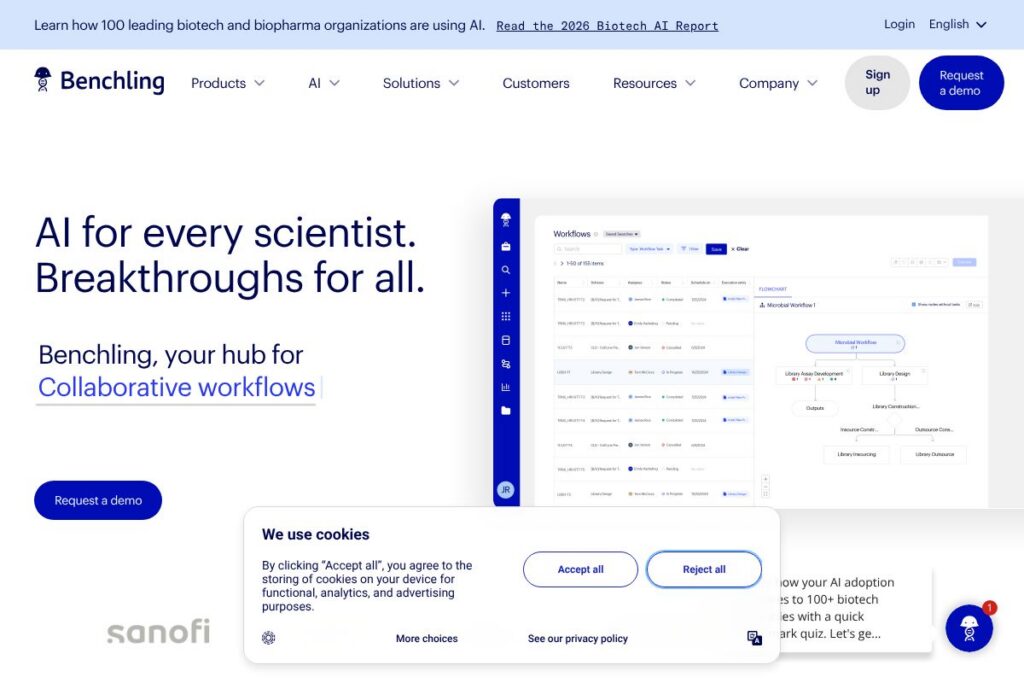
Benchling is a cloud-native platform built for biotechnology R&D that combines an electronic lab notebook, registries for biological entities, workflow automation, and data integrations into a single biology-first system. It is used by research teams in discovery, preclinical, in vivo, and bioprocess environments to replace fragmented spreadsheets, paper notebooks, and siloed instrument outputs with structured, searchable data.
Compared with general-purpose ELNs such as LabArchives and research data platforms like RSpace, Benchling emphasizes a unified data model for biomolecules, cell lines, plasmids, and reagents and provides domain-specific features for sequence design and sample tracking. Against laboratory informatics suites such as LabVantage and Dotmatics, Benchling is positioned more toward life sciences R&D teams that need a modern cloud experience and built-in biology objects rather than solely focusing on LIMS workflows or cheminformatics analytics.
Benchling performs particularly well at connecting experimental records to molecular designs and sample inventories while supporting collaboration across dispersed teams. The platform is suited for academic labs, biotech startups, and enterprise R&D groups that require structured biological data, versioned experimental history, and integrations to instruments and downstream analytics.
How Benchling Works
Benchling captures research activities through a web-based electronic lab notebook where users create protocols, record experimental steps, and attach data files. Entries are linked to structured registry objects such as constructs, cell lines, and aliquots so that researchers can trace lineage and reuse designs across experiments.
Workflows and automation let teams reduce manual steps by routing tasks, enforcing approvals, and triggering downstream actions when samples move between stages. Instrument outputs and CSV data can be attached or ingested into Benchling so results stay linked with the experimental context.
Teams use Benchling to run practical workflows like designing a plasmid, ordering synthesized DNA, recording transfections, and tracking resulting clones through an in-house pipeline. Collaboration features include shared access controls, comments on entries, and activity logs that preserve audit trails for reproducibility and handoffs.
Benchling features
Benchling is organized around experiment capture, biological entity registries, sample and inventory management, workflow automation, integrations, and analytics. Recent product directions emphasize improved AI-assisted design tools, enhanced instrument connectivity, and expanded compliance features for regulated workflows.
Let’s talk Benchling’s Features
Electronic Lab Notebook
The notebook provides structured templates for experiments, protocol steps, and results with rich text, attachments, and embedded sequence viewers. It links notebook entries to registry objects and supports versioning and access controls so teams can manage who sees and edits experimental records.
Molecular Design and Sequence Tools
Benchling includes sequence editing, alignment, and design tools for DNA and protein sequences with annotation features for restriction sites, primers, and codon optimization. These tools speed design iterations and keep sequence versions linked to experimental records and orderable sequences.
Registries and Sample Tracking
Registries let teams model constructs, cell lines, animals, reagents, and plate maps as structured objects that can be queried and tracked over time. Sample lineage features capture transformations, aliquots, and storage locations to maintain a clear chain of custody for materials.
Workflow Automation and Protocols
Built-in workflow capabilities let teams create multi-step protocols with conditional logic, required approvals, and task assignments to standardize operations and reduce manual bookkeeping. Automations can trigger notifications, update registry states, or export data when workflow steps complete.
Instrument and Data Integrations
Benchling supports ingesting instrument outputs and integrates with lab systems to centralize data. Integrations and connectors reduce manual file handling, enable automated data capture, and help correlate instrument metadata with experimental context.
AI and Computational Tools
AI-assisted features help with sequence suggestions, primer design, and data summarization to accelerate routine tasks. Computational tooling is intended to reduce repetitive manual work and let scientists focus on interpretation and experimental decisions.
Security, Compliance, and Administration
The platform offers role-based access controls, audit logs, and administrative tools for provisioning and policy enforcement suitable for regulated and non-regulated labs. Enterprise customers can configure SSO and adapt permissions to organizational requirements.
With these capabilities Benchling centralizes experimental data, reduces manual reconciliation between systems, and helps teams move from ad hoc records to a searchable, reproducible R&D data foundation.
Benchling pricing
Benchling uses an enterprise-focused subscription model with custom pricing that varies by organization size, feature set, deployment needs, and integration requirements. Pricing is not published on a dedicated pricing page and is typically provided via a demo or sales engagement tailored to the customer’s scope.
Enterprise Subscriptions
Enterprise subscriptions are customized and often include notebooks, registries, workflow automation, integrations, and admin/security features. Costs depend on seat counts, required modules, and SLAs.
Academic and Small Lab Options
Benchling commonly works with academic groups and smaller labs to provide scaled plans or community access; terms and included modules are negotiated with Benchling sales. For details about specific plans and to request a quote, see Benchling’s platform overview and contact options.
What is Benchling Used For?
Benchling is used to plan, record, and share biological experiments while keeping designs and sample metadata linked to results. Typical use cases include molecular cloning workflows, cell line engineering, assay development, and in vivo study tracking where traceability between materials and experimental outcomes is important.
Research organizations use Benchling to standardize lab processes, reduce transcription errors, and accelerate handoffs between discovery, preclinical teams, and process development. The platform is also used to collect instrument outputs centrally and to produce datasets that feed downstream analytics and machine learning pipelines.
Pros and Cons of Benchling
Pros
- Biology-first data model: The platform models biomolecules, cell lines, and reagents natively so experimental records are directly connected to the scientific objects researchers work with, improving traceability and reuse.
- Integrated notebook and registries: Notebook entries are linked to registries and workflows which reduces duplication of effort and makes sample lineage and version history easy to follow.
- Strong collaboration and governance: Role-based access controls, audit trails, and admin tools support team collaboration while preserving compliance and data integrity.
Cons
- Enterprise pricing and procurement: Benchling is priced and packaged for teams, which can make initial procurement slower for small labs that need a lightweight, low-cost solution.
- Customization complexity for edge cases: Highly customized workflows or unusual instrument integrations may require engineering effort or professional services to implement effectively.
- Learning curve for standardized use: Getting teams to adopt structured registries and enforced workflows requires process changes and training, particularly in labs used to informal record keeping.
Does Benchling Offer a Free Trial?
Benchling offers a free plan for qualifying academic and nonprofit teams and provides demo or trial options for enterprise customers. Academic users can often access core notebook and registry features at no charge, while commercial organizations typically engage with Benchling for a trial or proof of concept prior to purchasing. For eligibility and to request access, see Benchling’s contact and demo request page.
Benchling API and Integrations
Benchling provides a developer API and documentation for programmatic access to notebooks, registries, and sample metadata; see Benchling’s API documentation and developer resources for endpoint details and authentication patterns. The API supports common workflows such as creating and querying registry objects, uploading files, and automating state transitions.
Key integrations include laboratory instruments and data systems, single sign-on providers, and business tools to connect Benchling to analytics and LIMS platforms. Teams commonly integrate Benchling with cloud data warehouses, ELN/LIMS connectors, and collaboration platforms to maintain a single source of truth for R&D data.
10 Benchling alternatives
Paid alternatives to Benchling
- Dotmatics — A research informatics suite focused on data analysis, cheminformatics, and scientific data visualization for discovery teams. See Dotmatics’ platform details.
- LabVantage — Enterprise LIMS that emphasizes sample management, regulatory compliance, and lab operations for larger organizations. Learn about LabVantage’s capabilities on their product page.
- Labguru — An ELN and inventory system aimed at life science labs, with experiment planning and sample tracking features. Explore Labguru’s offerings on their site.
- LabArchives — A general-purpose electronic lab notebook used by academic and industrial researchers for experiment capture and compliance. See LabArchives’ product information.
- RSpace — An ELN with collaboration and records management features targeted at research institutions and biotech companies. Review RSpace’s features at their website.
- Thermo Fisher SampleManager LIMS — A comprehensive LIMS for regulated environments, with strong sample lifecycle and process control features. Details are available on Thermo Fisher’s SampleManager page.
- PerkinElmer Signals — A research informatics platform with data capture, analytics, and lab orchestration features for scientific operations. See PerkinElmer’s Signals platform.
Open source alternatives to Benchling
- eLabFTW — An open source electronic lab notebook with protocol templates, inventory tracking, and team collaboration that can be self-hosted. See eLabFTW’s project page.
- openBIS — A data management system for managing large-scale experimental data and metadata in academic and research institutions. Explore openBIS on their site.
- FAIRDOM SEEK — An open platform for sharing and linking systems biology data and models, designed to improve reproducibility and data discovery. Learn more at FAIRDOM’s project page.
- Galaxy — While primarily a bioinformatics workflow platform rather than an ELN, Galaxy provides a reproducible environment for computational analyses that teams often use alongside lab records. See Galaxy’s documentation.
Frequently asked questions about Benchling
What is Benchling used for?
Benchling is used for capturing experiments, managing biological registries, and tracking samples across R&D workflows. Researchers use it to connect molecular designs to experimental results and to maintain reproducible records for discovery and preclinical programs.
Does Benchling have an API?
Yes, Benchling provides a RESTful API for notebooks, registries, and sample data. The API documentation explains available endpoints, authentication, and examples for automating data flows; consult Benchling’s API documentation.
How much does Benchling cost?
Benchling uses custom enterprise pricing that varies by organization and module selection. Costs depend on seat counts, required modules, integrations, and support levels; contact Benchling for a tailored quote via their contact page.
Can Benchling be used in regulated labs?
Yes, Benchling supports features that help regulated labs, such as audit logs, access controls, and configurable workflows. Many customers configure Benchling to meet internal governance and regulatory requirements, often with support from Benchling professional services.
Does Benchling integrate with lab instruments and data systems?
Benchling supports integrations for instrument data ingestion and connections to lab software and cloud data platforms. Teams commonly use the Benchling API, custom connectors, and third-party middleware to centralize instrument outputs and analysis pipelines.
Final verdict: Benchling
Benchling stands out as a biology-first platform that combines an electronic lab notebook, structured registries, and workflow automation to create a searchable R&D data foundation. It excels at linking molecular designs to experimental records and at providing tools that reflect common life science workflows, which reduces context loss across teams and experimental stages.
Compared with Dotmatics, which also targets discovery informatics and data analysis, Benchling emphasizes structured biological objects and notebook-to-registry traceability while Dotmatics has deeper cheminformatics and analytics focus. Both vendors use enterprise pricing models, so choice often comes down to whether your primary need is an integrated biology-first ELN and sample registry or advanced analytics and cheminformatics integration.
For teams evaluating lab informatics, Benchling is a strong option when reproducible experiment capture, sample lineage, and cloud-native collaboration are priorities. To assess fit and obtain pricing tailored to your organization, request a demo or contact Benchling through their enterprise inquiry and demo page.