What is delight.ai
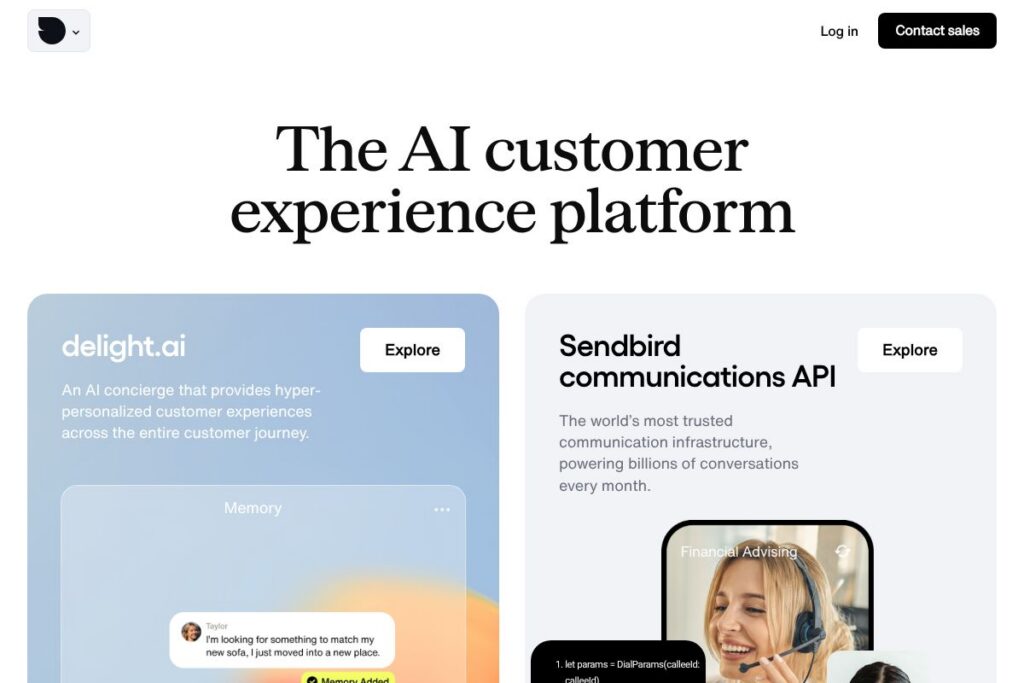
delight.ai is an AI customer experience platform built for enterprise use, focused on delivering hyper-personalized conversational interactions across the entire customer journey. It combines an AI concierge layer with Sendbird’s real-time messaging and communication infrastructure to automate common support flows, route complex requests to human agents, and surface contextual recommendations based on customer signals.
Compared with competitors, delight.ai emphasizes integration with a full communications stack. For example, Twilio provides building blocks for programmable messaging and voice with transparent pay-as-you-go pricing, while Intercom focuses on product-led growth and in-app conversations with packaged support automation. Zendesk centers on ticketing and contact center workflows with broad third-party integrations. delight.ai differs by packaging AI-driven conversational routing and personalization on top of Sendbird’s messaging and voice/video APIs, which makes it a tighter fit for companies that need both real-time communication and AI CX in a single platform.
All of this makes delight.ai especially well suited to enterprise teams that require secure, scalable conversational AI integrated directly with messaging, voice, and moderation features. The platform excels at reducing friction across digital channels and at handing off to agents when conversations require human context, making it a good match for finance, telco, e-commerce, and large SaaS businesses looking to reduce support load while improving customer satisfaction.
How delight.ai Works
delight.ai runs as an AI layer that sits alongside your customer messaging and voice channels. Incoming messages or calls are analyzed by the AI concierge, which uses customer context, interaction history, and configurable business rules to respond, recommend actions, or classify intent.
When the AI determines a query needs human attention, the platform routes the conversation into an agent workflow on top of Sendbird’s communications API, preserving the full message history and metadata. Implementation typically involves installing Sendbird SDKs in your web or mobile app, connecting backend webhooks, and configuring the AI concierge through a management console.
Operationally, teams use delight.ai to automate frequent tasks such as balance inquiries, order lookups, and subscription changes while keeping escalation paths to live agents. This hybrid flow lets enterprises tune automation thresholds and maintain compliance and quality controls for sensitive interactions. For developer reference, see the Sendbird Calls documentation for voice and video examples that integrate with conversational workflows.
delight.ai features
delight.ai centers on conversational automation paired with the communications primitives of Sendbird. Core capabilities include an AI concierge for personalized responses, omnichannel routing across in-app chat, SMS, and voice, and enterprise features such as moderation, compliance controls, and analytics. The platform continues to expand in areas like contextual recommendations and agent-assist tooling.
AI Concierge and Personalization
The AI concierge analyzes user context, transaction history, and real-time signals to generate personalized replies, product recommendations, and next-best actions. This reduces average handle time and supports dynamic, customer-centric responses across journeys.
Omnichannel Messaging
delight.ai supports routing and message synchronization across in-app chat, web chat, SMS, and other channels so customers get a continuous conversation experience. Messages and session state persist across devices and channels for consistent handoffs.
Voice and Video Calls
Voice and video are supported through Sendbird’s Calls APIs, allowing conversations to escalate from chat to real-time calls without losing context. Developers can initiate calls programmatically and preserve the associated conversation history for agent follow-up.
Agent Assist and Escalation
The platform provides agent-assist features that surface suggested replies, relevant knowledge base articles, and customer context to human agents. Escalation workflows are configurable so AI handles routine issues while agents manage exceptions.
Moderation and Compliance
Built-in moderation tools and compliance controls help filter sensitive content, enforce retention policies, and support regulatory needs for industries like finance and healthcare. These controls centralize content policies across channels.
Analytics and Reporting
delight.ai includes dashboards for conversation metrics, AI performance, and customer outcomes so teams can measure automation impact and tune models. Analytics support SLAs, agent performance tracking, and conversational funnel analysis.
Developer SDKs and Real-time Infrastructure
Sendbird’s SDKs and APIs provide real-time messaging, presence, and push notification support for web and mobile clients, simplifying integration of delight.ai into existing products. The SDKs are accompanied by developer documentation and webhooks for event-driven automation.
With these features, the biggest benefit is delivering a single, integrated surface that combines conversational AI with proven communication APIs, which reduces engineering overhead when adding intelligent automation to production communication channels. For technical implementation details and API references, consult the Sendbird developer documentation.
delight.ai pricing
delight.ai uses a tailored enterprise pricing model rather than a one-size-fits-all public price list. Pricing is typically structured around factors such as message or MAU volume, voice/video usage, AI request volume, and required service level agreements.
For specific rates, deployment options, and volume discounts, contact Sendbird directly through the contact Sendbird sales page to request a quote or to discuss pilot programs that align with your usage profile.
What is delight.ai Used For?
delight.ai is commonly used to automate and personalize customer interactions across the full lifecycle, including onboarding, self-service support, and proactive engagement. Enterprises deploy it to reduce support costs and improve response times while maintaining the ability to escalate to live agents.
Typical use cases include conversational self-service for account management, automated order status and returns handling, intelligent routing to specialized agents, and in-app AI concierges that recommend product features or offers based on user behavior. The platform is aimed at enterprise CX teams, digital product teams, customer support centers, and engineering teams that need a production-ready conversational stack.
Pros and Cons of delight.ai
Pros
- Enterprise-grade scalability: delight.ai is built on Sendbird’s infrastructure, which supports high-volume, low-latency conversations and can scale to meet enterprise traffic patterns.
- Integrated AI and communications: The platform pairs AI-driven personalization with messaging and voice APIs, reducing the need to stitch multiple vendors together.
- Strong developer toolset: SDKs and APIs for web, iOS, and Android simplify integration and let engineering teams control message flows and event handling.
- Agent assist and escalation: Built-in agent-assist features and configurable escalation paths maintain quality and enable hybrid AI/human workflows.
- Compliance and moderation controls: Tools for content moderation and retention make the platform suitable for regulated industries.
Cons
- Enterprise focus: The platform is optimized for large organizations and may be heavier than necessary for small teams or simple chatbots.
- Custom pricing and procurement: Pricing is tailored, which can lengthen procurement cycles compared with off-the-shelf SaaS tiers.
- Implementation complexity: Full-featured deployments that include voice, AI tuning, and integrations require engineering resources and integration work.
- Vendor consolidation risk: Relying on a combined AI and communications provider centralizes risk, so organizations should evaluate vendor lock-in and export options.
Does delight.ai Offer a Free Trial?
delight.ai offers enterprise trials or pilot programs on request. Prospective customers can engage with Sendbird to arrange pilots or proof-of-concept deployments that demonstrate AI behavior and integration with their messaging stack; contact Sendbird sales to start a pilot through the contact Sendbird sales page.
delight.ai API and Integrations
delight.ai is delivered alongside Sendbird’s developer APIs and SDKs, so developers can integrate AI-driven conversational features into web and mobile apps. The Sendbird developer documentation provides API references, SDK guides, and webhook details for implementing messaging, presence, and calls.
Integrations commonly include CRM and contact center systems, knowledge bases, and analytics platforms so conversations can reference customer records and update backend systems in real time. Teams typically connect delight.ai to systems such as Salesforce, Zendesk, or internal CRMs to provide contextual automation and reporting.
10 delight.ai alternatives
Paid alternatives to delight.ai
- Twilio — Programmable messaging, voice, and video APIs with pay-as-you-go and volume pricing suited to builders who want granular control over communications and AI add-ons.
- Intercom — In-app messaging and support automation with a focus on product-led engagement and marketing workflows.
- Zendesk — Ticketing and contact center platform with AI automation options and a broad ecosystem of integrations for support workflows.
- Genesys Cloud — Enterprise contact center platform with AI-enabled routing, workforce optimization, and multi-channel support.
- Freshdesk — Customer support solution with automation, chat, and contact center capabilities for mid-market companies.
- Amazon Connect — Cloud contact center service with integrations into AWS AI and analytics services for flexible, scalable voice and chat solutions.
- Talkdesk — Contact center platform with AI features, omnichannel routing, and integration capabilities for enterprise CX.
Open source alternatives to delight.ai
- Rasa — Open source conversational AI framework for building custom chatbots and assistants with full control over models and data.
- Rocket.Chat — Open source team chat platform that can be extended for customer-facing chat and integrated with custom bots.
- Chatwoot — Open source customer engagement suite for multi-channel messaging and shared inbox workflows.
- Matrix / Element — An open protocol and client for decentralized real-time communication that teams can use to build custom conversational solutions.
Frequently asked questions about delight.ai
What is delight.ai used for?
delight.ai is used to automate and personalize customer conversations across messaging and voice channels. Enterprises deploy it to reduce support load, accelerate resolution, and surface personalized recommendations during interactions.
Does delight.ai integrate with existing CRMs like Salesforce?
Yes, delight.ai is designed to integrate with CRMs and contact center systems. Integrations let the AI access customer context and write back events to systems such as Salesforce or Zendesk through API connectors and webhooks documented in the Sendbird developer documentation.
How does delight.ai handle sensitive data and compliance?
delight.ai includes moderation and compliance controls to manage retention and content policies. Enterprises can configure data handling, retention windows, and redaction rules to meet regulatory requirements for finance, healthcare, and other regulated sectors.
Can delight.ai be used for voice and video conversations?
Yes, delight.ai supports voice and video via Sendbird’s Calls APIs. Conversations can move from chat to calls while preserving context; see the Sendbird Calls documentation for implementation details.
How do I start a pilot with delight.ai?
You can request a pilot or proof of concept directly through Sendbird. Reach out to the team via the contact Sendbird sales page to discuss trial options and deployment requirements.
Final verdict: delight.ai
delight.ai stands out for combining a purpose-built AI concierge with Sendbird’s real-time messaging and calls infrastructure, which reduces integration overhead for teams that need both conversational AI and robust communications. Its strengths are personalization across journeys, agent assist features, and enterprise controls for moderation and compliance.
Compared with a competitor like Twilio, which publishes granular pay-as-you-go rates and focuses on building blocks, delight.ai targets enterprise buyers with integrated AI and communications under a tailored pricing model. That makes delight.ai a strong option when you want an end-to-end solution for high-volume, regulated environments, while Twilio may be preferable if you need a componentized approach with transparent unit pricing.
Overall, delight.ai is well suited to large organizations that require production-grade conversational AI embedded directly into their messaging and voice channels and who are prepared to engage in enterprise procurement for tailored pricing and support. For product details and to start conversations about pilots or pricing, visit the delight.ai product page on Sendbird or contact sales via the contact Sendbird sales page.